
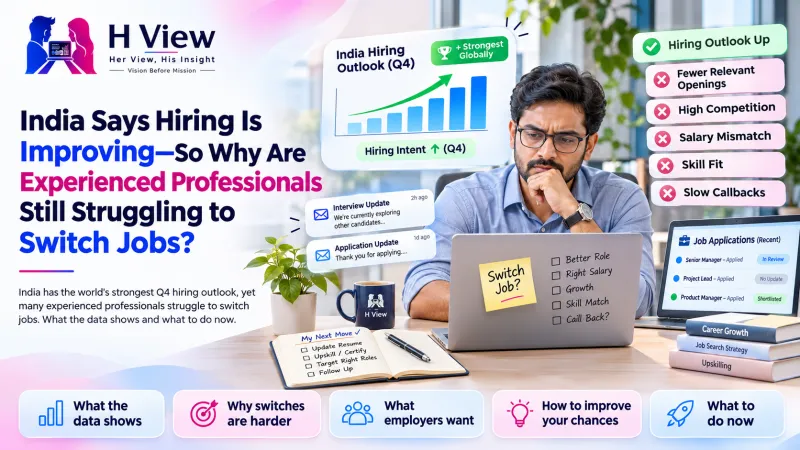
India Says Hiring Is Improving—So Why Are Experienced Professionals Still Struggling to Switch Jobs?
Hiring surveys sound upbeat, but job switches feel harder than ever. Here is why both are true, and how experienced professionals can adjust their search.
Short answer: Both things are true. Indian employers report the strongest hiring outlook in the world, but much of that hiring is selective: companies want specific new skills, often for reshaped roles, rather than more people for the same jobs. That is why many experienced professionals find it harder to switch jobs, even in a "good" market.
Last reviewed: 3 November 2026.
You read the headline on Monday morning: India leads the world in hiring confidence. By Monday evening, you have sent eight applications, heard back from none, and a recruiter has told you your profile is "not an exact match". If that gap between the news and your inbox feels personal, it is not. It is how this particular hiring cycle works.
What the hiring numbers actually say
ManpowerGroup's Employment Outlook Survey for October–December 2026, based on 3,055 Indian employers surveyed in July, put India's Net Employment Outlook at 54%. That was the highest of 42 countries, six points higher than the previous quarter and eleven points above a year earlier. According to People Matters, 65% of employers expect to increase headcount this quarter.
But one line in ManpowerGroup's own press release explains a lot. Among employers adding staff, nearly two-thirds said they were hiring to transform their workforce, while about a third were backfilling roles. In plain words: most new hiring is for different kinds of work, not simply more of the same work.
Tech hiring tells a similar story. Staffing firm Xpheno reported that active tech openings fell to 93,000 in June 2026, a 28-month low, before recovering to 123,000 in October, the highest in 18 months. The market is moving again, but it is moving towards particular skills, cities and work models.
Why experienced professionals feel the squeeze
1. Roles are being redesigned, not just refilled
When a company "transforms" a team, a role that used to be called Senior Analyst may now expect automation, AI tools and data storytelling. Ten years of experience in the old version of the job does not automatically count for the new one. Recruiters screen for the new keywords first.
2. Employers are paying for skills, not years
Indeed's AI at Work Tracker 2026 found that 40% of Indian employers now prioritise demonstrable AI skills and certifications over formal degrees. Experience still matters, but it has to be shown through current, visible work: projects, results and tools, not job titles alone.
3. Salary expectations and budgets don't line up
Experienced candidates typically expect a meaningful jump when they move. Aon's salary survey projects average increments of 9.1% for 2027, with technology consulting and services firms at the lowest, 6.6%. When a company can fill a redesigned role with someone cheaper who already has the new skill, the senior candidate loses on cost, not ability.
4. Office and location rules narrow the pool
Xpheno's data shows full-time remote tech openings falling to about 10,000 in October, down 23% from a year earlier. If you are only searching for remote roles in your current city, you are fishing in a much smaller pond than the headline numbers suggest.
 Also readFestive Hiring 2026: Are Digital Marketing Jobs Opening Up for Freshers?→
What to do differently in your job search
| Old approach | What works better now |
|---|---|
| Applying with the same CV everywhere | Rewrite the top third of your CV for each role, using the job post's own skill words |
| Listing responsibilities | Showing outcomes with numbers: time saved, revenue protected, errors reduced |
| Waiting to "finish a course" before applying | Learning one in-demand tool and using it in a small real project you can show |
| Only applying through job portals | Asking former colleagues for referrals into teams that are actually expanding |
| Insisting on the same title | Considering a lateral move into a growing function, then negotiating up |
Start with your LinkedIn headline and the first lines of your CV; recruiters spend seconds there. Our guide to what recruiters notice on LinkedIn walks through the fixes. When an offer comes, our salary negotiation guide helps you ask for a fair number without pricing yourself out.
Her View
Many experienced women returning after a break feel this market most sharply, because the gap on their CV collides with a demand for "current" skills. A short, recent project, even an unpaid one for a local business, can do more than a long explanation. Show the skill first; the story can come in the interview.
 Also readHiring Is Up—So Why Are Freshers Still Not Getting Jobs?→
His Insight
Read hiring surveys as a weather report, not a guarantee. A strong outlook means companies have budget, but they are spending it carefully. The professionals who switch successfully right now are the ones who look like the answer to a company's next problem, not the last one.
Related reading: is your stable job quietly holding you back?, AI skills for GCC jobs and how to resign professionally.
Frequently asked questions
Is it a good time to switch jobs in India?
Employer confidence is high for October–December 2026, so budgets exist. It is a good time if your skills match the roles companies are building; otherwise, upskill alongside your search.
Why do recruiters say I am "overqualified"?
Often it means your expected salary or seniority is above the role's budget, or your recent experience doesn't match the new tools listed. Ask which specific skill is missing.
How long does a job switch take for experienced professionals?
It varies widely, but notice periods of 60–90 days are common in India, so plan your search a few months ahead of when you want to move.
Should I take a lower title to switch?
Sometimes a lateral or slightly lower title in a growing team leads to faster progress than staying in a shrinking one. Compare growth, not just designation.
Sources
H View stories follow our editorial policy. Spotted an error? Tell us and we will correct it.
Rate this article
One tap is enough. No comment needed.
Was this article helpful?
Your answer goes straight to our editors.











Comments0
No comments yet. Start the conversation.