
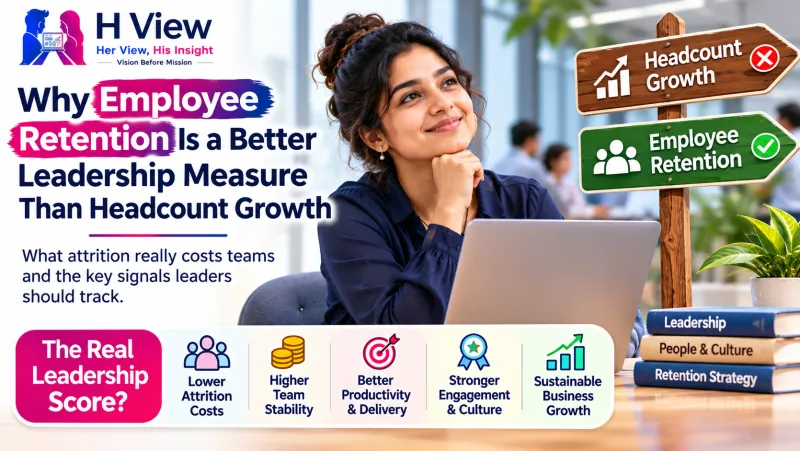
Why Employee Retention Is a Better Leadership Measure Than Headcount Growth
A manager who grows a team from 10 to 30 looks successful. A manager who keeps good people for five years often is. Why retention says more about leadership than headcount.
Employee retention is a better measure of leadership than headcount growth because it shows whether people choose to stay and grow under a leader. Headcount mostly reflects budget and hiring speed. Gallup estimates that replacing one employee can cost one-half to two times their annual salary, and 52% of people who left voluntarily said their manager or organisation could have done something to keep them.
In many Indian offices, managers are quietly ranked by the size of their teams. "She manages 40 people" sounds more impressive than "her team of 12 has hardly changed in four years." But ask the people in those teams which is the better leader, and the answer is often the opposite. Growing a team is a budget decision. Keeping good people is a leadership achievement.
What turnover really costs
Source: Gallup, "This Fixable Problem Costs U.S. Businesses $1 Trillion", March 2019
Why is headcount a misleading measure of leadership?
- It reflects budget, not skill. A manager can grow a team simply because funding arrived.
- It can hide churn. A team can grow on paper while losing its best people every quarter.
- It rewards hiring over developing. Replacing people is visible; growing them is quiet.
- It ignores knowledge loss. When experienced people leave, context, client relationships and shortcuts leave with them.
We wrote about the human side of this in stop replacing employees who leave and HR keeps hiring, but the system keeps losing people.
What does retention tell you that headcount doesn't?
Two ways to read the same team
Headcount view
- Team grew from 15 to 25
- 12 new hires this year
- Looks like success
Retention view
- But 7 experienced people left
- Average tenure fell
- New hires are still learning what leavers knew
Retention reveals whether people trust their manager, see a future and feel their work is valued. It is not perfect: some attrition is healthy, such as people leaving for big promotions or further study. But a pattern of good performers leaving the same manager is one of the clearest leadership signals a company has.
 Also readAI-Era Leadership: Why Managers Must Learn to Evaluate AI-Assisted Work→
Which retention signals should leaders track?
- Regretted attrition: how many people you wanted to keep actually left
- First-year attrition: new joiners leaving within 12 months
- Internal moves: people growing into new roles inside the company
- Tenure of top performers in each team
- Exit interview themes, reviewed every quarter
- Stay interviews: asking current employees what keeps them, and what might make them leave
How can managers improve retention?
The retention loop
None of this needs a large budget. It needs time and attention. Our guides on useful one-on-one meetings and habits that build trust are practical places to start.
Her View
People rarely leave over one bad day. They leave after months of feeling unheard, overloaded or overlooked. Many women in particular leave quietly after being passed over or given no flexibility during a hard life phase. A manager who notices early and asks "What would help you stay?" can change that outcome more often than we think.
 Also readLeadership Is a Daily Practice: 7 Habits That Build Trust at Work→
His Insight
If you are a leader, put regretted attrition next to headcount in every review. If a manager grows a team by 50% but loses a third of their best people, that is a warning, not a win. Linking part of managers' evaluations to retaining strong performers changes behaviour faster than any policy document.
H View Verdict
Headcount shows how much a company invested in a team. Retention shows whether people believed in the leader of that team. Measure regretted attrition, listen before people resign, and treat keeping good people as a core leadership result, not an HR afterthought.
Frequently Asked Questions
Why is employee retention important?
Retention protects knowledge, client relationships and team morale, and avoids replacement costs that Gallup estimates at one-half to two times an employee's annual salary.
What is regretted attrition?
Regretted attrition counts employees who left voluntarily and whom the organisation would have preferred to keep, such as strong performers or key specialists.
Can managers prevent employees from leaving?
Often, yes. Gallup found that 52% of voluntarily exiting employees said their manager or organisation could have done something to prevent them from leaving.
What is a stay interview?
A stay interview is a conversation with a current employee about what keeps them in the job and what might make them leave, held before they decide to resign.
H View stories follow our editorial policy. Spotted an error? Tell us and we will correct it.
Rate this article
One tap is enough. No comment needed.
Was this article helpful?
Your answer goes straight to our editors.












Comments0
No comments yet. Start the conversation.