

Best Digital Marketing Tools in 2026: What Marketers Actually Need and What They Can Skip
Open LinkedIn for a few minutes and you will probably come across a colourful graphic…
 Harika October 6, 2026
  By HarikaUpdated September 19, 20269 min read31 views
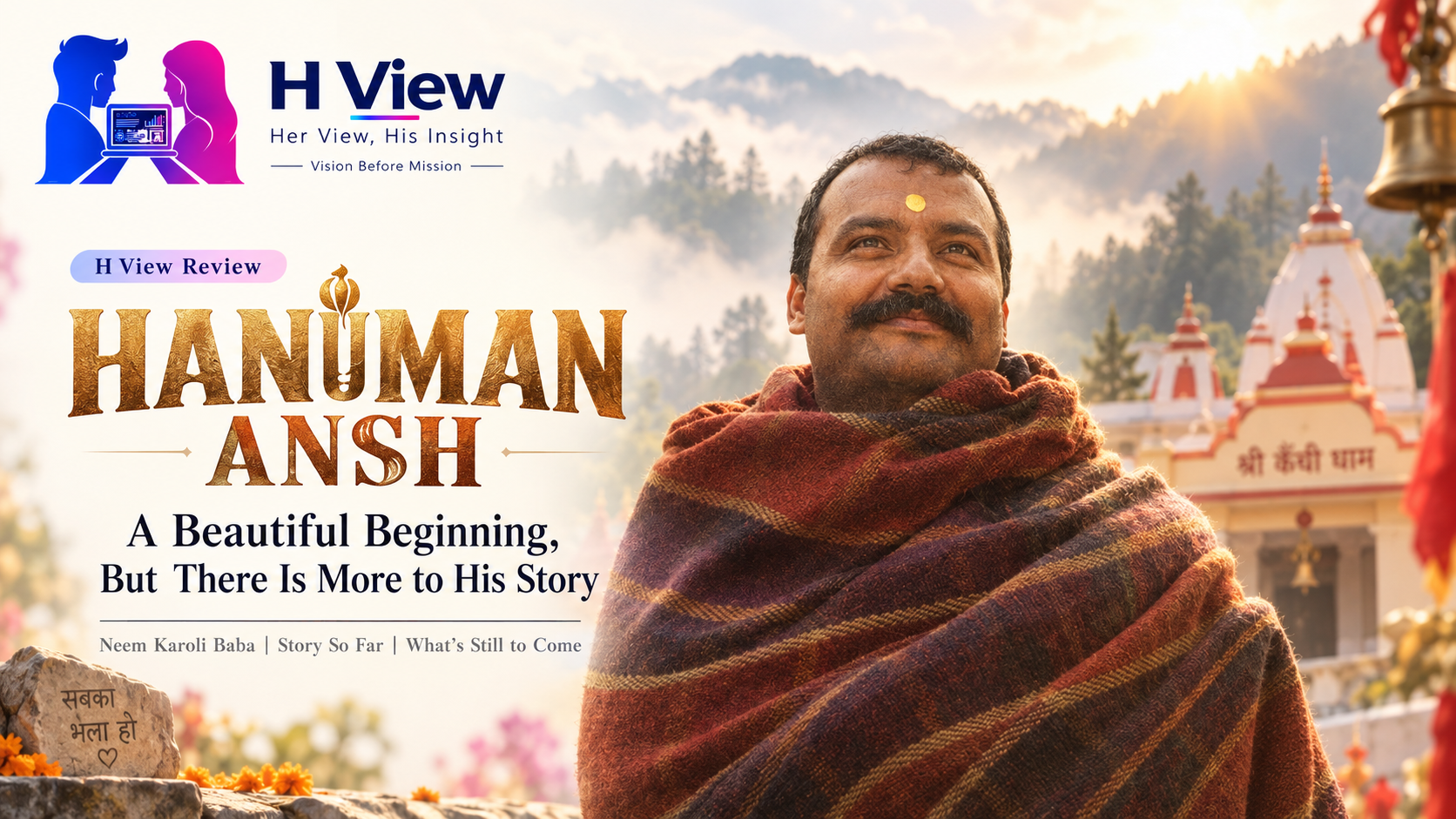
Hanuman Ansh is not the kind of film that ends when the screen goes dark. For many viewers, the real journey may actually begin after leaving the theatre. You find yourself wondering who Neem Karoli Baba really was, what happened after the period shown in the film, how Kainchi Dham became so important, and why decades later people from completely different parts of the world continue to speak about Maharaj-ji.
That was also my strongest feeling after watching the film. I enjoyed it. There is sincerity in the way it presents devotion, simplicity and the spiritual transformation of the man who would eventually become known as Neem Karoli Baba. It does not feel designed merely to create spectacle. At several moments, it asks the audience to slow down and experience the journey rather than simply watch events happen.
Yet when the film ended, I was left with a strange feeling: Had we actually seen Neem Karoli Baba’s life, or had we only watched its first chapter?
As it turns out, that feeling is not accidental.
The filmmakers have now clarified that Hanuman Ansh was envisioned as the first film in a trilogy. Producer Namrata Singh has explained that Part One concentrates on Maharaj-ji’s early years and takes his journey up to Kainchi Dham. Part Two is expected to explore the Kainchi chapter, while Part Three is planned around the international dimension of his influence.
Knowing this changes the way the first film can be viewed.
What initially feels like an incomplete biography begins to make more sense as the opening chapter of a much larger story. At the same time, I believe the film could have communicated this more strongly. A viewer unfamiliar with the trilogy plan can easily leave the theatre feeling that several important chapters of Baba’s life were simply left unexplored.
That is perhaps the biggest contradiction of Hanuman Ansh: the movie succeeds in making you interested in Neem Karoli Baba, but it ends just when that curiosity becomes strongest.
One of the better decisions in Hanuman Ansh is that it does not immediately begin with the globally recognized image of Maharaj-ji surrounded by devotees. Instead, it spends considerable time exploring the human and spiritual journey that came before that recognition.
The film follows Lakshman Narayan Sharma, who would later be known as Neem Karoli Baba, through his early spiritual experiences and wanderings. Reviewers have noted that the story begins around his childhood and the loss of his mother, before moving through experiences that gradually shape his spiritual path.
That slower approach will not work equally well for every viewer. At times the film can feel closer to a devotional biography than a conventional mainstream drama. But that is also part of its character. The filmmakers appear more interested in communicating faith and transformation than in constantly creating cinematic highs.
Most importantly, the film introduces Maharaj-ji to a generation that may know his name without knowing much about his life.
One of the film’s young producers, Anupriya Nagar, has said that part of her motivation was precisely this: younger Indians were sometimes learning about Neem Karoli Baba through foreigners rather than through Indian storytelling about his own life.
That observation becomes especially important when we look at everything the first movie has not yet covered.
For someone unfamiliar with Maharaj-ji, it would be easy to assume that the most important part of his story is already shown in the movie.
It isn’t.
The establishment and growth of Kainchi Dham became one of the defining chapters associated with Neem Karoli Baba. His teachings attracted people from different backgrounds, and his reputation spread far beyond the communities in which his early spiritual journey took place.
His philosophy was remembered less through complex theological arguments and more through extremely simple ideas: devotion to God, service to others, feeding people, compassion, and love.
That simplicity is one of the reasons his influence became so unusual. Maharaj-ji did not become internationally known through an organized global campaign. His name travelled largely through people whose encounters with him changed the direction of their own lives.
And this is where the next parts of the movie could become even more fascinating.
Kainchi Dham in Uttarakhand became closely associated with Neem Karoli Baba and remains an important destination for devotees today.
If Part Two truly concentrates on Kainchi, as the filmmakers have indicated, it has the potential to tell a very different story from Part One. The first film is essentially about the making of the spiritual figure. The next chapter can explore what happened when people began gathering around him, experiencing his teachings and carrying those experiences back into the world.
This is where Maharaj-ji’s story becomes broader than the biography of one saint.
Stories connected with his generosity, service and spiritual presence became central to how devotees remembered him. Accounts of extraordinary events and miracles also form a significant part of the tradition surrounding Maharaj-ji. His relatives have recently publicly supported the authenticity of several incidents depicted in Hanuman Ansh, saying the stories portrayed in the film were based on events associated with his life rather than being invented simply for cinema.
Of course, spiritual experiences and miraculous claims will always be interpreted differently depending on a viewer’s beliefs. A biographical film does not require every audience member to arrive at the same conclusion. What matters is understanding why these stories became inseparable from the way devotees remember Neem Karoli Baba.
Part Three may be particularly interesting for younger audiences because Neem Karoli Baba’s influence eventually travelled far beyond India.
The makers have said that the third film is intended to explore this international story. Producer comments have referenced the wider circle of prominent international personalities connected in different ways with Maharaj-ji’s legacy, including names such as Steve Jobs and Mark Zuckerberg.
This part requires some careful distinction.
Not every famous person commonly associated online with Neem Karoli Baba had a personal relationship with him. For example, Steve Jobs travelled to India seeking spiritual understanding and visited the Kainchi ashram after Maharaj-ji had already died. Years later, stories around that journey became part of Silicon Valley folklore. Mark Zuckerberg has also publicly discussed visiting the temple in India after Jobs suggested he travel there during a difficult period in Facebook’s early history.
So Maharaj-ji’s international influence is not simply a story about celebrities meeting a guru.
It is something more interesting: how the teachings and reputation of an Indian saint continued travelling through people long after his death.
If the third film handles that history responsibly rather than simply filling the screen with famous names, it could become the most globally accessible chapter of the trilogy.
This is where my criticism of the first movie remains.
Knowing that sequels are planned explains the ending, but it does not completely solve the problem.
When a movie introduces itself primarily through the life of Neem Karoli Baba, many ordinary viewers will naturally expect to leave understanding his life reasonably well. Instead, Hanuman Ansh provides extensive detail about one period and leaves enormous parts of his later influence unexplored.
For viewers already familiar with Maharaj-ji, this may clearly feel like Part One.
For viewers discovering him through the film, however, the ending can feel abrupt.
That distinction matters because a successful first part of a trilogy should ideally do two things simultaneously: leave room for another chapter and still provide enough emotional completion for the film currently being watched.
Hanuman Ansh succeeds more at the first than the second.
Interestingly, the production itself was made on an unusually modest scale. The film started with limited theatrical reach and grew substantially through audience response and word of mouth, becoming an unexpected commercial success. That makes its achievement impressive, but the extraordinary success also increases expectations for what the filmmakers do next.
There is another side to the argument.
Trying to compress Neem Karoli Baba’s childhood, wandering years, spiritual development, Kainchi Dham period, disciples, teachings and international legacy into a single two- or three-hour movie might have resulted in something much weaker.
Important incidents would become montages.
People would appear and disappear without enough context.
Decades would pass in minutes.
Viewed from that perspective, three films actually make sense.
The first introduces the person.
The second can introduce the community and teachings around him.
The third can show how that influence moved beyond India’s borders.
If the filmmakers execute those chapters carefully, the incompleteness many viewers currently feel may eventually become one of the trilogy’s strengths.
The problem is simply that audiences need to know this is the journey they have signed up for.
From my perspective, Hanuman Ansh worked because it made me interested in the person behind the movie rather than merely impressed by the movie itself.
But that curiosity also produced my biggest disappointment.
When the film ended, I felt there should have been much more. I wanted to understand the Baba people travel to Kainchi Dham for today. I wanted to understand why his teachings crossed countries and generations. I wanted to understand how someone portrayed with such simplicity eventually became influential among people who lived in completely different cultural and technological worlds.
Only after learning about the planned trilogy does that missing portion begin to make sense.
Perhaps the film could have made that promise clearer.
There is considerable commercial temptation after an unexpected hit to turn one successful movie into several sequels. But Hanuman Ansh appears to have an advantage here: the trilogy concept reportedly existed before the film became successful. The producers have said the project was pitched as three parts from the beginning.
That makes the sequels more meaningful than a conventional attempt to extend a hit franchise.
Still, Parts Two and Three will carry greater responsibility. The more the story enters documented modern history and touches globally known personalities, the more carefully cinema must separate established facts, devotees’ recollections, spiritual tradition and dramatic interpretation.
Faith does not need exaggeration to become interesting.
Neem Karoli Baba’s influence is already unusual enough.
No. The filmmakers have confirmed that it was conceived as the first instalment of a three-film series, with the opening film primarily covering Maharaj-ji’s early journey up to Kainchi Dham.
Yes, the producers have publicly discussed two further instalments. Part Two is expected to focus substantially on Kainchi, although the detailed screenplay and release schedule have not yet been finalized.
The producers have described the third film as the international chapter of Maharaj-ji’s influence, including the wider legacy associated with prominent international followers and visitors connected with Kainchi Dham.
His teachings influenced a number of Western spiritual seekers, and his ashram later became associated with internationally known visitors. His influence continued spreading through devotees and people inspired by their accounts of Maharaj-ji.
Yes. In some ways, that may be the ideal audience for the first film. It works as an introduction, although viewers should know beforehand that they are watching only the beginning of a much larger biography.
Harika is the co-founder of H View and covers AI, technology, gadgets, digital tools, online platforms, and modern internet trends. Her articles focus on simplifying complex topics with practical explanations, balanced opinions, and reader-first insights.
Share your real experience and help other readers decide better.
No community views yet. Be the first to share yours.

Open LinkedIn for a few minutes and you will probably come across a colourful graphic…
Harika October 6, 2026 
When an employee resigns, many organisations move quickly into replacement mode. The manager informs HR,…
Harika October 6, 2026 
For many corporate employees, the workday begins long before they actually start working. They wake…
Harika October 5, 2026 
Many projects begin with an assumption that sounds reasonable on paper: the client will explain…
Harika October 1, 2026