
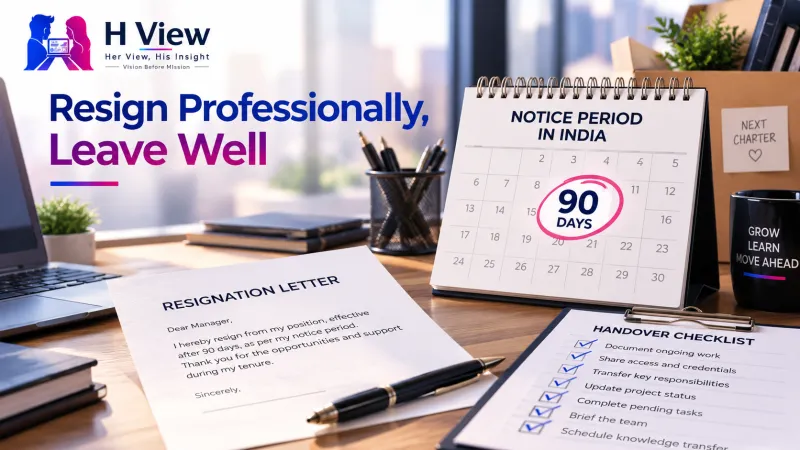
Notice Period in India: How to Resign Professionally, Handle a Long Notice and Leave on Good Terms
A 60- or 90-day notice period can make a job switch stressful. How to resign professionally, negotiate an early release or buyout, hand over well and leave with your relieving letter and reputation intact.
You have a new offer in hand. The salary is better, the role is exciting, and the new company wants you to join in thirty days. Then you open your appointment letter and see it: a ninety-day notice period.
For many professionals in India, the notice period is the most stressful part of switching jobs. Handled badly, it can delay joining, damage relationships with your current employer, or even affect your relieving letter. Handled well, it lets you leave with your reputation intact.
This guide explains how to resign professionally, manage long notice periods, and complete your exit smoothly.
Step 1: Read Your Contract Before You Resign
Your appointment letter or employment contract usually states:
- The length of the notice period, which can differ during probation and after confirmation.
- Whether the company allows a notice period buyout.
- How unused leave is treated during notice.
- Any bonds, training cost recovery or variable pay conditions.
Know these terms before you discuss joining dates with your new employer. Promising a date you cannot meet creates trouble on both sides.
Step 2: Resign the Right Way
- Tell your manager first, ideally in person or on a call, before sending the formal email.
- Send a short, polite resignation email through the official channel or HR system.
- Keep it simple: your last working day as per notice, a thank-you, and your commitment to a smooth handover.
“Dear [Manager], I am writing to formally resign from my position as [Role]. As per my notice period, my last working day would be [date]. I’m grateful for the opportunities I’ve had here and will ensure a complete handover of my responsibilities. I’d be happy to discuss the transition plan at your convenience.”
There’s no need to explain every reason or criticise the company in writing.
 Also readLinkedIn Profile for Job Search in India: What Recruiters Actually Notice and What to Fix First→
Options to Shorten a Long Notice Period
| Option | How it works | What to check |
|---|---|---|
| Early release | Employer agrees to relieve you earlier after handover | Get the revised date in writing |
| Notice buyout | Pay for the unserved days, sometimes supported by the new employer | Calculation basis and who pays |
| Leave adjustment | Some companies allow earned leave to offset notice days | Company policy decides this |
Ask politely, show your handover plan, and accept that the final decision rests with the employer under your contract. When negotiating your new offer, discuss notice support too, as we suggested in our salary negotiation guide.
Step 3: Make Your Handover Excellent
The quality of your handover is what people remember. A strong handover includes:
- A list of ongoing work, its status and deadlines.
- Documentation of processes, systems, credentials (shared securely) and known issues.
- Walkthroughs with the person taking over.
- Introductions to key clients or stakeholders where appropriate.
We explored why thorough handovers matter, and how they are sometimes misunderstood, in when ownership looks like defiance.
Step 4: Complete Your Exit Formalities
- Return company assets: laptop, ID card, access cards and any equipment.
- Collect documents: relieving letter, experience letter and your final payslips.
- Full-and-final settlement: check pending salary, leave encashment where applicable, reimbursements and deductions.
- Provident Fund: keep your UAN details handy to transfer your PF to the new employer.
Your relieving letter is especially important. Many new employers ask for it during background verification.
Handling a Counter-Offer
Your current company may offer more money to stay. Before accepting, ask yourself why you wanted to leave in the first place. If the reasons were growth, workload or culture, money alone may not fix them. We discussed this in our piece on career stagnation in stable jobs.
Mistakes to Avoid
- Absconding or stopping work without completing notice. It can affect your relieving letter and references.
- Badmouthing your manager or company on social media during or after notice.
- Accepting the new offer without confirming your realistic joining date.
- Taking confidential company files or data with you.
- Using fake documents to show an earlier release. See why fake documents can damage your career.
 Also readSalary Negotiation in India: What to Say, When to Say It and What Freshers Can Actually Ask For→
Her View: Leaving Well Is Also Self-Respect
Notice periods can feel uncomfortable, especially if colleagues become distant or managers suddenly pile on work. It is tempting to mentally check out.
But leaving with professionalism protects you. The industry is smaller than it looks, and the colleague you trained today may be your interviewer or reference tomorrow. Finish well, for your own record.
His Insight: The Notice Period Is a Negotiation, Not Just a Wait
Many professionals treat the notice period as a fixed sentence. In practice, there is often room for discussion: early release after handover, partial buyout, or leave adjustment. The key is to ask respectfully, show a clear transition plan and make it easy for your manager to agree.
Equally, be honest with your new employer about your realistic joining date. Good companies plan around genuine constraints; what they dislike is surprises.
H View Verdict
A notice period doesn’t have to damage your job switch. Read your contract, resign politely, plan an excellent handover, ask professionally for early release or buyout if needed, and complete exit formalities carefully.
Your last few weeks at a company shape how you are remembered. Leave in a way that makes people happy to recommend you.
Frequently Asked Questions
Can I leave before completing my notice period?
Only if your employer agrees to an early release or accepts a buyout as per your contract. Leaving without agreement can affect your relieving letter and references.
What is a notice period buyout?
It is a payment for the unserved notice days, calculated as per your contract. Sometimes the new employer agrees to support this cost.
Can I use leave to reduce my notice period?
Some companies allow it and others don’t. It depends on your company’s policy, so check with HR.
Why is the relieving letter important?
Many employers ask for it during background verification as proof that you exited properly from your previous job.
H View stories follow our editorial policy. Spotted an error? Tell us and we will correct it.
Rate this article
One tap is enough. No comment needed.
Was this article helpful?
Your answer goes straight to our editors.







Comments0
No comments yet. Start the conversation.