

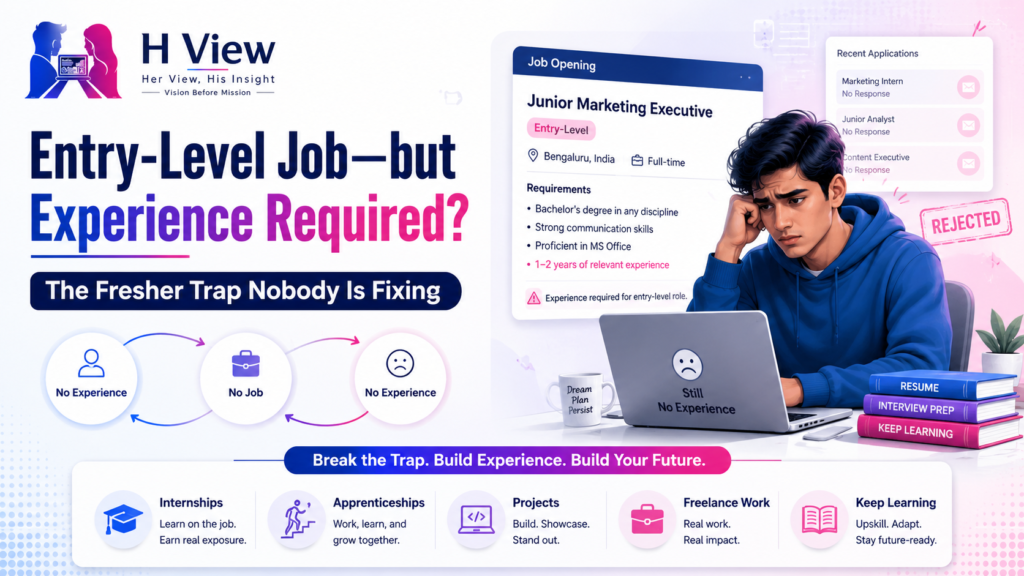
Entry-Level Job—but Experience Required? The Fresher Trap Nobody Is Fixing
A fresher opens a job portal and finds an attractive vacancy. The title says Entry-Level,…
 Satya Hemanth August 9, 2026
  By Satya HemanthUpdated September 20, 20266 min read89 views
Open any job portal today and you will see thousands of vacancies.
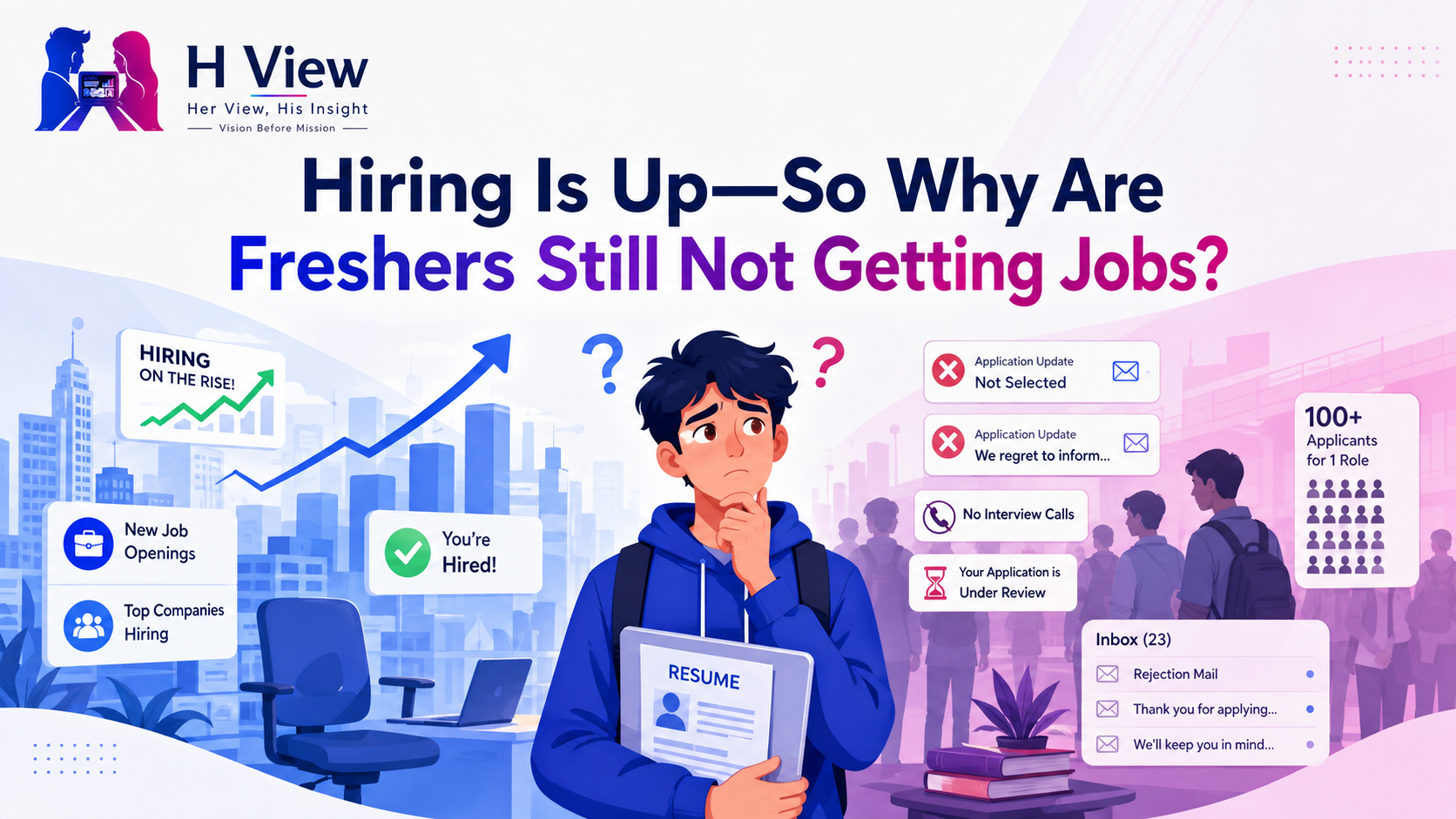
Companies announce hiring plans. Recruitment reports say fresher hiring intent is improving. Some industries are expanding again after months of cautious recruitment.
Yet many graduates tell a completely different story.
They apply repeatedly and receive no response. Some clear assessments but never reach interviews. Others discover that “entry-level” vacancies still want experience.
So both things appear to be true at the same time:
Companies are hiring—and many freshers are still struggling to get hired.
That contradiction is becoming increasingly visible in India.
TeamLease EdTech’s Career Outlook Report for the second half of 2026 says overall fresher hiring intent has improved. But the same report says hiring plans declined across roughly one-third of industries, including IT, consulting, telecom, marketing and advertising, media and entertainment, and educational services.
The problem, therefore, is not simply “Are jobs available?”
A better question is:
Where are those jobs, what kind of jobs are they, and are freshers prepared for the sectors actually hiring?
When headlines say hiring is rising, it does not mean every industry, city or job role is growing equally.
A graduate searching only for software-development jobs may face a very different market from someone applying in manufacturing, sales, customer operations, healthcare or financial services.
This matters because students often choose careers based on what was popular three or four years ago.
An engineering graduate may automatically search only for IT jobs. A B.Com student may wait exclusively for a banking role. An MBA graduate may reject operations or sales roles because they expected a corporate-office position.
Meanwhile, companies may be hiring elsewhere.
So a national increase in hiring can exist alongside unemployment for candidates targeting a narrow set of roles.
Freshers should not assume that the entire employment market is closed.
Current job platforms still show substantial numbers of fresher vacancies across customer support, sales, business development, HR, web development, graphic design, operations and other roles.
The challenge is that the opportunity available today may not look exactly like the career students imagined during college.
A candidate may have to consider:
The first job does not have to become the entire career.
Sometimes it simply provides the workplace experience needed to reach the next opportunity.
At the same time, saying “there are plenty of jobs” can oversimplify the problem.
A vacancy may be:
A graduate cannot automatically treat every available vacancy as equivalent employment.
India’s unemployment rate rose to 5.4% during April–June 2026, while labour-force participation for people aged 15 and above declined to 54.6%. Rural unemployment also increased during the quarter.
The job market therefore remains more complicated than a single positive hiring headline suggests.
Another important shift is employer expectation.
Companies may want entry-level talent because freshers can be trained and can grow with the organisation.
But businesses also increasingly want candidates who can contribute quickly.
That means employers may expect basic familiarity with:
This creates the familiar employability gap.
The college degree qualifies the candidate to apply.
Practical readiness often determines who progresses.
When freshers become anxious, they often increase application volume.
One person may apply for software development, data analysis, digital marketing, HR, testing, customer support and business development using the same resume.
The result is a profile that does not strongly match any particular role.
A better approach is to choose:
One primary career target + one related backup.
For example:
Primary: Data analyst
Backup: MIS or reporting executive
Or:
Primary: Software tester
Backup: Application-support associate
Then build the resume, skills and projects around that direction.
Job growth is not evenly distributed geographically.
A candidate searching only within their hometown may see very few relevant vacancies.
At the same time, relocating immediately to a major city without confirmed employment may be financially risky.
Freshers should therefore compare:
For example, current job listings in Andhra Pradesh show fresher opportunities spanning manufacturing, banking, healthcare, technical roles and operations—not only traditional software careers.
Broadening the location can sometimes matter as much as adding another skill.
Another mistake is assuming unemployment means another course is required.
A candidate learns:
Python → Java → Full Stack → Cloud → AI → Data Science.
But the resume still lacks one convincing job profile.
Instead, study 20–30 vacancies for one target role.
Identify the repeated requirements.
Then learn only what is missing.
The goal should be job-role readiness, not maximum certificate count.
A practical strategy is:
Know exactly which entry-level role you are targeting.
Do not depend on a syllabus created two years ago.
Create projects, case studies, test reports, dashboards or portfolios relevant to the role.
Do not assume your degree limits you to one sector.
Use company career pages, referrals, recruiters, apprenticeships and job portals.
If 30 targeted applications produce zero interviews, change the resume or targeting strategy.
If interviews happen but offers do not, work on interview readiness.
India can simultaneously have:
That sounds impossible until we recognise the mismatch.
Employers may need one set of skills, while students prepared for another.
Jobs may exist in one sector, while candidates wait for another.
Companies may offer temporary or junior roles, while graduates expect immediately stable professional positions.
The solution is not simply telling young people to accept anything.
It is improving the connection between education, skills, employer needs and realistic career expectations.
Hiring may be improving.
That does not mean every fresher suddenly has an easy path into employment.
The opportunity is becoming uneven.
Some industries are expanding while others reduce fresher hiring. Some employers want beginners but also expect practical readiness. Some jobs are growing outside the sectors graduates originally planned to enter.
Freshers should therefore stop asking only:
“Are companies hiring?”
Ask:
“Which companies are hiring people like me, for what roles, and what proof do I need to compete?”
The job market may be improving.
But finding your place in that market still requires direction, adaptability and practical evidence.
Overall hiring intent for freshers improved for the second half of 2026, but hiring plans declined in several major industries.
Your target industry, role, location, practical skills or application strategy may not match the areas where hiring is growing.
They can consider related roles that provide useful experience and career growth, but should evaluate salary, responsibilities and future opportunities carefully.
Only when it fills a specific requirement for the role you are targeting. Random certificates are unlikely to solve unclear career direction.
Relocation can increase opportunities, but candidates should preferably verify the employer and secure a genuine offer before taking on significant relocation expenses.
Choose a specific role, revise the resume around relevant requirements, strengthen practical proof and review the results after a focused set of applications.
Satya Hemanth is the founder of H View and writes on careers, sports, leadership, digital trends, and practical decision-making. His articles focus on clear explanations, real-world examples, and useful insights for students, young professionals, and everyday readers.
Share your real experience and help other readers decide better.
No community views yet. Be the first to share yours.
A fresher opens a job portal and finds an attractive vacancy. The title says Entry-Level,…
Satya Hemanth August 9, 2026 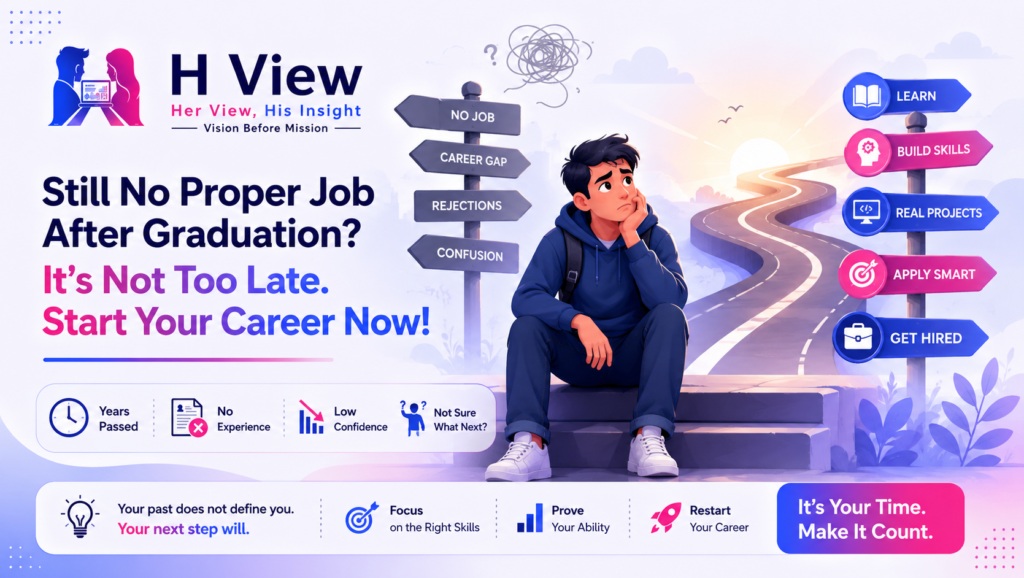
Graduation is usually presented as the beginning of professional life. But for many young people,…
Satya Hemanth July 31, 2026 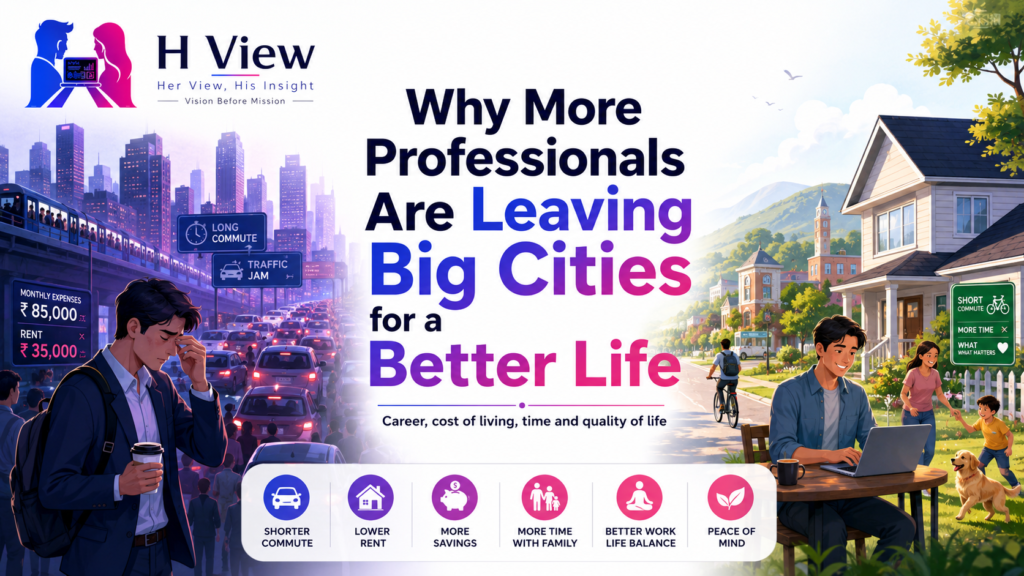
For decades, moving to a major city was considered an important step towards professional success.…
Satya Hemanth July 25, 2026