

CMF Clip Pro Explained: Are Open-Ear Earbuds the Future of Everyday Audio?
Most wireless earbuds are designed to block the outside world. They sit inside the ear…
 Harika August 5, 2026
  By HarikaUpdated September 20, 202611 min read64 views
Affordable technology has improved dramatically over the past few years. Buyers no longer expect a budget phone, smartwatch or pair of earbuds to provide only the most basic features.
They now want capable performance, attractive design, reliable software and products that do not immediately reveal where every rupee was saved.
This is the market CMF by Nothing is trying to enter differently.
At first glance, CMF can appear to be a simpler and more affordable extension of Nothing. Both brands share a design-led philosophy, use distinctive colours and communicate with a younger technology audience.
However, CMF is gradually becoming more than “Nothing for less.”
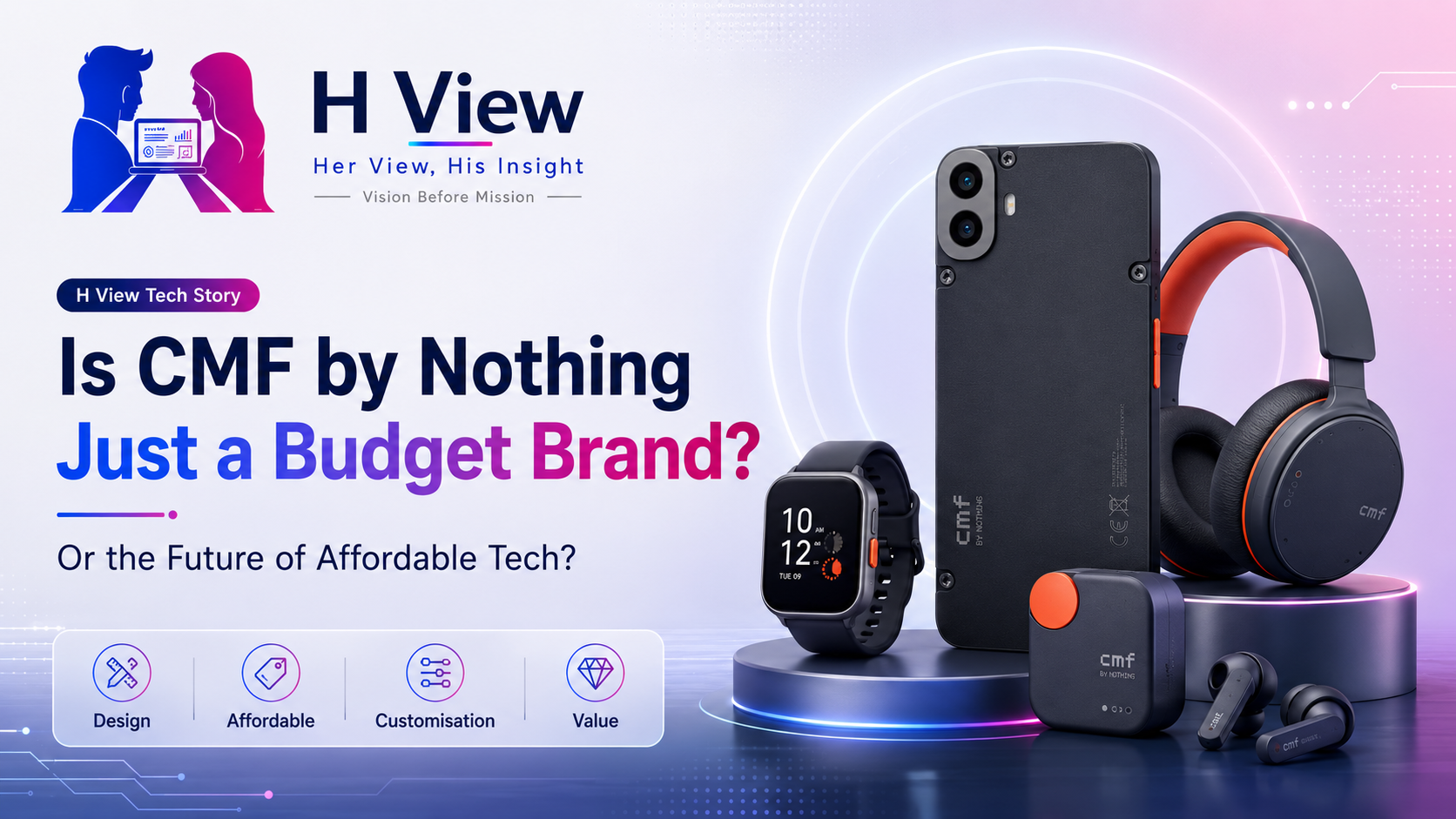
Its products use visible screws, replaceable or interchangeable elements, textured finishes, physical controls and brighter colour choices to develop an identity of their own. The current CMF range includes phones, watches, wireless earbuds and over-ear headphones, showing that the brand is developing into a broader affordable technology ecosystem.
The more important question is whether this identity produces genuinely better products—or simply makes budget devices look more interesting.
Nothing entered the market with products built around transparent design, clean software and a deliberately unconventional personality.
That strategy helped the company become recognisable, but it also created a challenge.
Nothing could not bring every product into lower price categories without risking the position of its main brand. A flagship or premium-looking Nothing device needs to feel different from an aggressively priced product designed primarily around value.
CMF gives the company room to serve a wider audience.
Instead of forcing the Nothing brand to compete everywhere, CMF can focus on accessible technology while experimenting with colour, materials, functional details and personalisation.
This is particularly important in India, where buyers compare products intensely across narrow price differences. A device cannot rely on branding alone. It must demonstrate value clearly through features, durability and daily usability.
CMF is commonly associated with the industrial-design terms Colour, Material and Finish.
These three elements strongly influence how a product looks and feels, even when its internal technology is similar to competing devices.
Colour establishes personality.
Material influences durability, weight and texture.
Finish determines whether a product feels smooth, matte, metallic, soft-touch or deliberately mechanical.
CMF by Nothing uses these ideas as more than a technical design phrase. They form the visible identity of the brand.
Instead of hiding construction details, CMF products may highlight screws, knobs, interchangeable parts or contrasting surfaces. The CMF Phone 2 Pro, for example, is offered in black, orange, white and light green, with different textures and finishes across its colour options. Nothing describes the design as using dual-tone finishes, visible screws and distinctive material cues.
This approach helps CMF products look considered rather than merely inexpensive.
Nothing and CMF are related, but they should not be treated as identical brands at different prices.
Nothing’s main products generally lean towards transparency, monochrome styling and a more futuristic industrial appearance.
CMF is often:
Nothing products often aim to look mysterious and technical.
CMF products frequently look approachable and practical.
This difference is important because a successful sub-brand requires its own reason to exist. If CMF only copied Nothing designs using cheaper plastic, customers would eventually view it as a compromised alternative.
Instead, CMF has started building a recognisable language of orange accents, modular details, large control knobs and interchangeable components.
CMF Phone 1 demonstrated how the brand could use affordability without becoming visually generic.
Its rear panel included visible screws and an Accessory Point that could support attachments such as a stand, card holder or lanyard. Nothing’s official product information described these accessories as attachable by unscrewing the Accessory Point cover.
The concept attracted attention because affordable phones rarely encourage physical customisation.
Most budget devices are sealed rectangles. Their colours may differ, but the physical experience remains fixed after purchase.
CMF Phone 1 suggested that a phone could become more personal through:
However, the idea also revealed an important limitation.
Modularity is valuable only when compatible parts remain available. A removable panel or accessory connector means little if users cannot easily purchase new covers or meaningful accessories later.
CMF must therefore support these ideas as an ecosystem rather than treating them as launch-day marketing features.
CMF Phone 2 Pro represents a more refined stage for the brand.
The phone retains visible design details and multiple colour treatments but moves towards a slimmer, more polished appearance. Its official product page highlights a 5,000 mAh battery, 8 GB of RAM and a four-camera system.
More importantly, its design demonstrates that CMF does not need to repeat the exact construction of Phone 1.
The four colour options use different visual and tactile approaches. The white version includes a sand-like polycarbonate texture, while the orange finish is designed to create a metallic-looking sheen.
This is a good example of CMF applying its name meaningfully.
The colours are not merely paint choices. Material and finish are used to make the variants feel different.
At the same time, buyers should avoid assuming that a creative exterior automatically guarantees the best phone in its price segment. Camera processing, software stability, display performance, network reliability and service support remain more important over several years of ownership.
CMF’s smartwatch range is another important part of the brand.
The current Watch 3 Pro includes a 1.43-inch AMOLED display, built-in dual-band GPS and claimed battery life of up to 13 days. It also tracks measurements such as heart rate, blood oxygen and stress.
The earlier Watch Pro 2 used interchangeable bezels, an AMOLED display, multi-system GPS and claimed battery life of up to 11 days.
Interchangeable bezels fit the CMF philosophy well because they provide a simple, visible form of personalisation.
However, affordable smartwatches must be evaluated carefully.
A long feature list does not automatically guarantee accurate health measurements, dependable notifications or polished software. Buyers should treat wellness data as general guidance rather than medical information.
CMF’s challenge is to ensure that design does not move faster than the companion application and long-term firmware support.
A watch may look attractive on the first day, but users will judge it later by:
CMF’s audio products may provide the clearest examples of functional design.
The CMF Buds Pro 2 charging case includes a customisable Smart Dial. The earbuds also offer dual drivers, hybrid active noise cancellation and multiple microphones.
A physical dial can be more satisfying and immediate than tapping a small touch area repeatedly.
Depending on software support, it can provide control over functions such as volume or playback without requiring the user to interact directly with the earbuds.
The CMF Headphone Pro continues this idea of visible physical interaction. Its official product page promotes interchangeable ear cushions, active noise cancellation and claimed battery life of up to 100 hours.
Interchangeable ear cushions are particularly interesting.
Ear cushions naturally wear over time. Allowing them to be replaced can support comfort, style and potentially longer product use—provided replacements remain readily available and reasonably priced.
The headphone’s construction still uses cost-conscious materials, including an ABS plastic outer shell, reinforced sliding arms and stainless-steel headband strips.
That does not automatically indicate poor quality. Plastic can reduce weight and cost. What matters is whether the product remains durable through daily folding, travel and adjustment.
India is one of the most competitive consumer-technology markets in the world.
Customers regularly compare:
This makes it difficult for a new brand to compete only through appearance.
CMF’s opportunity is to combine three things that affordable buyers increasingly want:
Many budget products offer the first point. Fewer succeed across all three.
CMF can stand out when it gives buyers something visually distinctive without demanding a large premium.
However, the brand must remain careful.
As soon as CMF pricing approaches more established mid-range options, customers may prioritise camera reliability, service networks and resale value over removable covers or bright colours.
The value proposition must remain clear.
Redmi and Realme have extensive experience in affordable phones and connected devices.
Their strengths often include:
CMF competes differently.
It may offer fewer models, but its products generally have a more coordinated visual identity. The software can also feel cleaner than some heavily customised budget interfaces.
Redmi or Realme may still provide better specifications in a direct price comparison, especially during promotions.
CMF becomes attractive when buyers are willing to trade a small amount of raw specification advantage for:
Motorola has built a strong position around relatively clean Android software and practical mid-range phones.
That makes it one of CMF’s more direct competitors.
Motorola may offer:
CMF may offer:
The deciding factors will often be camera quality, software-update promises and local service access.
OnePlus Nord products generally focus on performance, fast charging and connection to the wider OnePlus brand.
CMF focuses more heavily on design and physical interaction.
A Nord device may be better for someone who values speed, charging and established brand familiarity.
A CMF device may appeal more to someone who wants a less conventional appearance and a cleaner, more playful experience.
Again, CMF should not attempt to defeat every competitor using the same strategy. Its value comes from providing a recognisable alternative.
Affordable products always involve compromises.
The important question is whether those compromises affect areas buyers can accept.
Potential cost-saving areas may include:
Plastic is common across affordable products. It can be durable, but hinges, buttons and attachment points must survive long-term use.
Additional sensors can improve flexibility, but image processing and low-light consistency matter more than camera count alone.
Affordable phones and wearables may offer less protection than premium alternatives.
Features such as wireless charging, ultra-wideband or premium audio codecs may be absent depending on the product.
Long-term operating-system and security updates are essential because buyers increasingly keep devices for several years.
A younger brand may not provide the same physical repair coverage as larger manufacturers, although Nothing maintains customer-support and service-centre resources in India.
CMF should communicate these compromises clearly instead of allowing design to distract from them.
The word “modular” should be used carefully.
CMF products include replaceable, attachable or interchangeable elements. That is not the same as a fully modular electronic platform.
A truly modular device might allow major components such as the battery, camera, display or processor system to be replaced independently.
CMF currently focuses more on physical customisation than deep electronic modularity.
Examples include:
These features are meaningful, but they should not be exaggerated.
The best description is that CMF explores accessible customisation and replaceable external components.
CMF has a genuine opportunity to develop beyond its relationship with Nothing.
Its identity is already becoming recognisable through:
The collaboration around CMF Phone 2 Pro-inspired footwear also shows the brand experimenting beyond conventional electronics and inviting designers to translate its colours and textures into another product category.
That does not mean CMF should immediately expand into every lifestyle category.
Its reputation will still be built through dependable phones, audio devices and watches.
Design can attract attention. Product reliability creates loyalty.
CMF may be suitable for buyers who:
CMF may be less suitable for buyers who:
Each CMF product should be judged separately. A strong phone does not automatically make every CMF watch or audio product equally competitive.
CMF refers to Colour, Material and Finish, three important areas of industrial design that influence how a product looks and feels.
Yes. CMF is a sub-brand developed by Nothing for more accessible technology products.
CMF generally focuses on more affordable price segments, while Nothing-branded devices typically occupy higher mid-range and premium categories.
Some CMF products support replaceable or interchangeable external parts, such as phone covers, accessories, watch bezels and headphone cushions. They are not fully modular electronic devices.
The official Indian catalogue currently includes phones, watches, wireless earbuds and over-ear headphones.
CMF’s competitive pricing, cleaner software and distinctive design make it relevant for Indian buyers. Individual products should still be assessed for cameras, service, reliability and software support.
Harika is the co-founder of H View and covers AI, technology, gadgets, digital tools, online platforms, and modern internet trends. Her articles focus on simplifying complex topics with practical explanations, balanced opinions, and reader-first insights.
Share your real experience and help other readers decide better.
No community views yet. Be the first to share yours.
Most wireless earbuds are designed to block the outside world. They sit inside the ear…
Harika August 5, 2026 
Nothing and CMF belong to the same technology family, use the same software foundation and…
Harika July 28, 2026 
Nothing is disrupting the tech world with its unique design-led approach, offering transparent and expressive…
Harika July 16, 2026