
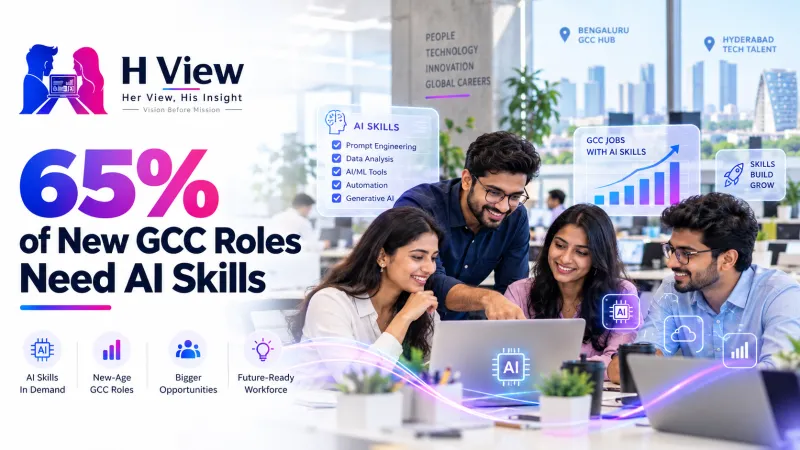
65% of New GCC Roles Reportedly Need AI Skills: What Should Indian Jobseekers Learn?
A new ANSR report says about 65% of new roles at Global Capability Centres in India need AI skills. Here is what that number really means, and what to learn first.
About 65% of new roles created at Global Capability Centres (GCCs) in India in 2026 require AI skills, according to ANSR's "Talent Trends in GCCs in India" report released on 24 September 2026. For jobseekers, this does not mean every role is an AI engineering job. It means AI tools, data skills and the judgement to use them are becoming part of ordinary job descriptions.
If you have scrolled LinkedIn this month, you have probably seen that 65% figure in a dozen posts, usually next to a course advert. It is worth slowing down and asking two questions. What does "requires AI skills" actually mean on a job description? And what should a B.Tech fresher in Vizag or a six-year Java developer in Pune do about it this year?
GCC hiring in India, 2026
Source: ANSR, Talent Trends in GCCs in India, 24 September 2026
What is a GCC, and why do they matter for jobs?
A Global Capability Centre is an in-house centre that a multinational company sets up in India to run technology, engineering, operations, finance or research work for its global business. Think of a European bank's technology hub in Hyderabad or an American retailer's engineering centre in Bengaluru. Unlike outsourcing firms, these teams work directly for the parent company.
According to ANSR, India now has more than 1,900 GCCs employing over 2.1 million professionals. Bengaluru has more than 1,000 of them and Hyderabad more than 400, with Coimbatore, Ahmedabad and Kochi emerging as newer hubs. GCC hiring grew about 12 to 15% year-on-year in the first half of 2026, faster than the wider IT and ITES sector, the report says.
What does "requires AI skills" really mean?
This is the part most posts skip. The ANSR report is based on an analysis of more than 5,000 live open roles and over 20,000 hiring patterns. The press release does not break the 65% figure down by type of AI work, so it is safest to read it broadly. It is unlikely to mean 65% AI scientist jobs. More realistically, it covers everything from building machine learning systems to using AI well inside a regular engineering, analytics or operations role.
What ANSR does spell out is the kind of people GCCs want. It describes two profiles in demand: the "AI-native engineer", who uses AI across the development process, and the "forward-deployed engineer", who combines engineering with consulting and business skills. A data analyst who can use AI to clean and explain data, or a developer who can build features on top of AI models, fits that picture.
 Also readHiring Is Up—So Why Are Freshers Still Not Getting Jobs?→
Which skills should Indian jobseekers learn first?
A practical learning path
The report names AI engineering, cloud platforms, cybersecurity, data engineering and product development as key capabilities. In plain terms, here is what that means for different people:
| If you are | Focus on |
|---|---|
| A fresher (0 to 2 years) | Strong basics in one language and SQL, one or two real projects that use an AI API, and clear explanations of what you built |
| Mid-career (3 to 8 years) | Bring AI into your current domain: testing, data pipelines, support automation or analytics. This group makes up about 62% of GCC hiring, per ANSR |
| Non-tech roles | AI-assisted analysis, reporting and process automation, plus domain knowledge in finance, HR or operations |
If you want to see what applied AI projects look like in practice, real case studies help more than certificates. For example, full-stack engineer Harika Behara's project portfolio shows how AI is used inside everyday products such as HR software, assessment tools and WhatsApp-based customer support.
What about salaries in GCCs?
ANSR reports a median annual pay of $25,000 to $40,000 for entry-level positions and $150,000 to $200,000 for lead AI or machine learning engineers. Treat these as broad medians across the roles analysed, not as offers you should expect. Pay varies a great deal by company, city and the actual work.
Her View
Numbers like 65% can make people anxious, especially those who took a career break or are just starting out. But most of the AI skills employers want can be learned step by step, often for free. Start small: use AI in the work you already do, notice where it helps and where it gets things wrong, and build from there. Steady learning beats panic buying courses.
 Also readWhy More Professionals Are Leaving Big Cities for a Better Life→
His Insight
Look at the experience data before the AI headline. A median of six years and 62% of hiring in the three to eight year band tells you GCCs mostly want people who already understand a domain and can apply AI to it. For freshers, that means competing with proof: a GitHub repository with a working project and a clear README will often say more than a certificate.
H View Verdict
The ANSR figure is real and significant, but it describes a shift in how jobs are done, not a world where only AI specialists get hired. Learn strong fundamentals, use AI tools critically in your current work, and build one or two projects you can explain end to end. That combination fits most of the 65%.
Frequently Asked Questions
What percentage of new GCC jobs need AI skills?
About 65% of new GCC roles created in India in 2026 require AI skills, according to ANSR's Talent Trends in GCCs in India report released on 24 September 2026.
How many GCCs are there in India?
ANSR says India has more than 1,900 Global Capability Centres employing over 2.1 million professionals, with Bengaluru and Hyderabad as the largest hubs.
Can freshers get jobs in GCCs?
Yes, but most GCC hiring is for experienced people, with a median of six years. Freshers improve their chances with strong fundamentals and real projects that show they can use AI tools responsibly.
Which skills are most in demand in GCCs?
The report highlights AI engineering, cloud platforms, cybersecurity, data engineering and product development, along with the ability to combine engineering with business understanding.
H View stories follow our editorial policy. Spotted an error? Tell us and we will correct it.
Rate this article
One tap is enough. No comment needed.
Was this article helpful?
Your answer goes straight to our editors.









Comments0
No comments yet. Start the conversation.