
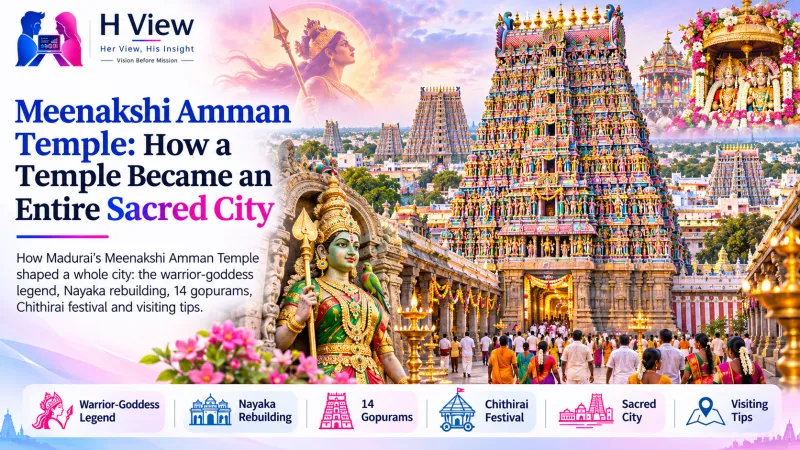
Meenakshi Amman Temple: How a Temple Became an Entire Sacred City
In Madurai, streets are named after Tamil months and laid out around a goddess. The story of the Meenakshi Amman Temple, and the city that grew in its embrace.
The Meenakshi Amman Temple in Madurai, Tamil Nadu, is dedicated to Goddess Meenakshi and her consort Sundareswarar (Shiva). Its present form largely dates to the Nayaka rulers of the 16th and 17th centuries. With 14 gopurams, vast halls and concentric streets laid out around it, the temple shaped Madurai into a true temple city, where festivals still set the rhythm of urban life.
Many Indian cities have a famous temple. Madurai is different: the temple is the city’s centre in every sense. Its streets run in rectangles around the shrine, named after the Tamil months in which processions pass along them. Its markets, music and calendar all revolve around the goddess. To visit Meenakshi is to understand how, in South India, a temple could organise an entire urban world.
Temple card
| Deities | Meenakshi (Parvati) and Sundareswarar (Shiva) |
| Location | Madurai, on the Vaigai river, Tamil Nadu |
| Ancient link | Madurai, the Pandya capital, celebrated in Sangam Tamil literature |
| Present form | Largely 16th–17th century, under the Madurai Nayakas |
| Gopurams | 14, the tallest about 52 m (southern tower) |
| Main festival | Chithirai Thiruvizha (April–May), the celestial wedding |
Who is Meenakshi?
Meenakshi, “the fish-eyed one”, is a form of Parvati. The Tamil tradition, told in the Thiruvilaiyadal Puranam, describes her as a princess born to the Pandya king Malayadhwaja and his queen after a sacrifice for a child. She was born with three breasts, and a divine voice said the third would disappear when she met her future husband. Raised as a warrior heir, she ruled Madurai and set out to conquer the world. When she reached Mount Kailash and faced Shiva in battle, her third breast vanished. Shiva came to Madurai as Sundareswarar, “the beautiful lord”, and married her, with Vishnu giving the bride away.
This story makes Meenakshi unusual among Hindu goddesses: she is a ruling queen, a warrior and a bride. In Madurai, her shrine is visited first, before Sundareswarar’s, and the city is often described as hers. Many devotees say Madurai is ruled by the goddess, with Shiva as her consort.
How old is the temple?
Madurai is one of India’s oldest cities, the capital of the Pandya kingdom and the setting of the Tamil Sangam literary academies described in early texts. A shrine to the goddess and Shiva is believed to have existed here for well over a thousand years, and the Tamil Shaiva saints of the seventh century sang of Madurai’s Shiva.
However, the temple suffered severe damage during the invasions of the early fourteenth century, when Malik Kafur’s army raided the south. The vast complex we see today was largely rebuilt and expanded by the Madurai Nayakas, who governed first for the Vijayanagara empire and then independently. Vishwanatha Nayaka, the founder of the dynasty, is credited with replanning the city around the temple, and Tirumala Nayaka, who ruled in the 1620s to 1650s, added many halls and features.
Ancient period — Madurai the Pandya capital; shrine to Shiva and the goddess.
7th century — Tamil Shaiva saints praise Madurai’s Shiva.
Early 14th century — Temple damaged during invasions from the north.
16th century — Madurai Nayakas rebuild the temple and plan the city around it.
1623–1659 — Tirumala Nayaka’s reign; major additions, including halls and festival traditions.
20th–21st centuries — Regular kumbhabhishekam renovations; repainting of gopurams.
 Also readWhy South Indian Temples Have Giant Gopurams→
How did the temple shape the city?
The Nayaka city plan placed the temple at the centre, with streets arranged in concentric rectangles around it, like the layers of a lotus. Each ring of streets is named for the Tamil month in which festival processions travel along it: Adi streets, Chithirai streets, Avani Moola streets and Masi streets. This means the city literally moves with the festival calendar. When the deities process out, the whole population turns out along these streets.
Around the temple grew markets for flowers, brassware, textiles and food, as well as music and dance traditions linked to temple service. Even today, building rules in the old city have aimed to keep structures lower than the gopurams, so the towers remain visible across Madurai.
What should you see inside?
| Feature | What it is | Look for |
|---|---|---|
| The gopurams | 14 gateway towers, four great outer ones | Thousands of painted stucco figures |
| Meenakshi shrine | The goddess holds a parrot | Visited before Sundareswarar by custom |
| Sundareswarar shrine | Shiva as a lingam | Large Nataraja and other bronzes |
| Potramarai Kulam | The Golden Lotus Tank | Linked with Sangam poets in legend |
| Ayiram Kaal Mandapam | The “thousand-pillar hall” (with 985 pillars per common count) | Now a museum of temple art |
| Musical pillars | Pillars that give notes when tapped | Protected; do not strike them |
| Ashta Shakti Mandapam | Entrance hall with eight goddesses | Panels of Meenakshi’s life |
What is the Chithirai festival?
The Chithirai Thiruvizha, held in the Tamil month of Chithirai (April–May), is Madurai’s defining event and one of South India’s largest festivals. Over about two weeks, it re-enacts the coronation of Meenakshi as queen, her conquest, and her celestial wedding (Thirukalyanam) to Sundareswarar. Huge temple chariots are pulled through the Masi streets by crowds of devotees.
The festival also includes the journey of Kallazhagar, a form of Vishnu from the Azhagar Kovil temple, who travels to Madurai believing he will attend his sister’s wedding. He arrives too late and enters the Vaigai river, an event watched by vast crowds. Tirumala Nayaka is often credited with linking the Shaiva and Vaishnava festivals, uniting communities in a single celebration.
 Also readMahakaleshwar Ujjain: What Makes the Bhasma Aarti Unlike Any Other Temple Ritual→
How should you plan a visit?
- Enter early morning or in the evening to avoid heat and crowds.
- Dress modestly; traditional clothing is expected in inner areas.
- Leave phones at the counters; mobile phones are not allowed inside.
- Visit Meenakshi first, then Sundareswarar, as tradition holds.
- See the night ceremony (palliyarai), when Sundareswarar is carried to Meenakshi’s chamber.
- Explore the old city: Thirumalai Nayakkar Mahal palace, flower market and Gandhi Memorial Museum.
- Combine with Rameswaram, about 170 km away, for a South India circuit.
Her View: In Madurai, the goddess is not a consort in the background; she is the queen of the city. That is a rare and powerful image of the feminine divine.
His Insight: The Nayakas used festival routes as urban planning. Streets named after months mean the city’s layout is also its calendar.
Frequently asked questions
Who built the Meenakshi Amman Temple?
An ancient shrine stood here for centuries, but the present complex was largely rebuilt and expanded by the Madurai Nayakas in the 16th and 17th centuries.
How many gopurams does the Meenakshi temple have?
Fourteen, with the tallest, the southern tower, about 52 metres high.
When is the Chithirai festival?
In the Tamil month of Chithirai, usually April–May, culminating in the celestial wedding and chariot festival.
Are mobile phones allowed in the Meenakshi temple?
No. Phones must be deposited at counters outside.
Sources and how this article was researched
This is a desk-research article. Legends are presented as tradition.
- Arulmigu Meenakshi Sundareswarar Temple (HR&CE, Government of Tamil Nadu)
- Wikipedia: Meenakshi Temple
- Wikipedia: Madurai Nayak dynasty
Part of H View’s Devotion & Heritage series. See also: Why South Indian Temples Have Giant Gopurams.
H View stories follow our editorial policy. Spotted an error? Tell us and we will correct it.
Rate this article
One tap is enough. No comment needed.
Was this article helpful?
Your answer goes straight to our editors.







Comments0
No comments yet. Start the conversation.