
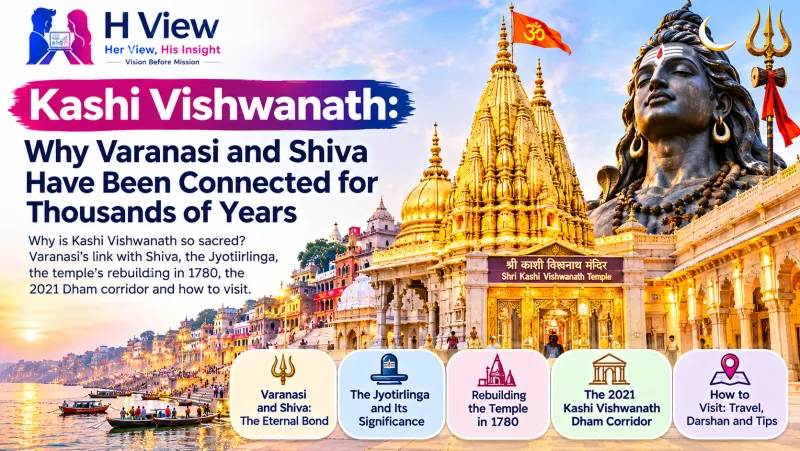
Kashi Vishwanath: Why Varanasi and Shiva Have Been Connected for Thousands of Years
Hindus believe Kashi rests on Shiva’s trident and that dying here brings liberation. How did one city and one god become inseparable?
Kashi Vishwanath, in Varanasi, is one of Shiva’s twelve Jyotirlingas, and Hindu tradition treats the whole city of Kashi as Shiva’s own home, said to rest on his trident. Dying here is believed to bring moksha. The present temple was rebuilt in 1780 by Maharani Ahilyabai Holkar, and since December 2021 a corridor links it to the Ganga.
Few places on earth have been sacred for as long, or as continuously, as Varanasi. Kings, empires and buildings have come and gone, but pilgrims have never stopped walking its lanes to reach Vishwanath, the Lord of the Universe. To understand why, you have to understand how Hindus see the city itself, not just the temple at its centre.
Temple card
| Deity | Vishwanatha / Vishweshwara, “Lord of the Universe” |
| Status | One of the 12 Jyotirlingas |
| City names | Kashi, Varanasi, Banaras, Avimukta, Anandavana |
| Present temple | Built 1780, Maharani Ahilyabai Holkar of Indore |
| Gold plating | Shikharas gilded with gold donated by Maharaja Ranjit Singh in the 1830s |
| Managed by | Shri Kashi Vishwanath Temple Trust, under a 1983 Uttar Pradesh law |
| Corridor | Kashi Vishwanath Dham, inaugurated 13 December 2021 |
Why is Kashi considered Shiva’s city?
In the Puranas, and especially in the Kashi Khanda of the Skanda Purana, Kashi is called Avimukta, “never abandoned”, because Shiva never leaves it. Tradition says the city rests on the tip of his trident, held above the earth, so that it survives even the dissolution of the universe at the end of each cosmic age. In this view, Kashi is not simply a city that contains a Shiva temple. The entire city is the temple, and Shiva is its permanent resident.
The name itself carries meaning. Kashi comes from a root meaning “to shine”, so Kashi is the luminous city, the place where the light of liberation shines. Another old name, Anandavana, the forest of bliss, recalls a time when the area was wooded and full of ascetics. Varanasi refers to the land between the Varuna and Asi rivers, two small streams that meet the Ganga at the city’s northern and southern edges.
Why do Hindus believe dying in Kashi brings liberation?
This belief is one of the most distinctive features of the city. Tradition holds that when a person dies in Kashi, Shiva himself whispers the taraka mantra, the mantra that carries the soul across, into their ear, freeing them from the cycle of rebirth. That is why many elderly Hindus have historically come to Varanasi to spend their final days, and why there are guest houses, known as mukti bhawans, where people stay specifically to die in the city.
It is also why the cremation grounds at Manikarnika and Harishchandra ghats sit at the heart of the riverfront rather than at the edge of town, as in most places. Fires burn there day and night. For a first-time visitor, this can be startling. For devotees, it is a constant, honest reminder that life is brief, and that Kashi is where one prepares for what comes after.
How old is the connection between Varanasi and Shiva?
Varanasi is often described as one of the oldest continuously inhabited cities in the world. Kashi appears as a powerful kingdom in early Buddhist and Jain literature, and the Buddha delivered his first sermon at nearby Sarnath around the fifth century BCE, which tells us the area was already a centre of religious life. Shiva worship in the city is described at length in Puranic texts compiled over the first millennium CE.
The specific temple buildings, however, have changed many times. That is a crucial point: the sanctity of the place has been continuous, even when the structures were not.
Ancient period — Kashi a major kingdom and pilgrimage centre; Sarnath nearby.
12th–16th centuries — Temples destroyed and rebuilt several times during a turbulent period.
1585 — Rebuilt by Raja Todar Mal, a minister in Akbar’s court, with the scholar Narayan Bhatt, according to historical accounts.
1669 — Demolished on Aurangzeb’s orders; the Gyanvapi mosque was built on the site. The site is the subject of ongoing court cases.
1780 — Present temple built by Maharani Ahilyabai Holkar of Indore next to the old site.
1830s — Maharaja Ranjit Singh donates gold for the shikharas, giving the name “Golden Temple of Varanasi”.
1983 — Uttar Pradesh government takes over management through the Shri Kashi Vishwanath Temple Act.
2021 — Kashi Vishwanath Dham corridor opens, connecting the temple to the Ganga.
Who was Ahilyabai Holkar, and why does she matter here?
Maharani Ahilyabai Holkar ruled the Malwa kingdom from Indore and Maheshwar in the second half of the eighteenth century. She is remembered as one of India’s most capable and devout rulers, and she funded the repair and building of temples, ghats, wells and rest houses across the subcontinent, from Somnath to Kedarnath. Her construction of the present Kashi Vishwanath temple in 1780 restored a central shrine to the city after more than a century. A statue of her now stands in the Kashi Vishwanath Dham complex, recognising that legacy.
What does the temple look like?
The present temple is relatively compact, built in the North Indian Nagara style with curved shikharas. Its most famous feature is the gold covering on two of its spires, from Maharaja Ranjit Singh’s gift. Inside, the Jyotirlinga sits in a silver-lined basin in the sanctum. Because the lingam is small and the sanctum busy, darshan is usually brief, but devotees value even a moment there. Around the main shrine are smaller shrines to other deities, including Kaal Bhairav, Dandapani, Avimukteshwara and Vishnu.
What does the 2021 corridor change?
Before 2021, pilgrims reached the temple through a maze of narrow, crowded lanes, a defining but often difficult part of the experience. The Kashi Vishwanath Dham project, inaugurated on 13 December 2021, cleared a route of roughly 400 metres from the temple to Lalita and Manikarnika ghats. According to government figures, the project covers about 5.5 acres. It added open plazas, a museum, a Vedic centre, guest facilities and amenities, and during clearance a number of small, old temples hidden inside houses were uncovered and restored.
Supporters praise the easier, safer access and the restored view between the temple and the river. Critics regret the loss of old neighbourhoods and the character of the lanes. Both views reflect what it means to change a living, ancient city, and both are worth understanding before you visit.
What rituals should visitors know about?
| Ritual | When | What happens |
|---|---|---|
| Mangala Aarti | Before dawn | The first aarti of the day; tickets needed |
| Bhog Aarti | Midday | Food offering to the deity |
| Saptarishi Aarti | Evening | Performed by priests representing the seven sages |
| Shringar Aarti | Night | Decoration of the lingam |
| Maha Shivaratri | Annual, Feb–March | The city’s biggest festival, with all-night worship |
| Shravan month | July–August | Mondays draw very large crowds of Kanwariyas |
Timings change by season and festival; always check the trust’s official website before planning.
What else makes up sacred Kashi?
A pilgrimage to Kashi traditionally includes more than the main temple. The Panchakroshi Yatra is a circuit of about 80 km around the sacred zone, visiting more than a hundred shrines over five days. Even short visits usually include:
- Kaal Bhairav temple — the city’s guardian (kotwal), traditionally visited first.
- Annapurna temple — the goddess of food, near Vishwanath.
- Dashashwamedh Ghat — site of the famous evening Ganga aarti.
- Manikarnika Ghat — the principal cremation ghat; observe respectfully, without photography.
- Sankat Mochan Hanuman temple — associated with Tulsidas, author of the Ramcharitmanas.
How should you plan a visit?
- Book aarti or special darshan online on the official Shri Kashi Vishwanath Temple website.
- Leave phones and bags in lockers; electronics are not allowed inside the temple.
- Visit Kaal Bhairav first, as local tradition suggests.
- Go early morning for shorter queues, and avoid Mondays in Shravan unless you want the festival crowd.
- Take a boat at dawn along the ghats, then end the day with the evening Ganga aarti.
- Use official counters only and ignore touts offering quick darshan.
Her View: In Kashi, life and death share the same riverbank. That honesty is why so many people find peace here rather than fear.
His Insight: The temple has been destroyed and rebuilt again and again, yet worship never moved away. Few places on earth show such stubborn continuity of faith.
Frequently asked questions
Who built the present Kashi Vishwanath temple?
Maharani Ahilyabai Holkar of Indore, in 1780.
Why is Kashi Vishwanath called the Golden Temple?
Its shikharas were gilded with gold donated by Maharaja Ranjit Singh of Punjab in the 1830s.
Are phones allowed in Kashi Vishwanath?
No. Phones and electronic items must be left in lockers outside.
Why do people wish to die in Varanasi?
Hindu tradition holds that Shiva grants liberation (moksha) to those who die in Kashi by whispering the taraka mantra.
How long is the Kashi Vishwanath corridor?
About 400 metres, linking the temple to the Ganga ghats. It opened on 13 December 2021.
Sources and how this article was researched
This is a desk-research article. Puranic beliefs are presented as tradition; legal disputes are noted without comment.
- Shri Kashi Vishwanath Temple Trust (official website)
- Wikipedia: Kashi Vishwanath Temple
- New India Samachar (PIB) on the 2021 corridor
Part of H View’s Devotion & Heritage series. See also: 10 Temples in India Everyone Should Visit at Least Once.
H View stories follow our editorial policy. Spotted an error? Tell us and we will correct it.
Rate this article
One tap is enough. No comment needed.
Was this article helpful?
Your answer goes straight to our editors.








Comments0
No comments yet. Start the conversation.