
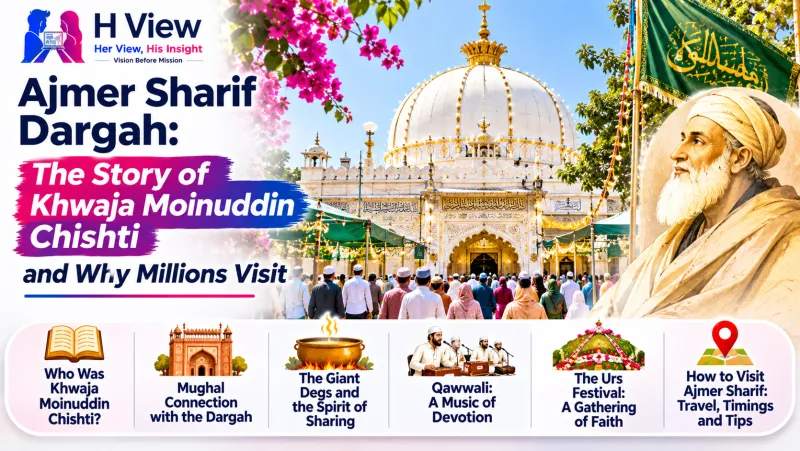
Ajmer Sharif Dargah: The Story of Khwaja Moinuddin Chishti and Why Millions Visit
A Sufi saint arrived in Ajmer more than 800 years ago preaching love and service. Today people of every faith tie threads at his shrine. The story of Ajmer Sharif.
Ajmer Sharif Dargah in Rajasthan is the shrine of Khwaja Moinuddin Chishti (c. 1141–1236), the Sufi saint who established the Chishti order in India. Revered as Gharib Nawaz, “benefactor of the poor”, he taught love, humility and service. People of all faiths visit his tomb, especially during the annual Urs, which marks his death anniversary.
Walk into the lanes around the dargah and you hear qawwali, smell roses and incense, and see a crowd that is Muslim, Hindu, Sikh and Christian, rich and poor, local and foreign. That mix is the legacy of a saint who believed the highest worship was to help those in need.
Site card
| Saint | Khwaja Moinuddin Hasan Chishti, “Gharib Nawaz” |
| Born | c. 1141, Sistan region (present-day Iran–Afghanistan) |
| Arrived in Ajmer | Late 12th century |
| Died | 1236, Ajmer |
| Order | Chishtiyya Sufi order, founder in India |
| Main festival | Urs, in the Islamic month of Rajab |
| Managed by | Dargah Committee under the Dargah Khwaja Saheb Act, 1955, with hereditary khadims serving pilgrims |
Who was Khwaja Moinuddin Chishti?
Born in the Sistan region of Persia, he lost his parents young and, according to Sufi tradition, gave away his inheritance after meeting a mystic. He studied at centres of learning such as Samarkand and Bukhara and became a disciple of Khwaja Usman Harooni, a master of the Chishti order, named after the town of Chisht in present-day Afghanistan. After years of travel, he came to India and settled in Ajmer in the late twelfth century, then an important Rajput city.
He lived simply, kept an open kitchen and spoke to people in their own terms. Sufi sources attribute to him teachings that the best form of devotion is to relieve the suffering of the distressed, feed the hungry and help the helpless. His disciples, including Qutbuddin Bakhtiyar Kaki of Delhi, spread the Chishti order, which later produced saints like Nizamuddin Auliya.
What did the Chishti order teach?
- Love of God and humanity as inseparable.
- Service to the poor, through open kitchens (langar) and care.
- Distance from royal courts; early Chishti saints refused land grants and political involvement.
- Music (sama) as a path to spiritual ecstasy, the root of qawwali.
- Openness to all, regardless of religion or caste.
 Also readHow Ancient Indian Temples Were Built Without Modern Machinery→
How did the Mughals shape the dargah?
The saint’s tomb became a pilgrimage centre soon after his death in 1236, but its greatest patrons were the Mughals. Emperor Akbar was deeply devoted to the shrine. According to historical accounts, he made pilgrimages to Ajmer, including walking on foot from Agra to give thanks after the birth of his son Salim, later Emperor Jahangir. Akbar built a mosque in the complex and donated a giant cooking cauldron. Jahangir and Shah Jahan added further structures, and Shah Jahan built a fine white marble mosque. Princess Jahanara also endowed buildings.
c. 1141 — Moinuddin Chishti born in Sistan.
Late 1100s — Settles in Ajmer.
1236 — Dies in Ajmer; tomb becomes a shrine.
15th century — Sultans of Malwa build early structures, including a gateway.
1560s–1570s — Akbar’s pilgrimages and gifts.
17th century — Shah Jahan’s marble mosque and other additions.
1915 — Nizam Gate, built with support from the Nizam of Hyderabad.
1955 — Dargah Khwaja Saheb Act sets up the Dargah Committee.
What will you see inside the dargah?
| Feature | What it is |
|---|---|
| Nizam Gate | The grand main entrance, built in 1915 |
| Buland Darwaza | A tall gateway where the Urs flag is hoisted |
| The Degs | Two giant cauldrons used to cook tabarruk (blessed food) for distribution; traditionally linked to Akbar and Jahangir |
| Akbari Masjid | Mosque built by Akbar |
| Shahjahani Masjid | White marble mosque built by Shah Jahan |
| Mazar Sharif | The saint’s tomb under a domed chamber, with a silver railing |
| Mehfil Khana | Hall for qawwali gatherings |
What happens at the Urs?
The Urs, meaning “wedding” in the Sufi sense of the saint’s union with God, is held over the first six days of the Islamic month of Rajab, the anniversary of his death. It begins with the hoisting of a flag on the Buland Darwaza. During the Urs, the tomb chamber’s special door, the Jannati Darwaza, is opened; qawwali sessions run through the nights; food is cooked in the degs and distributed; and huge numbers of pilgrims arrive from across India and abroad. Because the Islamic calendar is lunar, the Urs moves through the Gregorian year.
What are the customs of a visit?
- Chadar offering: devotees offer an embroidered cloth (chadar) and roses at the tomb.
- Threads (mannat): many tie threads on the jali screens while making a wish, returning to untie them if it is fulfilled.
- Khadims: hereditary custodians guide pilgrims and say prayers on their behalf.
- Qawwali: devotional music, especially in the evenings and on Thursdays.
 Also readMahakaleshwar Ujjain: What Makes the Bhasma Aarti Unlike Any Other Temple Ritual→
How should you plan a visit?
- Cover your head; caps and scarves are sold outside.
- Dress modestly and remove shoes at the designated counters.
- Go early morning or late evening to avoid the heaviest crowds; expect large numbers on Thursdays and during the Urs.
- Keep belongings minimal; security checks are strict.
- Be careful with donations; give only through recognised channels or khadims you trust.
- Combine with Pushkar, about 15 km away, for the Brahma temple and lake.
Her View: Tying a thread at the jali is a small, quiet act of hope shared by people of every religion. It is one of India’s most human scenes.
His Insight: The early Chishtis refused royal patronage, yet emperors came to them. Influence built on service outlasted the empires themselves.
Frequently asked questions
Who is buried at Ajmer Sharif?
Khwaja Moinuddin Chishti, the Sufi saint who founded the Chishti order in India, who died in 1236.
Can non-Muslims visit Ajmer Sharif?
Yes. People of all faiths visit; cover your head and dress modestly.
When is the Ajmer Urs?
Over the first six days of the Islamic month of Rajab, so its Gregorian dates change each year.
What are the degs at Ajmer?
Two giant cauldrons used to cook blessed food for distribution, traditionally associated with Akbar and Jahangir.
Sources and how this article was researched
This is a desk-research article. Traditional accounts are identified as such.
Part of H View’s Devotion & Heritage series: Indian Heritage Beyond Temples. See also: Golden Temple, Amritsar.
H View stories follow our editorial policy. Spotted an error? Tell us and we will correct it.
Rate this article
One tap is enough. No comment needed.
Was this article helpful?
Your answer goes straight to our editors.









Comments0
No comments yet. Start the conversation.