
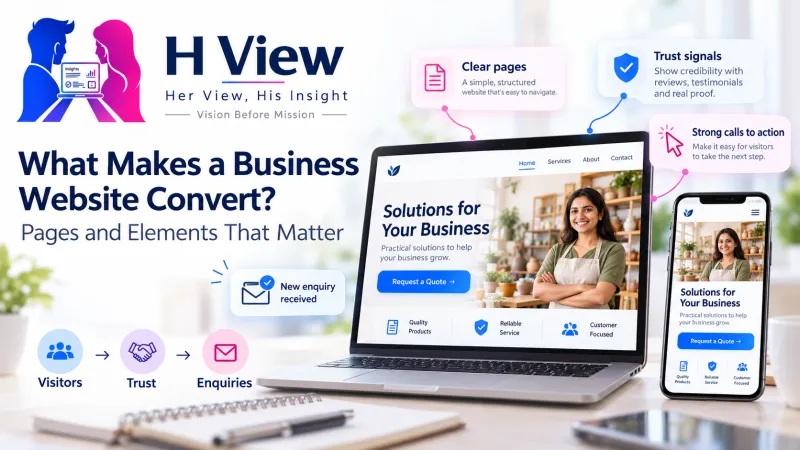
What Makes a Business Website Convert? Pages and Elements That Matter
A business website converts when visitors quickly understand what you offer, trust you and know what to do next. The pages and elements that turn visits into enquiries.
A business website converts when a visitor understands what you offer within seconds, trusts that you are real and reliable, and sees one clear next step such as calling, booking or buying. The right pages, visible contact details, proof from real customers and a fast, simple form matter far more than fancy design.
Conversion simply means a visitor doing what you hoped: sending an enquiry, booking a consultation, placing an order or tapping the WhatsApp button. Many Indian small businesses have a website that looks fine yet brings almost no enquiries. Usually the problem is not traffic. It is that the site does not answer the visitor's questions or make the next step easy.
What does "conversion" mean for a business website?
A conversion is any action that moves a visitor closer to becoming a customer. For a clinic it is an appointment request. For a coaching centre it is a demo class booking. For a boutique it is an order or a message asking about sizes. Before you change anything on your business website, decide which one or two actions matter most, because every page should point towards them.
How visitors become enquiries
People drop off at each stage, so fix the stage where most of them leave.
This mirrors the wider marketing journey we covered in the digital marketing funnel explained. The website is where many of those stages actually happen.
Which pages does every business website need?
You do not need fifty pages. Most small businesses convert well with a handful of focused ones.
What a converting website includes
Not every business needs every page, but each one answers a question buyers ask.
- Home page: says in one line what you do, for whom and where, for example "Physiotherapy clinic in Kondapur for back pain, sports injuries and post-surgery rehab".
- Service pages: one page per main service, so a person searching for "bridal blouse stitching" lands on that exact page, not a general list.
- About page: faces, qualifications and the story behind the business. People buy from people.
- Contact page: phone, email, WhatsApp, address with a map and opening hours.
- Policies: privacy, refunds and delivery terms, especially if you take payments online.
 Also readWordPress, Custom-Built Website or Website Builder: Which Should Your Business Choose?→
Why do trust signals matter so much?
A visitor who has never met you is asking one silent question: "Is this business real and safe?" Research from Nielsen Norman Group found that hiding contact details makes a company seem evasive, while a visible phone number signals that the business is willing to be reached. Their guidelines recommend at least a phone number and an email address, and a contact form of only three to five fields.
Trust matters even more when money changes hands online. Baymard Institute, which studies checkout usability, puts the average documented cart abandonment rate at about 70 percent across 50 studies. Among US shoppers who abandoned for reasons other than just browsing, many named fixable problems.
Why online shoppers abandon checkout
Source: Baymard Institute cart abandonment research. Reason percentages are from US shoppers.
The data comes from US shoppers, but the lesson travels well: unclear trust, forced sign-ups and long forms lose customers everywhere. Useful trust signals for an Indian business include:
- Real Google reviews, ideally linked to your Google Business Profile
- Photos of your actual shop, clinic, team or work, not stock images
- Your GST number, registration or certifications where relevant
- A secure padlock (HTTPS) and clear refund and delivery policies
- Logos of clients or institutions you have worked with, if you have permission
How do you write a call to action that people click?
A call to action (CTA) is the button or link that tells visitors what to do next. Weak sites have none, or have ten competing ones. Strong sites have one main action per page, repeated where it makes sense.
Weak vs strong calls to action
Weak
- "Submit"
- Hidden at the bottom of a long page
- A form with ten required fields
- Several buttons fighting for attention
Strong
- "Book a free demo class"
- Visible near the top and again at the end
- Name, phone and one question
- One main action, one backup like WhatsApp
Tell people exactly what happens when they click.
For many Indian customers, a tap-to-call or WhatsApp button converts better than a form, because it feels personal and immediate. Offer both and see which brings more real enquiries.
How do you find out where your website is losing visitors?
Guessing wastes time. Use free tools to see what is actually happening:
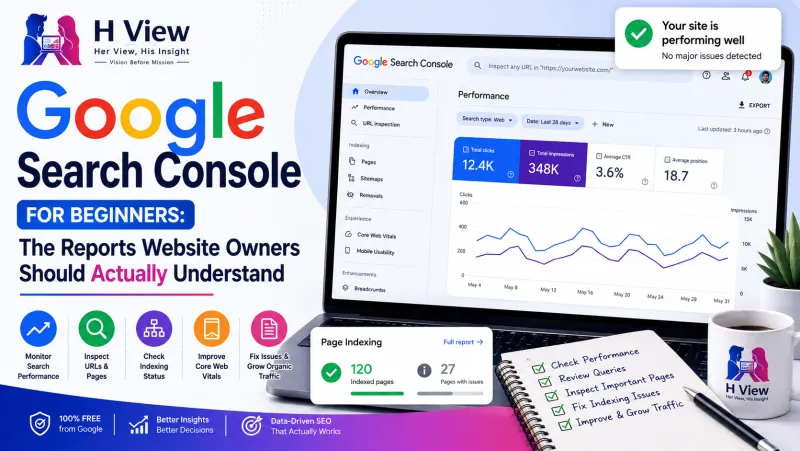
- Check Google Search Console to see which searches bring people to which pages.
- Use an analytics tool to see which pages people leave from most often.
- Count enquiries by source: ask every new customer how they found you.
- Open your own site on a basic phone using mobile data and try to contact yourself. Time how long it takes.
- Ask two customers to use the site while you watch silently. Note where they hesitate.
Quick conversion checklist
- One-line promise at the top of the home page
- Phone and WhatsApp visible on every page
- One main call to action per page
- Contact form with five fields or fewer
- Real photos and real customer reviews
- Prices or starting prices where possible
- Site loads and works well on a phone
Her View
Behind every enquiry is a person who is a little unsure. A mother searching for a tuition centre wants to know her child will be safe and cared for. A first-time patient wants to know the doctor will listen. Your business website is often the first conversation you have with them. Warm words, real faces and honest answers to their worries convert better than any clever slogan, because they make people feel seen.
 Also readDomain, Hosting and DNS Explained for Business Owners→
His Insight
Treat your website like a shop counter. Measure it. If 500 people visit in a month and 5 enquire, your conversion rate is 1 percent. Doubling that to 2 percent gives you as many extra leads as doubling your traffic, and it is usually cheaper. Fix the biggest leak first: unclear headline, hidden contact details or a long form. Change one thing at a time so you know what worked.
H View Verdict
A business website converts when it is clear, trustworthy and easy to act on. Focus on a handful of strong pages, visible contact details, real proof and one clear call to action per page. Measure enquiries, fix the biggest drop-off and repeat.
Want this done for your business?
If your website gets visitors but few enquiries, the H View team can review it and rebuild the pages that matter. H View studies how your business works today and builds the right digital platform for it, from search visibility to turning manual work into automated systems.
- Website SEO
- GEO and AI search visibility
- Websites and apps
- CRM and ERP
- Management portals
- Automation and digitisation
Frequently Asked Questions
What is a good conversion rate for a small business website?
It varies widely by industry, price and traffic source, so there is no single number to aim for. The most useful benchmark is your own past performance. Track your rate every month and work to improve it step by step.
Should I show prices on my business website?
Showing prices or starting prices usually helps, because it filters out people who cannot afford you and reassures those who can. If your work is custom, give typical ranges or packages. Hidden pricing often makes people leave to check a competitor.
Is a WhatsApp button better than a contact form?
For many Indian customers a WhatsApp button feels quicker and more personal. A form is still useful for detailed requests and for people who prefer email. Offering both and tracking which brings more genuine enquiries is the safest approach.
How many pages should a small business website have?
Most small businesses do well with a home page, one page per main service, an about page, a contact page and policies. Add FAQs and reviews as you grow. Quality and clarity matter more than page count.
Do stock photos hurt conversions?
Stock photos are not harmful in themselves, but they do little to build trust. Real photos of your team, premises and work show visitors that you are a genuine business. Even good phone photos usually work better than generic images.
H View stories follow our editorial policy. Spotted an error? Tell us and we will correct it.
Rate this article
One tap is enough. No comment needed.
Was this article helpful?
Your answer goes straight to our editors.





Comments0
No comments yet. Start the conversation.