
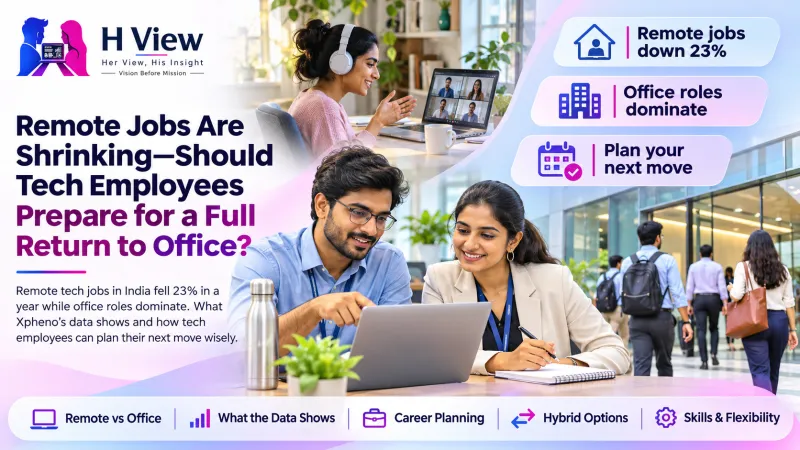
Remote Jobs Are Shrinking—Should Tech Employees Prepare for a Full Return to Office?
Tech hiring is recovering, but mostly inside office walls. Here is what the latest data says about remote and hybrid roles, and how to plan if you value flexibility.
Short answer: Yes, tech employees should plan for more office time. Remote jobs are a shrinking slice of India's tech market: Xpheno counted about 10,000 remote tech openings in October 2026, down 23% from a year earlier, while full-time work-from-office roles dominate. Fully remote work isn't disappearing, but it is becoming harder to find and more competitive.
Last reviewed: 6 November 2026.
During the pandemic, "remote-first" became a badge many tech companies wore proudly. Five years on, the badge is quietly coming off. If you built your life around working from home, perhaps by moving back to your hometown or arranging childcare around a laptop, the latest hiring data deserves a careful look before your next job switch.
What the latest tech hiring data shows
| Month (2026) | What Xpheno reported |
|---|---|
| June | Active tech openings fell to 93,000, a 28-month low; 70% were full-time work-from-office roles; hybrid openings fell 26% year-on-year |
| July | Openings rebounded 14% to 106,000; full-time remote roles fell 21% month-on-month and year-on-year |
| October | Openings rose to 123,000, the highest in 18 months; remote openings fell to about 10,000, down 9% from September and 23% from a year earlier |
Xpheno also posted in October that full-time work-from-office jobs made up 81% of all active tech openings in India. In short, the tech job market is recovering, but almost all of that recovery is happening in offices.
One caution: these numbers count active job openings, not people actually hired, and they cover tech roles only. They describe where demand is heading, not what every company will do.
Why companies are pulling people back
Collaboration and training
Many employers argue that freshers and mid-level staff learn faster when they sit near experienced colleagues. With entry-level hiring under pressure this year, companies want the juniors they do hire to ramp up quickly.
Global capability centres are growing
Tech roles in global capability centres (GCCs) have been one of the strongest growth areas. These centres often follow their parent company's office policy, which increasingly means fixed in-office days.
Security and control
After a year of high-profile security incidents, some firms prefer sensitive work to happen on managed networks in managed buildings.
 Also readRemote Jobs Abroad: How Indian Developers Can Find Genuine International Contracts→
Should you prepare for a full return to office?
Prepare for it, without assuming it. The realistic picture for most tech professionals in 2026 is a spectrum:
- Full office: now the default for most new openings, especially in IT services and many GCCs.
- Hybrid: still common for existing employees and senior roles, though new hybrid openings have shrunk.
- Fully remote: still available, mainly in startups, specialised roles and international contracts, but competition is intense.
A practical plan if you value flexibility
- Know your non-negotiables. Is it fully remote, or is two to three office days a week acceptable? Being clear saves months of wasted applications.
- Negotiate flexibility before you sign, not after. Get the work arrangement in the offer letter or written email.
- Look at tier-2 and tier-3 cities. Hiring outside the big metros has been growing, and an office job near home can beat a remote job that may change later.
- Build skills remote employers can't easily find locally. Specialists have more bargaining power to work remotely than generalists.
- Consider international contracts carefully. Our guide to finding genuine remote jobs abroad explains how to avoid fake offers and handle payments legally.
Her View
Remote work quietly made it possible for many women, caregivers and people with disabilities to stay in tech careers. As offices return, those are the employees who risk being pushed out first. If flexibility is what keeps you working, say so clearly in interviews, and look for companies that publish their hybrid policy rather than ones that promise it vaguely.
 Also readAI Skills Are Changing Salaries—Will Employees Without AI Skills Start Earning Less?→
His Insight
Think of office attendance as part of the salary package. A role that requires five days in the office with a long commute is effectively paying less, in time and money, than a hybrid role with the same CTC. Compare offers on total cost of working, not just the number on the letter.
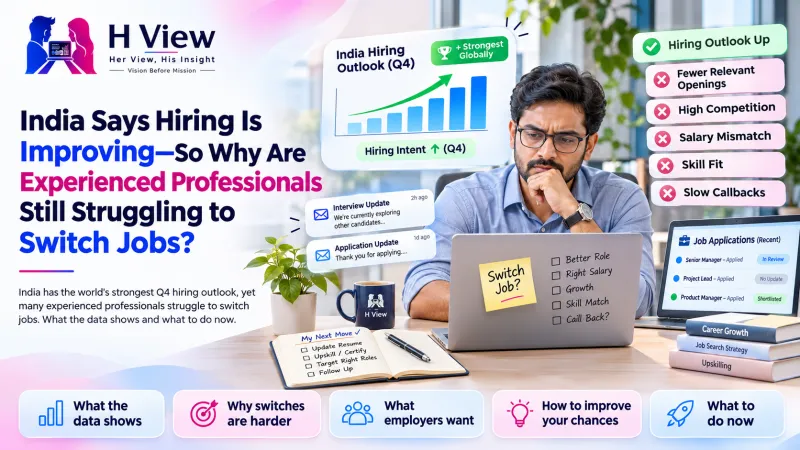
Related reading: why job switches feel harder despite strong hiring, what GCC employers look for and salary negotiation in India.
Frequently asked questions
Are remote jobs disappearing in India?
Not disappearing, but shrinking. Xpheno counted about 10,000 remote tech openings in October 2026, down 23% year-on-year, while office roles made up most new demand.
Is hybrid work still common?
Many existing employees still work hybrid, but new hybrid openings have fallen sharply in 2026. Check the policy for each role rather than assuming.
Can I negotiate remote work in a job offer?
Yes, especially if you have specialised skills. Ask early, and make sure the agreed arrangement is written into your offer or confirmed by email.
Which roles are most likely to stay remote?
Specialised engineering, data and security roles, startup positions and international contracts tend to offer more remote options than large IT services projects.
Sources
H View stories follow our editorial policy. Spotted an error? Tell us and we will correct it.
Rate this article
One tap is enough. No comment needed.
Was this article helpful?
Your answer goes straight to our editors.










Comments0
No comments yet. Start the conversation.