
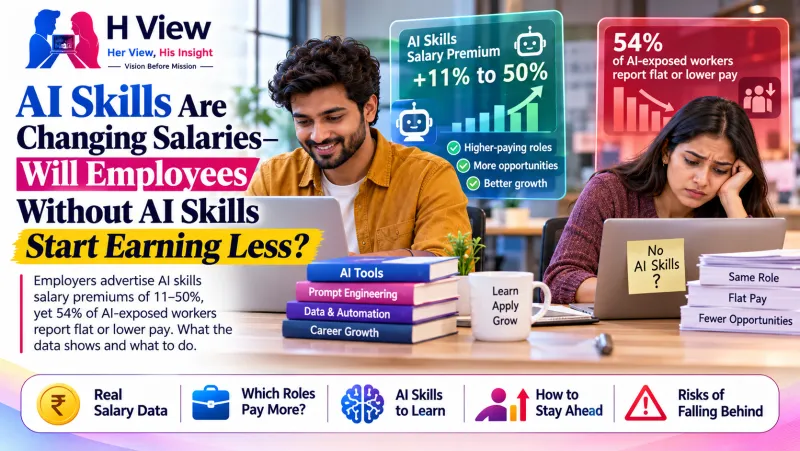
AI Skills Are Changing Salaries—Will Employees Without AI Skills Start Earning Less?
Companies say they pay more for AI skills, but most workers haven't felt it. Here is what the 2026 data shows, who is really benefiting, and practical steps to stay valuable.
Short answer: Not automatically, but the AI skills salary gap is real and growing. In Indeed's 2026 India survey, 66% of employers said they pay substantial premiums for AI-skilled roles, while 54% of AI-exposed workers said their pay stayed flat or fell. The premium mostly goes to people who can show AI skills, not to everyone who simply uses AI.
Last reviewed: 5 November 2026.
Your manager mentions "AI" in every meeting. Job posts list it under "must have". Your cousin in Bengaluru says she got a hike after moving into an "AI role". Meanwhile, your own appraisal letter looks a lot like last year's. If you're wondering whether the people around you are pulling ahead while you stand still, the data suggests the worry isn't imagined, but the picture is more nuanced than "learn AI or be left behind".
What the 2026 data says about AI and pay
| Finding | Source |
|---|---|
| 66% of employers say they offer substantial salary premiums for AI-skilled roles | Indeed AI at Work Tracker 2026 |
| Over 40% say AI roles command an 11–30% premium; 26% report 31–50% | Indeed AI at Work Tracker 2026 |
| 54% of AI-exposed workers say their pay stagnated or fell in the past year | Indeed AI at Work Tracker 2026 |
| AI skills appear in 15.4% of tech job descriptions, up from 0.9% in 2020 | Naukri World AI Day Report 2026 |
| 77% of Indian professionals use AI at work | Naukri World AI Day Report 2026 |
| Established use of AI productivity tools rose to 56% of organisations in 2026, from 46.1% | Aon Salary Increase and Turnover Survey 2026-27 |
The Indeed study surveyed 1,267 employers and 2,541 employees across India. Its central finding is a split: companies are willing to pay extra to hire AI talent from outside, but many are not raising pay for existing staff whose jobs are already being changed by AI.
Why most workers haven't felt the AI premium
Using AI isn't the same as having AI skills
Asking a chatbot to draft an email is now normal; Naukri found 77% of professionals use AI at work. Because it is so common, it no longer stands out. The premium goes to skills that are still scarce: building AI workflows, evaluating outputs, working with data, or redesigning a process around AI tools.
Premiums are paid at the point of hiring
Salary jumps usually happen when people change jobs, and companies are using premiums to attract specific talent. Annual increments for existing employees are set from a broader budget; Aon projects an average 9.1% hike for 2027, and some employers are finding AI productivity gains without paying more for them.
Productivity gains are being absorbed, not shared
When work gets faster because of AI, some managers simply raise targets. We explored that tension in should management raise targets when AI speeds up work? Unless employees can show the value they created, the gain often disappears into the organisation.
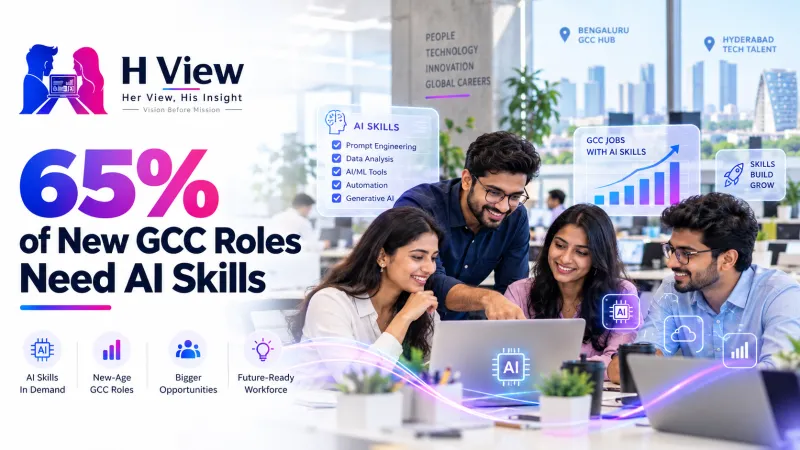 Also read65% of New GCC Roles Reportedly Need AI Skills: What Should Indian Jobseekers Learn?→
So, will people without AI skills earn less?
In absolute terms, most won't see a pay cut because of AI. The more likely risk is relative: slower increments, fewer promotions and weaker bargaining power compared with colleagues who can show AI-enabled results. Over a few years, that gap compounds. Indeed also found that 40% of employers now prioritise demonstrable AI skills and certifications over formal degrees, which means proof of skill is becoming a currency of its own.
Five practical steps to protect your earning power
- Pick one AI use in your actual job. Not a generic course; one task you do every week that AI could make faster or better.
- Measure the result. Hours saved, errors reduced, turnaround time improved. Numbers turn "I use AI" into "I created value".
- Learn to check AI's work. Judgement is the scarce skill. Our guide on whether to trust an AI answer covers simple checks.
- Add proof to your profile. A short project description, a certification or a portfolio sample on LinkedIn helps recruiters notice you.
- Bring it to your appraisal. Present AI-driven improvements as outcomes, then use our salary negotiation guide when you ask for more.
Her View
Many people quietly avoid AI because they fear looking foolish or worry it will replace them. Start small and private: use it for one task, check every result, and note what worked. Confidence comes from repetition, not from a big certificate. The goal isn't to become an AI expert overnight; it is to become the person who knows how to use it well in your own job.
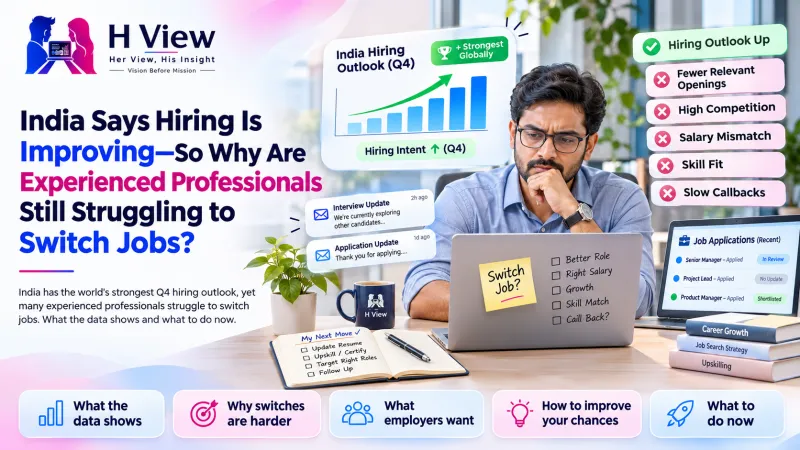 Also readIndia Says Hiring Is Improving—So Why Are Experienced Professionals Still Struggling to Switch Jobs?→
His Insight
The salary premium for AI skills will probably shrink as the skills become common, just as basic computer skills once commanded extra pay and then became expected. The lasting advantage will belong to people who combine domain knowledge with AI: an accountant who automates reconciliation, a marketer who runs faster experiments. That combination is harder to copy than either half alone.
Related reading: AI skills for GCC jobs, why job switches feel harder despite strong hiring and signs your career is stagnating.
Frequently asked questions
How much more do AI-skilled roles pay in India?
In Indeed's 2026 survey, over 40% of employers said AI roles carry an 11–30% premium over non-AI roles, and 26% reported premiums of 31–50%.
Do I need to learn coding to get an AI salary premium?
Not always. Many valuable AI skills involve using tools well, designing workflows and checking outputs within your own field. Technical roles naturally command the highest premiums.
Will AI reduce salaries for non-AI jobs?
Widespread pay cuts aren't evident in the data. The bigger risk is slower growth relative to colleagues who can show AI-enabled results.
Which AI certification should I get?
Choose one tied to the tools your industry actually uses, and pair it with a real project. A certificate without applied work carries less weight.
Sources
H View stories follow our editorial policy. Spotted an error? Tell us and we will correct it.
Rate this article
One tap is enough. No comment needed.
Was this article helpful?
Your answer goes straight to our editors.




Comments0
No comments yet. Start the conversation.