
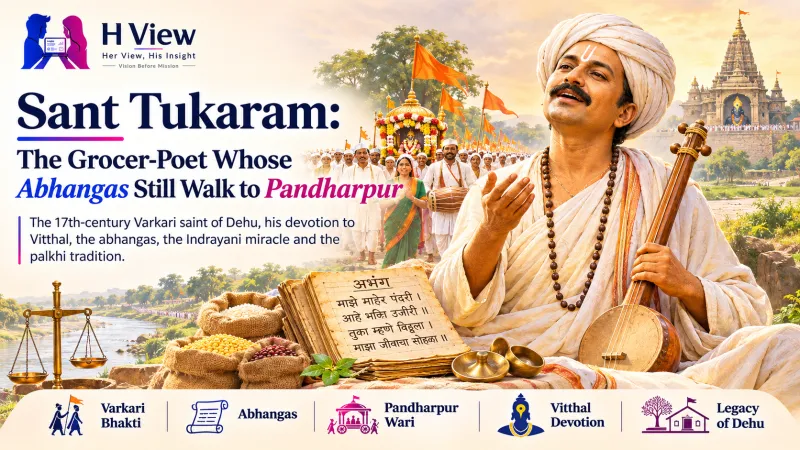
Sant Tukaram: The Grocer-Poet Whose Abhangas Still Walk to Pandharpur
A bankrupt grocer who lost his family to famine turned his grief into poems to Vitthal. Four centuries on, lakhs of pilgrims sing them on the road to Pandharpur.
Sant Tukaram was a seventeenth-century Marathi poet-saint from Dehu, near Pune, and a central figure of the Varkari bhakti tradition devoted to Lord Vitthal of Pandharpur. A grocer by trade, he wrote thousands of devotional poems called abhangas in everyday Marathi. His palkhi still leads lakhs of pilgrims to Pandharpur every year.
At a glance
| Home | Dehu, on the Indrayani river, near Pune, Maharashtra |
| Period | c. 1608–1650 (scholars give slightly different dates) |
| Deity | Vitthal (Vithoba) of Pandharpur, a form of Krishna |
| Tradition | Varkari sampradaya |
| Work | Tukaram Gatha, a collection of abhangas |
| Remembered on | Tukaram Beej (Phalgun Vadya Dwitiya), the day of his departure |
Who was Sant Tukaram?
He was born into a family of small traders in Dehu who ran a grocery and moneylending business and were hereditary devotees of Vitthal. By the standards of his time, he was not a scholar or a priest, and he wrote in the language of ordinary people. That is exactly why his poetry travelled. He spoke of God the way a villager speaks of a close friend or a parent, with love, complaint and humour.
How did hardship shape his devotion?
In his early twenties, a severe famine struck the Deccan (around 1630–31). Tukaram lost his first wife and a son, his business collapsed, and he gave away what was left of his money, including the loan papers of people who owed him. He withdrew to the hills near Dehu, especially Bhandara hill, to pray and reflect. Out of that grief came a deeper devotion and the first of his abhangas.
 Also readParamahansa Yogananda: The Yogi Who Brought Kriya Yoga to the West→
What are abhangas?
An abhang is a devotional poem in a simple metre meant to be sung, often in groups, to the beat of cymbals (taal) and the mridang. Tukaram’s abhangas cover:
- Love for Vitthal, often addressing him as mother or companion.
- Criticism of hypocrisy, empty ritual and caste pride.
- Moral advice for daily life: honesty, compassion and humility.
- Personal confession of doubt and longing.
His line that God is found among those who suffer, and that the true saint is one who embraces the downtrodden, is still quoted across Maharashtra.
What is the story of the manuscripts in the Indrayani?
According to tradition, some orthodox Brahmins objected to a non-Brahmin writing on spiritual matters in Marathi. Under pressure, Tukaram sank his notebooks in the Indrayani river and sat fasting on its bank. After thirteen days, devotees say, the manuscripts rose to the surface undamaged. Whether one reads this as a miracle or as a story of how his poems survived in the memory of people who sang them, it captures how deeply they were loved.
c. 1608 — Born at Dehu (date debated).
c. 1630–31 — Famine; loss of family and business.
1630s–40s — Composes abhangas; kirtans at Dehu; followers gather, including the poet Bahinabai.
Tradition — Manuscripts sunk in and recovered from the Indrayani.
c. 1650 — Departs; Varkaris believe he ascended to Vaikuntha.
1685 — His son Narayan Maharaj is credited with starting the palkhi tradition from Dehu.
What is the Pandharpur Wari?
Every year, in the monsoon month of Ashadh, Varkaris walk for about three weeks to Pandharpur to reach the Vitthal temple by Ashadhi Ekadashi. Two great palkhis lead the walk: Sant Tukaram’s from Dehu and Sant Dnyaneshwar’s from Alandi. Pilgrims walk in groups called dindis, singing abhangas the whole way.
| Aspect | Details |
|---|---|
| Start | Dehu (Tukaram palkhi), Alandi (Dnyaneshwar palkhi) |
| Destination | Vitthal-Rukmini temple, Pandharpur |
| Distance | Roughly 250 km on foot |
| Season | June–July, ending on Ashadhi Ekadashi |
| Ritual highlights | Ringan (circular horse run), dindi singing |
 Also readLahiri Mahasaya: The Householder Yogi Who Revived Kriya Yoga→
How can you visit Tukaram’s places?
- Dehu: the Sant Tukaram temple and Gatha Mandir on the Indrayani, about 30 km from Pune.
- Bhandara hill: where he meditated, near Dehu.
- Pandharpur: the Vitthal temple, best outside peak wari days if you want quiet darshan.
- Join a stage of the wari for a day; many dindis welcome first-timers.
Her View: His poems are full of tenderness: God as a mother who waits for her child. That warmth is why grandmothers still hum them.
His Insight: Tukaram democratised spirituality. A bankrupt trader writing in everyday language challenged religious gatekeepers and won, through song.
Frequently asked questions
Where was Sant Tukaram born?
At Dehu, on the Indrayani river near Pune, Maharashtra.
What is the Tukaram Gatha?
The collected abhangas attributed to Tukaram, numbering in the thousands, preserved and sung by the Varkari tradition.
Which god did Tukaram worship?
Vitthal, also called Vithoba, of Pandharpur, regarded as a form of Krishna.
What is Tukaram Beej?
The day, in the month of Phalgun, when Varkaris remember his departure from the world.
Sources and how this article was researched
This is a desk-research article. The Indrayani story is presented as tradition; dates follow mainstream scholarship.
Part of H View’s Devotion & Heritage series. Previously: Paramahansa Yogananda. Next: Mirabai.
H View stories follow our editorial policy. Spotted an error? Tell us and we will correct it.
Rate this article
One tap is enough. No comment needed.
Was this article helpful?
Your answer goes straight to our editors.











Comments0
No comments yet. Start the conversation.