
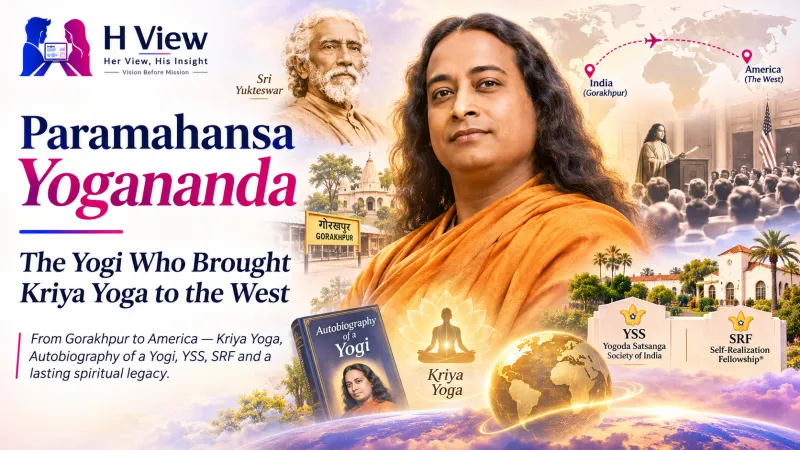
Paramahansa Yogananda: The Yogi Who Brought Kriya Yoga to the West
In 1920, a young Bengali monk sailed to Boston with little money and a big mission. His book later became a spiritual classic. The story of Paramahansa Yogananda.
Paramahansa Yogananda (1893–1952) was an Indian monk who brought Kriya Yoga meditation to the West. Born Mukunda Lal Ghosh in Gorakhpur, he trained under Sri Yukteswar, moved to the United States in 1920, founded Yogoda Satsanga Society of India and Self-Realization Fellowship, and wrote Autobiography of a Yogi (1946), one of the most widely read spiritual books.
At a glance
| Birth name | Mukunda Lal Ghosh |
| Born | 5 January 1893, Gorakhpur (now Uttar Pradesh) |
| Guru | Swami Sri Yukteswar Giri, disciple of Lahiri Mahasaya |
| Organisations | Yogoda Satsanga Society of India (1917); Self-Realization Fellowship (1920) |
| Famous book | Autobiography of a Yogi, 1946 |
| Died | 7 March 1952, Los Angeles |
Who was Paramahansa Yogananda?
He was a spiritually intense boy from a Bengali family whose parents were disciples of Lahiri Mahasaya. As a teenager, he kept running away towards the Himalayas in search of a teacher. He found one in 1910 in Varanasi: Sri Yukteswar, a strict, clear-minded master who ran an ashram at Serampore near Kolkata. Yogananda trained under him for about ten years, while also completing a degree from Calcutta University in 1915. That year he took monastic vows in the Swami order and became Swami Yogananda.
Why did he go to America?
In 1917, he started a school for boys at Ranchi combining modern education with yoga, the beginning of Yogoda Satsanga Society of India. In 1920, he was invited as India’s delegate to the International Congress of Religious Liberals in Boston. He sailed that year and stayed in America for most of the rest of his life, teaching meditation in lecture tours that filled large halls across the country. In 1925, he set up the Self-Realization Fellowship headquarters at Mount Washington in Los Angeles.
1893 — Born in Gorakhpur.
1910 — Meets Sri Yukteswar.
1915 — Takes sannyasa; becomes Swami Yogananda.
1917 — Founds a school at Ranchi; YSS begins.
1920 — Speaks in Boston; founds Self-Realization Fellowship.
1925 — Mount Washington headquarters in Los Angeles.
1935–36 — Returns to India; meets Gandhi and Anandamayi Ma; receives title Paramahansa from his guru.
1946 — Autobiography of a Yogi published.
1952 — Dies in Los Angeles on 7 March.
 Also readLahiri Mahasaya: The Householder Yogi Who Revived Kriya Yoga→
What is Autobiography of a Yogi about?
The book tells his life story and, through it, introduces the lineage of Mahavatar Babaji, Lahiri Mahasaya and Sri Yukteswar, along with saints he met, including Anandamayi Ma. It mixes spiritual teaching, Indian life of the early twentieth century and accounts of miracles. It has been translated into dozens of languages and is still in print, with many readers in India and abroad saying it changed their lives.
What did Yogananda teach?
| Teaching | In practice |
|---|---|
| Kriya Yoga | A meditation technique given after preliminary lessons and initiation |
| Self-realisation | Direct personal experience of God through meditation |
| Unity of Christ and Krishna | He presented the teachings of Jesus and the Bhagavad Gita as one truth |
| Balanced living | Meditation with work, service and healthy habits |
| Lessons by post | Home-study lessons, still offered by YSS and SRF |
What happened at the end of his life?
On 7 March 1952, Yogananda spoke at a dinner in Los Angeles for India’s ambassador, Binay Ranjan Sen, and died shortly after finishing his speech. Self-Realization Fellowship describes this as his mahasamadhi. In 1977, India Post issued a commemorative stamp in his honour.
 Also readAnandamayi Ma: The Joy-Permeated Mother Who Walked Across India→
Where can you connect with his legacy in India?
- YSS Ranchi ashram — the first centre, founded 1917–18.
- YSS Dakshineswar ashram — on the Ganga near Kolkata.
- Serampore — site of Sri Yukteswar’s ashram, where he trained.
- Gorakhpur — his birthplace.
Her View: His book is the reason many people first heard of Indian saints like Lahiri Mahasaya and Anandamayi Ma. He was a storyteller as much as a teacher.
His Insight: He offered meditation lessons by post in the 1920s. That was distance learning, decades before online courses.
Frequently asked questions
Who was Paramahansa Yogananda’s guru?
Swami Sri Yukteswar Giri of Serampore, a disciple of Lahiri Mahasaya.
When was Autobiography of a Yogi published?
In 1946. It remains in print and has been translated into many languages.
What is the difference between YSS and SRF?
Both were founded by Yogananda. YSS (1917) serves India and neighbouring countries; SRF (1920) serves the rest of the world.
When did Yogananda die?
On 7 March 1952 in Los Angeles, shortly after giving a speech.
Sources and how this article was researched
This is a desk-research article based on the sources below.
Part of H View’s Devotion & Heritage series. Previously: Lahiri Mahasaya. Next: Sant Tukaram.
H View stories follow our editorial policy. Spotted an error? Tell us and we will correct it.
Rate this article
One tap is enough. No comment needed.
Was this article helpful?
Your answer goes straight to our editors.







Comments0
No comments yet. Start the conversation.