
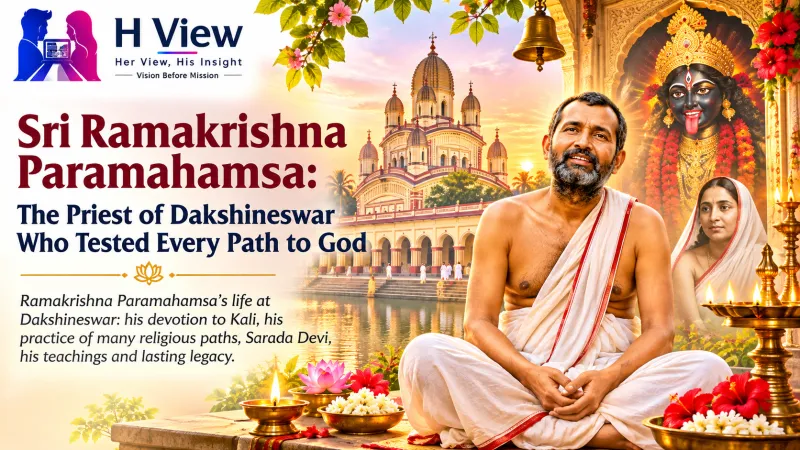
Sri Ramakrishna Paramahamsa: The Priest of Dakshineswar Who Tested Every Path to God
A village boy with little schooling became a temple priest near Kolkata, then spent years practising one spiritual path after another. His conclusion still shapes Indian thought.
Sri Ramakrishna Paramahamsa (1836–1886) was a Bengali mystic and priest at the Dakshineswar Kali temple near Kolkata. After intense devotion to the Divine Mother, he practised Tantra, Advaita Vedanta, Islam and Christianity and concluded that all sincere paths lead to the same God. His disciple Swami Vivekananda carried that message worldwide.
At a glance
| Birth name | Gadadhar Chattopadhyay |
| Born | 18 February 1836, Kamarpukur, Bengal |
| Temple | Dakshineswar Kali temple, founded by Rani Rashmoni in 1855 |
| Spouse | Sarada Devi, later revered as the Holy Mother |
| Key text | Sri Sri Ramakrishna Kathamrita by Mahendranath Gupta (“M”) |
| Died | 16 August 1886, Cossipore, Kolkata |
Who was Sri Ramakrishna?
He was a village boy from a poor Brahmin family who disliked formal schooling but loved songs, stories and the countryside. As a child he fell into ecstasies at the sight of dark clouds and flying cranes, or while playing Shiva in a village drama. That sensitivity to the sacred defined his life. He never wrote a book; what we know comes from disciples who recorded his conversations, especially “M”, whose diaries became the Kathamrita, known in English as The Gospel of Sri Ramakrishna.
What happened at the Dakshineswar Kali temple?
In 1855, the wealthy widow Rani Rashmoni opened a large temple to Goddess Kali on the Ganga at Dakshineswar. Gadadhar’s elder brother became its priest, and Gadadhar soon took over. Worship was not a duty for him; he wanted to see the Mother. He wept, prayed and refused food until, by his own account, he had an overwhelming vision of Kali as an ocean of light. Some temple staff thought he had lost his mind. Rani Rashmoni and her son-in-law Mathur Babu protected him.
 Also readSwami Vivekananda: The Monk Who Carried India’s Voice to the World→
Why did he practise so many different paths?
Having reached God through devotion, he wanted to test whether other paths led to the same place. Over about twelve years, he practised each with complete seriousness.
| Path | Teacher or approach | Approx. period |
|---|---|---|
| Devotion to Kali | Self-driven worship | From 1856 |
| Tantra | Bhairavi Brahmani, a woman adept | 1861–1863 |
| Vaishnava bhakti | Devotion to Rama and Krishna in various moods | 1860s |
| Advaita Vedanta | The monk Totapuri; nirvikalpa samadhi | c. 1865 |
| Islam | Under a Sufi, Govinda Rai | c. 1866 |
| Christianity | Reflection on Christ | c. 1874 |
His conclusion was simple and became famous: as many faiths, so many paths (jato mat, tato path).
Who was Sarada Devi in his life?
Ramakrishna married Saradamani Mukhopadhyay in 1859, when she was a child, following custom. When she came to Dakshineswar as a young woman, their relationship remained spiritual rather than conjugal. In 1872, he worshipped her ritually as the Divine Mother. After his death, Sarada Devi guided his disciples for decades and is revered today as the Holy Mother.
What did Ramakrishna teach?
- God can be realised in this life, through sincere longing.
- God has form and is formless; both views are true at different levels.
- Lust and greed (kamini-kanchan) are the main obstacles for seekers.
- Serve people as God, not out of pity.
- Do your duties in the world, holding God like a maid holds a master’s child: with care, but knowing it is not yours.
He taught through parables and everyday images, such as the lake with many ghats where people draw the same water under different names.
1836 — Born at Kamarpukur.
1855–56 — Joins Dakshineswar temple; becomes priest.
1859 — Marriage to Sarada Devi.
1861–1874 — Practises Tantra, Vedanta, Islam and Christianity.
1879–1885 — Young disciples, including Narendranath (Vivekananda), gather.
1886 — Dies of throat cancer at Cossipore on 16 August.
 Also readRamana Maharshi: The Silent Sage of Arunachala and the Question “Who Am I?”→
How can you visit the places of his life?
- Dakshineswar Kali temple — his room, preserved, faces the Ganga.
- Belur Math — across the river; reachable by ferry from Dakshineswar.
- Cossipore Udyanbati — the garden house where he spent his last months.
- Kamarpukur — his birthplace in Hooghly district, with a Ramakrishna Math centre.
Her View: Ramakrishna worshipped God as Mother and his own wife as the Goddess. Few saints placed the feminine so close to the centre of their spiritual life.
His Insight: He did not argue that religions are equal; he tested it personally, path by path. That is experimental spirituality.
Frequently asked questions
What is Ramakrishna famous for?
For his intense devotion to Kali and his teaching, drawn from practising many religions, that all sincere paths lead to the same God.
Who was Ramakrishna’s most famous disciple?
Swami Vivekananda, who founded the Ramakrishna Mission in his name in 1897.
What is the Gospel of Sri Ramakrishna?
An English translation of the Kathamrita, Mahendranath Gupta’s record of Ramakrishna’s conversations from 1882 to 1886.
When did Ramakrishna die?
He died at Cossipore, Kolkata, on 16 August 1886, aged 50.
Sources and how this article was researched
This is a desk-research article based on the sources below.
- Ramakrishna Math and Ramakrishna Mission, Belur Math
- Wikipedia: Ramakrishna
- Mahendranath Gupta, The Gospel of Sri Ramakrishna, trans. Swami Nikhilananda
Part of H View’s Devotion & Heritage series. Previously: Swami Vivekananda. Next: Anandamayi Ma.
H View stories follow our editorial policy. Spotted an error? Tell us and we will correct it.
Rate this article
One tap is enough. No comment needed.
Was this article helpful?
Your answer goes straight to our editors.








Comments0
No comments yet. Start the conversation.