
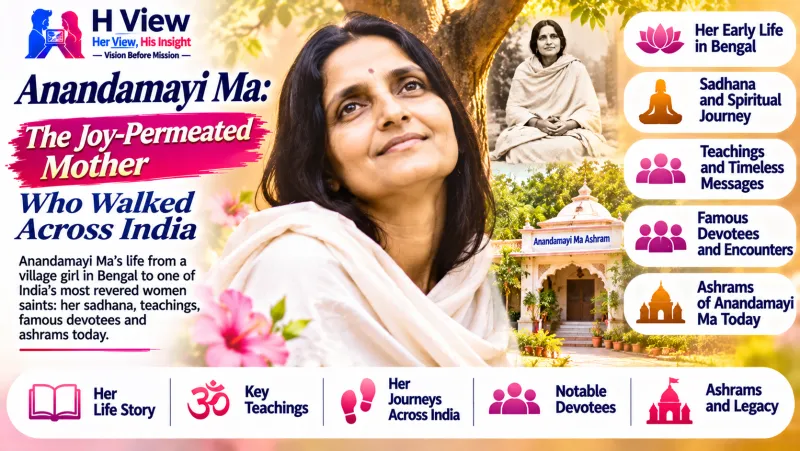
Anandamayi Ma: The Joy-Permeated Mother Who Walked Across India
She had no guru, wrote no books and called herself “this body”. Yet prime ministers, scholars and villagers sought her out. The story of Anandamayi Ma.
Anandamayi Ma (1896–1982) was a Bengali saint, born Nirmala Sundari in present-day Bangladesh, who became one of the most revered spiritual figures of twentieth-century India. Without a formal guru, she lived in a state devotees described as constant bliss, travelled ceaselessly and taught that the highest duty of every person is to seek God.
At a glance
| Birth name | Nirmala Sundari |
| Born | 30 April 1896, Kheora, Tripura district, Bengal (now in Brahmanbaria, Bangladesh) |
| Husband | Ramani Mohan Chakrabarti, known as Bholanath |
| Name “Anandamayi” | “Joy-permeated”, given by devotees in Dhaka in the 1920s |
| Died | 27 August 1982, Dehradun |
| Samadhi | Kankhal ashram, Haridwar |
Who was Anandamayi Ma?
She was a village girl with barely two years of schooling who grew into a spiritual teacher consulted by scholars, politicians and monks. She almost never spoke of herself as “I”. Instead, she said “this body”, a habit that captured her detachment from personal identity. Paramahansa Yogananda, who met her, devoted a chapter of Autobiography of a Yogi to her, calling her the “Joy-Permeated Mother”.
How did her spiritual life begin?
She was married at about twelve, in 1909, as was common then, and went to live with her husband’s family some years later. Bholanath accepted, over time, that his wife’s life was not an ordinary one. In her twenties, at Bajitpur, she went through years of intense, self-directed sadhana, performing rites spontaneously, and in 1922 she initiated herself. For long periods she kept silence. Bholanath later took initiation from her, an unusual reversal of roles for the time.
1896 — Born at Kheora, East Bengal.
1909 — Married to Ramani Mohan Chakrabarti.
1918–1924 — Years of intense sadhana at Bajitpur; self-initiation in 1922.
1924–1932 — Dhaka, at the Shahbag garden; devotees gather and call her Anandamayi.
1932 onwards — Leaves Bengal; travels across North India for the rest of her life.
1950 — Shree Shree Anandamayee Sangha registered to manage her ashrams.
1982 — Dies at Dehradun; samadhi at Kankhal, Haridwar.
 Also readSwami Vivekananda: The Monk Who Carried India’s Voice to the World→
What did Anandamayi Ma teach?
Her teaching was spoken, simple and adapted to whoever stood in front of her. She did not ask people to leave their religion or families.
- Seek God first. “To be a human being only means to seek the Supreme” is a line her devotees treasure.
- Every path is valid. She guided followers of many traditions, saying each must follow the path that suits them.
- Set aside time daily. She urged householders to reserve even a short period each day for prayer or meditation.
- Remember God at all times. Repeating the divine name (japa) was her most common practical advice.
- Accept what comes. Joy and sorrow, she said, both come from the same source.
Who were her famous devotees?
| Devotee or visitor | Connection |
|---|---|
| Kamala Nehru | A close devotee from the 1930s |
| Indira Gandhi | Visited her over many years |
| Gopinath Kaviraj | Renowned Sanskrit scholar of Varanasi, a devoted follower |
| Paramahansa Yogananda | Met her and wrote about her in his autobiography |
| Swami Sivananda and others | Contemporary saints who held her in high regard |
Why did she keep travelling?
After leaving Dhaka in 1932, she rarely stayed long anywhere. Her devotees built ashrams for her across India, in Varanasi, Vrindavan, Kankhal, Dehradun, Naimisharanya and elsewhere, yet she moved between them and many other places. She said she went wherever “kheyal”, a spontaneous inner prompting, took her. For devotees, this meant her presence was shared widely rather than held in one centre.
 Also readSri Ramakrishna Paramahamsa: The Priest of Dakshineswar Who Tested Every Path to God→
Where can you visit her ashrams today?
- Kankhal, Haridwar — her samadhi shrine; the most visited of her ashrams.
- Varanasi (Bhadaini) — on the Ganga, with a school and hospital run by the Sangha.
- Dehradun (Kishenpur) — where she spent her final days.
- Kheora, Bangladesh — her birthplace, with a small temple.
Her View: In an age when religious authority was almost entirely male, a woman with no institution behind her became a teacher whom monks and prime ministers sought out. That alone makes her remarkable.
His Insight: She never built a brand around herself; devotees built ashrams, and she kept moving. Her influence spread because she refused to be fixed in one place.
Frequently asked questions
Where was Anandamayi Ma born?
At Kheora, in present-day Brahmanbaria district of Bangladesh, on 30 April 1896.
Did Anandamayi Ma have a guru?
No. She said she needed no outside guru and initiated herself in 1922.
Where is Anandamayi Ma’s samadhi?
At her ashram in Kankhal, Haridwar, Uttarakhand.
What does Anandamayi mean?
It means “permeated with joy” or “bliss-filled”, a name given by her devotees.
Sources and how this article was researched
This is a desk-research article based on the sources below.
- Shree Shree Anandamayee Sangha (official website)
- Wikipedia: Anandamayi Ma
- Paramahansa Yogananda, Autobiography of a Yogi, chapter 45
Part of H View’s Devotion & Heritage series. Previously: Sri Ramakrishna Paramahamsa. Next: Trailanga Swami.
H View stories follow our editorial policy. Spotted an error? Tell us and we will correct it.
Rate this article
One tap is enough. No comment needed.
Was this article helpful?
Your answer goes straight to our editors.








Comments0
No comments yet. Start the conversation.