
Return to Office vs Remote Work: What Research Reveals About Productivity, Retention and India’s IT Jobs
New research shows why return-to-office policies need more than attendance counts. We compare hybrid retention and remote collaboration findings for Indian tech jobs.
Research does not point to one office model for every Indian technology team. A Trip.com hybrid trial found fewer resignations without detectable performance losses, while a Microsoft study found more siloed collaboration after a shift to fully remote work. Expert contributor Dr. Gleb Tsipursky, behavioral scientist and CEO of Disaster Avoidance Experts, shares his perspective below.
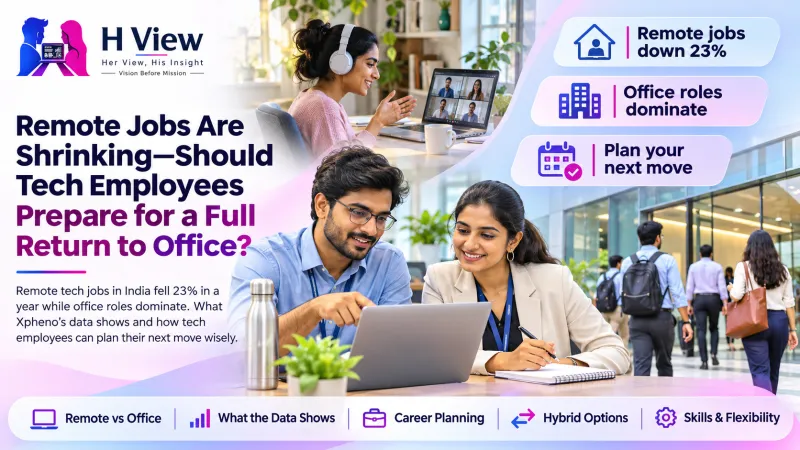
H View recently reported a decline in remote technology vacancies and a rise in office-first roles. That trend affects the options job seekers see, but vacancy data records employer preference; it does not show whether attendance makes a team more effective.
Why fewer remote jobs do not settle the productivity debate
H View’s recent report on remote job listings and return-to-office expectations described a changing hiring market. A vacancy marked “office” or “hybrid” tells candidates what an employer is offering. It does not establish that the arrangement makes a team faster, produces better software or serves customers more effectively.
Hiring data and performance data answer different questions. Employers may need in-person mentoring, client coordination, security or project planning. Those needs can be real, but office days remain a policy choice. Delivery, quality, collaboration and retention measures help show whether a rule works.
What did the 1,612-person hybrid-work experiment find?
A six-month randomized Trip.com trial assigned 1,612 graduate employees in its Airfare and IT divisions either to work from home on Wednesdays and Fridays or to work in the office five days a week. Researchers followed outcomes for up to two years. The paper appeared in Nature in 2024.
In the hybrid group, 4.8% resigned during the trial, compared with 7.2% in the office-only group—a one-third relative reduction. Hybrid employees also reported higher job satisfaction. Researchers found no detectable difference in performance reviews, promotions or participating engineers’ lines of code.
Random assignment is stronger than asking workers to recall how productive they felt. But “no detectable difference” does not prove identical performance in every setting. This was one Chinese travel-technology company, graduate employees and one two-days-at-home schedule. It did not test Indian IT services firms or fully remote work.
Also readRemote Jobs Are Shrinking—Should Tech Employees Prepare for a Full Return to Office?→Why can fully remote work make collaboration harder?
A study of 61,182 Microsoft employees in the United States examined the first six months of 2020, when the company shifted to firm-wide remote work. In Nature Human Behaviour, researchers reported more static, siloed collaboration networks with fewer bridges between groups. Communication also shifted from meetings and calls toward messages and email.
A developer, tester and product manager can finish separate tasks but discover late that each understood a feature differently. A quick conversation might expose the dependency sooner; remote teams may need to schedule or document that exchange. This is a coordination risk, not proof that individuals do less work.
The Microsoft study used communication data during a pandemic-era shift. The pandemic changed more than location, and schedules were not randomly assigned. It examined a broad move to remote work, not a controlled hybrid comparison. It cannot show that five office days are necessary or best.
What the two studies can—and cannot—tell us
| Question | Trip.com experiment | Microsoft analysis |
|---|---|---|
| Design | Randomized six-month trial | Analysis of a pandemic-era shift |
| People studied | 1,612 graduate employees in a Chinese technology company | 61,182 US information workers |
| Work arrangement | Two home days; three office days | Firm-wide remote work |
| Main finding | Fewer resignations; no detectable loss in measured performance | More siloed networks and less synchronous communication |
| Useful conclusion | This hybrid model worked well on measured outcomes at this company | Remote organizations may need to design cross-team connections |
| Not established | That every job or schedule has the same result | That office attendance improves performance or is required |
The studies address different questions: one tested retention and performance under a hybrid schedule; the other examined communication networks during a move to remote work. They are compatible. Both suggest that how teams organize work matters alongside where people sit.
Expert Insight: Dr. Gleb Tsipursky on India’s RTO debate
Behavioral scientist and Disaster Avoidance Experts CEO Dr. Gleb Tsipursky shared this comment directly with H View for this follow-up:
“A fall in remote job listings tells us what employers are demanding, not whether those demands make Indian tech teams more effective. The right test is whether office days improve mentoring, coordination and customer results enough to justify the lost flexibility.”
This is a management framework, not a result from either study. Teams can identify work that benefits from being together—onboarding, mentoring, relationship-building or complex decisions—and test whether those sessions improve results. Focused individual tasks may need a different arrangement.
What should Indian IT employers measure before setting office rules?
Attendance shows who entered a building, not what work produced. Compare teams or time periods using job-related measures, accounting for project scope, staffing and customer demand. Useful indicators include:
- Delivery: whether teams meet milestones and how long work takes from request to release.
- Quality: defects, rework, production incidents and the effort needed to fix them.
- Customers: response times, resolution rates and customer feedback.
- Retention: voluntary exits, especially in teams that are hard to recruit for.
- Learning: how quickly new hires become independent and whether mentoring leads to better work.
- Coordination and wellbeing: cross-team handoff delays alongside commute time, stress and employee feedback.
No single metric is enough: faster delivery can come with more defects, while retention can shift with the job market. Compare several signals and ask employees what blocks their work before deciding that more attendance is the answer.
What can employees do as remote opportunities decline?
Flexibility is easier to discuss before accepting an offer than after a policy changes. Ask whether the job is office-first, hybrid or remote, how many days are expected, whether terms are written down and whether the schedule can change.
Workers can make a case through dependable delivery, clear updates and collaborative habits. Look for teams with established remote practices. Negotiation will not succeed in every role, so weigh commute costs, time and possible relocation against the full offer.
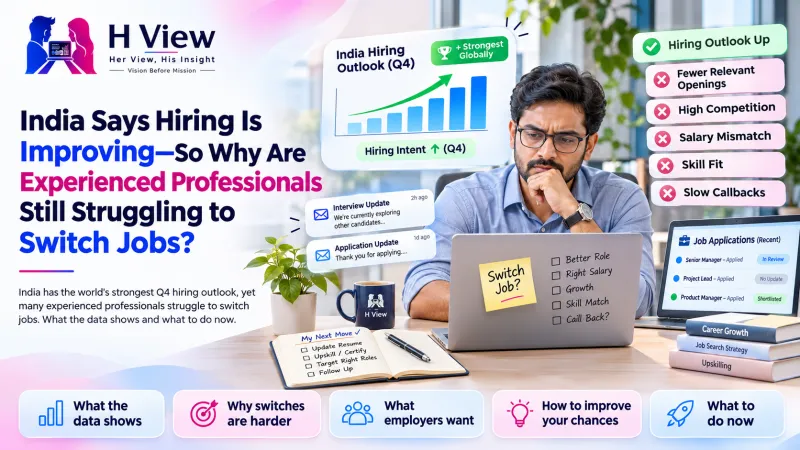
For more context on the wider hiring picture, see H View’s reports on India’s hiring recovery and experienced professionals and why employee retention is a useful leadership measure.
 Also readWhy More Professionals Are Leaving Big Cities for a Better Life→
Her View: flexibility should not become a career penalty
Attendance rules affect people differently. Parents, caregivers, women returning after a break and workers far from tech hubs may face higher costs, though people within these groups have varied needs. That is a reason to consider access and opportunity while still accounting for job requirements.
Make office days purposeful: pair new hires with mentors, resolve project risks across teams or hold customer workshops. If staff commute only to join video calls alone, review the arrangement. Clear expectations and transparent exceptions also make policies fairer.
His Insight: employers need outcomes, not attendance numbers
Some work benefits from being together: confidential systems, hands-on training, ambiguous problem-solving or urgent customer coordination. Employers should name those needs and schedule around them. A blanket rule can add commute costs without showing that the work improved.
Retention is a business outcome alongside delivery and quality. Employers can pilot a schedule, review results after a defined period and revise it when evidence does not support the policy.
H View Verdict: let evidence shape the workplace
The Trip.com trial found improved retention without detectable harm to measured performance under one hybrid schedule. The Microsoft study warns that remote teams may lose informal connections unless they deliberately share information across groups.
The useful question for Indian employers is which work needs proximity and whether the arrangement improves delivery, quality, learning and retention. Workers deserve clear expectations; employers need measurable results. A policy that explains both is more credible than one that counts badges.
Frequently asked questions
Is remote work less productive than office work?
There is no universal answer. Trip.com’s hybrid trial found no detectable decline in measured performance. Microsoft’s study found more siloed collaboration during a fully remote shift, highlighting coordination risks rather than proving lower individual productivity.
Does hybrid work reduce employee resignations?
Trip.com recorded one-third fewer resignations in its hybrid group than its office-only control group. That result comes from one company and schedule; Indian employers should evaluate their own teams.
Why are Indian IT companies asking employees to return to offices?
Employers may seek in-person mentoring, onboarding, security or coordination. Those are possible reasons; an attendance rule alone does not show improved outcomes.
What jobs are better suited to hybrid or remote work?
Tasks with clear digital outputs and few on-site dependencies may be easier remotely. Work involving equipment, in-person service, hands-on training or rapid cross-team decisions may need more time together.
Can Indian technology professionals negotiate remote work in 2026?
Some workers can negotiate, depending on role and employer. Ask about the schedule before accepting, get terms in writing and explain how you will collaborate. Then weigh flexibility against the full offer.
H View stories follow our editorial policy. Spotted an error? Tell us and we will correct it.
Rate this article
One tap is enough. No comment needed.
Was this article helpful?
Your answer goes straight to our editors.









Comments0
No comments yet. Start the conversation.