
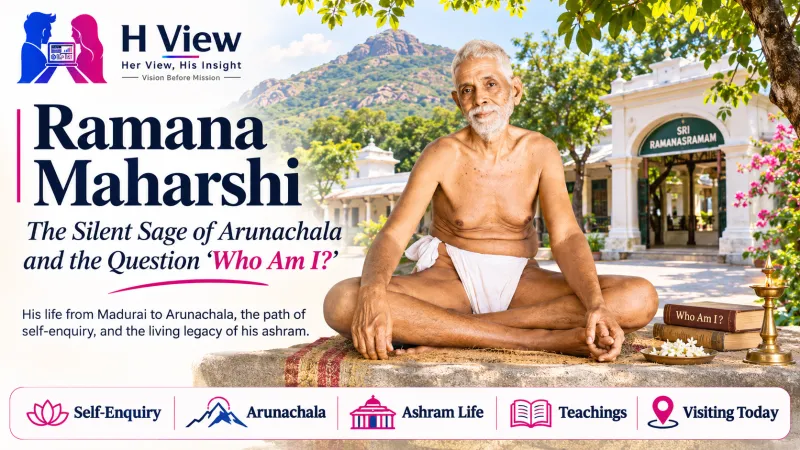
Ramana Maharshi: The Silent Sage of Arunachala and the Question “Who Am I?”
At sixteen, a schoolboy in Madurai lay down and imagined his own death. What he found changed his life, and later drew seekers from across the world to a hill in Tamil Nadu.
Ramana Maharshi (1879–1950) was a sage from Tamil Nadu who, after a sudden awakening at sixteen, spent the rest of his life at the sacred hill of Arunachala in Tiruvannamalai. He taught self-enquiry, the practice of asking “Who am I?”, often through silence, and Sri Ramanasramam still welcomes visitors today.
At a glance
| Birth name | Venkataraman Iyer |
| Born | 30 December 1879, Tiruchuzhi, near Madurai |
| Awakening | July 1896, aged 16, in Madurai |
| Arrived at Arunachala | 1 September 1896; never left |
| Teaching | Self-enquiry (atma vichara) and surrender |
| Died | 14 April 1950, Sri Ramanasramam |
Who was Ramana Maharshi?
He was an ordinary schoolboy who became one of the twentieth century’s most respected spiritual teachers without ever travelling, lecturing or founding a movement. He wore only a loincloth, ate what the ashram ate and answered questions when asked. Yet writers, scientists and seekers came from Europe and America to sit in his presence, and many said his silence taught them more than words.
What happened to him at sixteen?
In July 1896, sitting alone in his uncle’s house in Madurai, the teenager was gripped by a sudden fear of death. Instead of running from it, he lay down, held his breath and imagined his body as a corpse. He asked: if the body dies, am I dead? His own later account says he realised that the “I” he felt was not the body at all, and that this awareness never left him again.
His interest in school and family life faded. Weeks later, on 29 August 1896, he left home with a short note saying he was going in search of his Father, and travelled to Tiruvannamalai, the town at the foot of Arunachala, a hill he had felt drawn to since childhood. He arrived on 1 September 1896.
 Also readSwami Vivekananda: The Monk Who Carried India’s Voice to the World→
How did he live at Arunachala?
1896 — Sits in deep absorption in the Arunachaleswara temple, including an underground vault (Patala Lingam), often unaware of insects biting him.
1899–1916 — Lives in Virupaksha Cave on the hill; visitors begin calling him Brahmana Swami.
1907 — The scholar Kavyakantha Ganapati Muni names him “Bhagavan Sri Ramana Maharshi”.
1916–1922 — Moves to Skandashram, higher on the hill; his mother Alagammal joins him.
1922 — After his mother’s death, he settles near her samadhi; Sri Ramanasramam grows around him.
1934 — Paul Brunton’s A Search in Secret India introduces him to Western readers.
14 April 1950 — Dies at the ashram after illness; a bright light crossing the sky that evening was reported by several witnesses.
What is self-enquiry, and how is it practised?
Self-enquiry is the practice of turning attention to the sense of “I” itself. Ramana’s small booklet Who Am I? (Nan Yar?) sets out the method: whenever a thought arises, rather than following it, ask “To whom did this thought come?” The answer is “to me”, and then you ask, “Who am I?” The aim is not an intellectual answer but to rest in the awareness that remains.
- Sit quietly and notice thoughts as they arise.
- Ask “to whom?” each time a thought appears.
- Trace the “I” back to its source instead of to the thought.
- Rest there as long as possible; return gently when distracted.
- Carry it into daily life, which Ramana said mattered more than formal sitting.
For those who found this hard, he offered another route: complete surrender to God or the guru. He said both paths lead to the same place.
| Ramana’s approach | What it asks of you | Best suited to |
|---|---|---|
| Self-enquiry | Attention to the source of “I” | Reflective, inward temperaments |
| Surrender | Letting go of the doer, trusting a higher power | Devotional temperaments |
| Silence (mouna) | Simply being in the presence of the teacher | Anyone; Ramana called it the highest teaching |
Why does Arunachala matter so much in his story?
For Ramana, Arunachala was not just a place but Shiva himself in the form of a hill. He composed devotional hymns to it, including the Five Hymns to Arunachala, and encouraged giri pradakshina, the barefoot walk of about 14 km around the hill. On full-moon nights, especially during Karthigai Deepam, lakhs of pilgrims still make that walk.
 Also readShirdi Sai Baba: The Life, Teachings and Living Legacy of the Fakir of Shirdi→
How can you visit Sri Ramanasramam today?
- Location: on the south side of Arunachala, about 2 km from the Arunachaleswara temple in Tiruvannamalai.
- Entry: free and open to all; the old meditation hall and Ramana’s samadhi hall are the heart of the ashram.
- Stay: limited accommodation is allotted on request through the ashram’s website, well in advance.
- Walk up: a short climb leads to Virupaksha Cave and Skandashram, both open to visitors in daytime.
- Etiquette: silence in the halls, modest dress, no photography in meditation areas.
Her View: Ramana is the rare teacher whose method costs nothing and needs no equipment. One honest question, asked sincerely, is the whole practice.
His Insight: He never left one small town for 54 years, yet his influence reached across the world. Depth, not reach, built his legacy.
Frequently asked questions
What did Ramana Maharshi teach?
He taught self-enquiry, asking “Who am I?” to discover the true Self beyond body and mind, and surrender to God as an equal path.
When did Ramana Maharshi die?
He died at Sri Ramanasramam, Tiruvannamalai, on 14 April 1950, aged 70.
What is the book “Who Am I?”
A short text based on his answers to a devotee’s questions, setting out the method of self-enquiry. It is free to read on the ashram’s website.
Is Sri Ramanasramam open to everyone?
Yes. People of any faith or none may visit, meditate and attend the daily chanting.
Sources and how this article was researched
This is a desk-research article based on the sources below.
- Sri Ramanasramam (official website)
- Wikipedia: Ramana Maharshi
- Arthur Osborne, Ramana Maharshi and the Path of Self-Knowledge (biography)
Part of H View’s Devotion & Heritage series. Previously: Shirdi Sai Baba. Next: Swami Vivekananda.
H View stories follow our editorial policy. Spotted an error? Tell us and we will correct it.
Rate this article
One tap is enough. No comment needed.
Was this article helpful?
Your answer goes straight to our editors.








Comments0
No comments yet. Start the conversation.