
Canonical URLs Explained: Which Page Should Search Engines Treat as Primary?
When the same content is reachable at several addresses, a canonical URL tells search engines which one is the main version. How canonicals work, why they are hints and how they differ from redirects.
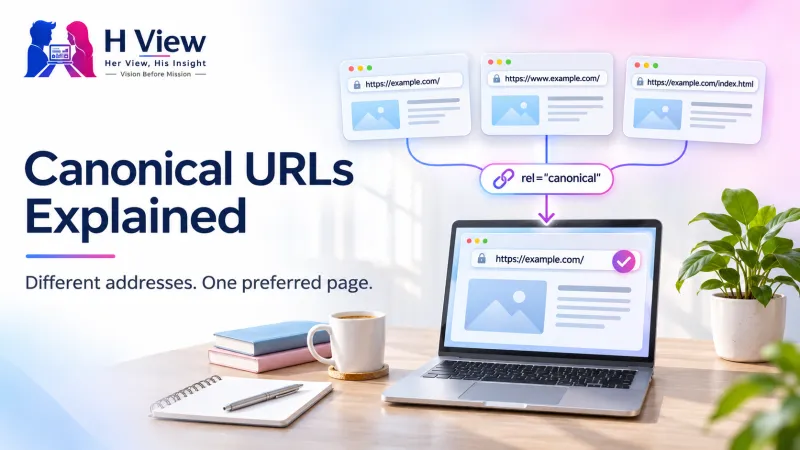
A canonical URL is the address you want search engines to treat as the main version of a page when the same or very similar content can be reached at more than one address. You signal it mainly with a rel="canonical" tag or a redirect, and search engines then combine the duplicates' signals into that one preferred URL.
Duplicate addresses are more common than most site owners realise, and they usually happen by accident, not because anyone copied content.
How can one page end up with several URLs?
- With and without
www, or withhttpandhttps. - With tracking or filter parameters, such as
?utm_source=…or?sort=price. - The same product listed in two categories, giving two paths.
- Printer-friendly or mobile versions of a page.
- Trailing slash differences, such as
/servicesand/services/.
To a visitor these look identical. To a search engine they can be separate pages competing with each other.
Why does choosing a canonical matter?
Google's guide to consolidating duplicate URLs lists several reasons: to choose which URL people see in search results, to consolidate signals such as links from different versions into one preferred URL, to simplify tracking for a piece of content, and to avoid spending crawling time on duplicates.
 Also readWhy Does a WordPress Login Page Keep Redirecting? How Logins, Cookies and Site URLs Work→
What are the ways to signal a canonical?
| Method | Strength (per Google) | When it fits |
|---|---|---|
| Redirect | Strong signal | When the duplicate page should no longer be visited at all |
rel="canonical" link tag | Strong signal | When duplicates must stay accessible, such as filtered product lists |
| Sitemap inclusion | Weak signal | Listing preferred URLs in your sitemap supports the other methods |
Google treats these as signals rather than commands. If your canonical tag, sitemap, internal links and redirects disagree, Google may choose a different URL from the one you prefer. Its guidance specifically warns against declaring one URL in a sitemap and a different URL for the same page with a canonical tag.
How is a canonical different from a redirect?
A redirect sends visitors and search engines to another address; the old URL effectively stops being a page. A canonical tag leaves both pages open to visitors but tells search engines which one to show and credit. Use redirects when retiring duplicates, and canonicals when duplicates have a practical reason to exist. Google's guide to redirects and Google Search explains the different redirect types.
What mistakes cause problems?
- Pointing a canonical to a page that redirects, returns an error or is marked noindex.
- Every page accidentally declaring the home page as canonical.
- Theme and SEO plugin both adding different canonical tags.
- Canonicalising pages that are not actually similar, which Google may ignore.
Search Console's URL Inspection tool shows both the canonical you declared and the one Google selected, which is the quickest way to spot a mismatch.
Her View / His Insight
Her View: Think of the canonical as telling search engines, "If you only remember one address for this page, remember this one." It helps your best version get the credit.
His Insight: Consistency wins. Canonical tags, internal links, sitemaps and redirects should all point to the same preferred URL; mixed signals are the most common reason Google picks something else.
Frequently asked questions
Should a page have a canonical tag pointing to itself?
Yes, a self-referencing canonical is common practice and helps clarify the preferred version when parameters or variations appear.
Is duplicate content a penalty?
Ordinary duplicates caused by URL variations are not usually a penalty. The issue is that signals get split and the wrong version may appear in search.
Why did Google choose a different canonical from mine?
Often because other signals, such as internal links, sitemaps or redirects, point elsewhere, or because the pages are not similar enough.
Unsure which version Google is indexing?
HView's Digital Solutions team can review canonicals, redirects and sitemaps together in a technical SEO audit.
References
H View stories follow our editorial policy. Spotted an error? Tell us and we will correct it.
Rate this article
One tap is enough. No comment needed.
Was this article helpful?
Your answer goes straight to our editors.











Comments0
No comments yet. Start the conversation.