
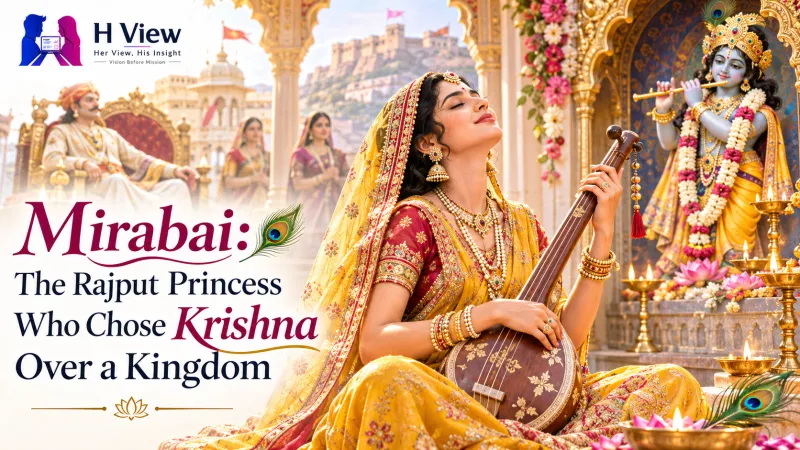
Mirabai: The Rajput Princess Who Chose Krishna Over a Kingdom
She was a royal bride of Mewar who sang and danced for Krishna in public, defying her in-laws. Five centuries later, her songs are still sung across India.
Mirabai (c. 1498–c. 1547) was a Rajput princess and poet-saint of the bhakti movement who devoted her life to Krishna, whom she regarded as her true husband. Married into the royal family of Mewar, she defied social and family pressure to sing and worship openly, and her devotional songs remain among the most loved in India.
At a glance
| Born | c. 1498, Kudki near Merta, Rajasthan, in the Rathore clan |
| Married | c. 1516 to Bhoj Raj, heir of Rana Sanga of Mewar |
| Devotion | Krishna as Giridhar Gopal, her beloved |
| Language of songs | Rajasthani and Braj Bhasha, also Gujarati versions |
| Later life | Vrindavan, then Dwarka |
| Died | c. 1547, Dwarka (per tradition) |
Who was Mirabai?
She was born into the Rathore royal family of Merta and, tradition says, fell in love with Krishna as a child after receiving a small image of him. When she was married into the powerful Sisodia family of Mewar at Chittor, she continued to treat Krishna as her real husband. That devotion, expressed openly in song and dance in temples among ordinary people, clashed with the expectations placed on a royal woman.
What do we know from history, and what from legend?
Historical records of Mirabai are thin; most of her story comes from devotional biographies written after her death and from the songs themselves. Scholars agree on the outline: a Rathore princess married into Mewar, widowed young, who left the court and lived as a devotee. The dramatic details belong to tradition.
| Event | Status |
|---|---|
| Born into the Rathores of Merta | Broadly accepted |
| Married to Bhoj Raj of Mewar, widowed by about 1521 | Broadly accepted |
| Her in-laws tried to poison her; the poison turned to nectar | Devotional legend |
| A snake sent in a basket became a Krishna image or garland | Devotional legend |
| Lived in Vrindavan and Dwarka | Strong tradition |
| Merged into Krishna’s image at Dwarka | Devotional legend of her death |
 Also readAnandamayi Ma: The Joy-Permeated Mother Who Walked Across India→
Why did she leave the royal court?
After her husband’s death, and the deaths of other family members amid wars with the Delhi Sultanate and later rulers, a widow of her status was expected to live in seclusion, and by some accounts to commit sati. Mirabai refused. She kept company with sadhus, sang in public, and ignored caste and purdah rules. Tradition says her husband’s family tried to stop her by force, and eventually she left Chittor for a life of pilgrimage.
What did her songs say?
Her songs, known as Mira bhajans or padas, are short lyrics addressed to Krishna. They speak of longing, separation and absolute surrender. Common themes include:
- Krishna as husband: she calls herself his bride, owing no one else loyalty.
- Defiance of social rules: she accepts gossip and censure for his sake.
- Viraha, the pain of separation from the beloved.
- Joy in simple devotion: singing, dancing and the company of saints.
Hundreds of songs bear her name, though scholars note many were added by later singers in her style. Mahatma Gandhi admired her courage and included her songs in his ashram’s prayers, and singers like M. S. Subbulakshmi brought her bhajans to modern audiences.
c. 1498 — Born near Merta.
c. 1516 — Married to Bhoj Raj of Mewar at Chittor.
c. 1521 — Widowed.
1520s–1530s — Conflict with the royal family; leaves Chittor.
Later years — Vrindavan, then Dwarka.
c. 1547 — Dies at Dwarka, per tradition.
 Also readSant Tukaram: The Grocer-Poet Whose Abhangas Still Walk to Pandharpur→
Where can you trace Mirabai’s life?
- Meera Mahal, Merta (Rajasthan): a museum in her ancestral town, near the Charbhuja temple.
- Meera temple, Chittorgarh Fort: a temple associated with her worship inside the fort complex.
- Vrindavan: places linked by tradition with her stay.
- Dwarkadhish temple, Dwarka (Gujarat): where tradition says she merged into Krishna.
Her View: Mirabai said no to everything expected of a royal widow and yes to the life she chose. Five hundred years later, that still reads as courage.
His Insight: Her songs survived not in palace archives but in the mouths of ordinary singers. Popular memory, not power, preserved her.
Frequently asked questions
Who was Mirabai’s husband?
Bhoj Raj, the crown prince of Mewar and son of Rana Sanga. He died young, around 1521.
Whom did Mirabai worship?
Krishna, especially as Giridhar Gopal, the lifter of Govardhan hill.
Where did Mirabai die?
Tradition says at Dwarka in Gujarat, around 1547.
Are all songs attributed to Mirabai written by her?
Not necessarily. Scholars believe many were composed later by singers in her name and style.
Sources and how this article was researched
This is a desk-research article. Miracle accounts are identified as legend.
Part of H View’s Devotion & Heritage series. This completes our first ten spiritual personalities. Start from the beginning: Shirdi Sai Baba.
H View stories follow our editorial policy. Spotted an error? Tell us and we will correct it.
Rate this article
One tap is enough. No comment needed.
Was this article helpful?
Your answer goes straight to our editors.







Comments0
No comments yet. Start the conversation.