
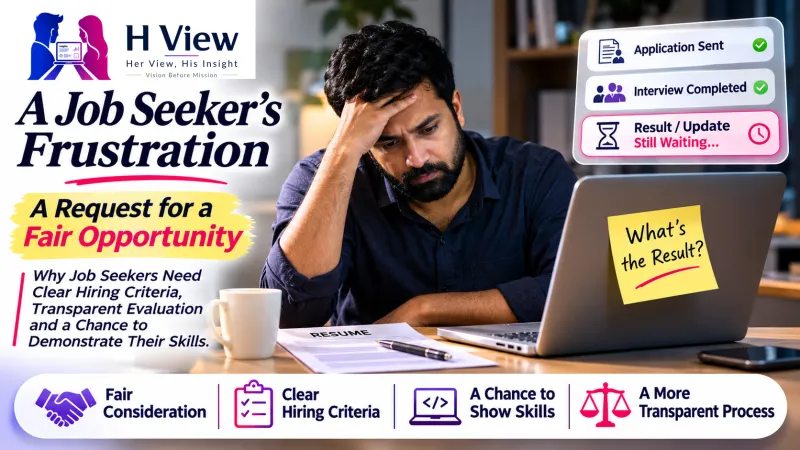
A Job Seeker’s Frustration: A Request for a Fair Opportunity
A B.Tech and MBA graduate asks for a fair chance to demonstrate his abilities. Satya Hemanth reflects on being overlooked, the hope behind H View, and what respectful hiring can mean for young job seekers.
What does a fair chance mean to a job seeker? It means being considered for a role and getting an opportunity to show what you can do. It does not mean receiving a job without an interview or being excused from evaluation. I am writing this as a B.Tech and MBA graduate who wants to be judged by my ability, effort and willingness to learn—not only by the years of experience beside my name.
Rejection Hurts, But Silence Is Harder
I know that employers cannot interview everyone who applies, and I do not expect them to. If I am invited to an interview and the team decides I am not the right fit, I can accept that. It may disappoint me, but at least I know I was heard and considered.
Being ignored feels different. You send an application, wait for a response, and keep checking whether anything has changed. After a while, the silence starts to feel personal, even though you may never know what happened behind the scenes. Did the company fill the role? Did my application reach a recruiter? Was I missing a skill? Without a reply or a conversation, there is no way to learn or move forward with confidence.
I am not asking anyone to hand me a job. I am asking for a fair opportunity to demonstrate my knowledge, dedication and willingness to learn. Give me a chance to explain how I think, show what I have worked on, and answer questions about the role. Then make the decision based on what you see.
A Resume Cannot Tell The Whole Story
A resume is useful. It helps a recruiter understand a candidate’s education, experience and skills quickly. But it is only a page or two, and it cannot show everything about the person behind it: how they approach a problem, how they respond to feedback, what they have taught themselves, or how seriously they take a responsibility.
Experience matters, and some positions need someone who can take ownership from the first day. Still, when every entry-level opportunity asks for prior experience, a graduate can feel caught in a loop: the job requires experience, but the first chance to gain it never comes. That does not mean every graduate is suited to every role. It means employers can look at relevant projects, a short practical exercise, communication and learning ability alongside the years listed on a resume.
The difficulty of entering work is not just an individual feeling. India’s Periodic Labour Force Survey for 2025 reported unemployment of 9.9% among people aged 15–29, rising to 13.6% for urban youth in that age group. Those figures cover all young people, not only graduates, and they do not measure unanswered applications. They cannot explain anyone’s personal experience, but they do show why early-career opportunities deserve serious attention. Read the official 2025 PLFS summary.
 Also readApplied for the Job—but Was There Ever a Job? The Rise of Ghost Hiring→
What A Fair Hiring Process Could Look Like
Recruiters work under time pressure and may receive more applications than they can review in depth. I understand that. Fairness does not require a long interview with every applicant; it asks for a process that is clear, relevant and respectful.
- Be clear about the role. Separate essential skills from preferences, and explain what the person will actually do.
- Give candidates a response. A short update or rejection is kinder than leaving people uncertain indefinitely.
- Assess skills that matter. A structured interview, portfolio review or short practical task can show how someone approaches the work.
- Keep assignments reasonable. A hiring task should be brief and relevant, not a large unpaid project.
- Make room for potential. When suitable, trainee roles, internships and apprenticeships can help people build the experience employers seek.
These steps can help companies too. Clear criteria make it easier to compare applicants fairly, reduce confusion and show candidates what the organization values. Even when the answer is no, a respectful process leaves a better impression of the employer.
The Weight Of Waiting
When you are trying hard and not hearing back, it is easy to question yourself. You wonder whether your degree matters, whether you should learn one more skill, or whether you are missing something everyone else understands. You try to stay hopeful, but each unanswered application makes it harder to know what to change.
I know that feeling because it is what I was trying to express in my message to HR professionals and recruitment teams. Behind an application is a person who has spent time preparing it and is hoping for a chance to speak. A candidate can handle a rejection. What is harder is feeling that nobody even looked.
At the same time, I do not want to suggest that a degree automatically entitles anyone to a job. A company has to choose the person who can do the work, and candidates have to keep learning and improving. I am asking for consideration in how that choice is made: let people be assessed against the actual role, and communicate with them as people.
Building H View With My Sister
My sister and I built H View together, and that work has become one way for us to turn difficult experiences and questions into something useful. It did not make the uncertainty of job searching disappear, and it is not a substitute for the opportunity I am asking employers to provide. But building something with my sister gave that frustration a direction: we could create a place to share perspectives, explain issues that matter to young people and keep learning through the work itself.
Starting and running H View has asked for patience, teamwork and a willingness to keep going when progress is slow. I do not want to dress that up as a perfect success story. It is still work in progress. What it has taught me is that potential becomes visible when someone is trusted with a real responsibility and given room to learn as they contribute.
Many young people are in a similar position. They have studied, prepared, applied and tried to improve, yet they are still waiting for someone to give them a first conversation. Their stories may be different from mine, but the request is often simple: please look at what I can do, not only at what I have not yet had the chance to do.
Her View: A Little Consideration Goes A Long Way
From my sister’s and my shared experience of building H View, I have learned that encouragement does not have to be grand to matter. A clear response, a chance to explain your work, or honest feedback about a missing skill can help someone decide what to do next. Small acts of consideration can make a difficult process feel less impersonal.
 Also readHiring Is Up—So Why Are Freshers Still Not Getting Jobs?→
His Insight: Potential Needs A First Opportunity
My insight is simple: hiring should test for the ability a role actually needs. Experience is one signal, but it is not the only one. When a candidate has not yet been given the chance to build a long work history, a relevant project, a focused interview or a fair practical assessment may reveal more than the number of years on a resume.
H View Verdict
No applicant can expect a guaranteed job, and no employer can speak to every person who applies. But job seekers deserve a process that gives them a reasonable chance to be seen, assesses them on relevant evidence and lets them know where they stand. That is the fair opportunity I am asking for—not a promise, only a chance to prove myself.
Please don't judge a candidate only by the years of experience mentioned on a resume. Sometimes, the person who has never been given an opportunity may have the dedication, potential, and determination that your organization is looking for.
Frequently Asked Questions
Is A Job Seeker Asking For A Fair Chance Asking For A Guaranteed Job?
No. A fair chance means an opportunity to be considered and assessed against the role. The final hiring decision remains with the employer.
How Can Employers Assess Candidates Without Much Experience?
They can use structured interviews, relevant portfolio work, short practical exercises and clear entry-level pathways. Assessments should be connected to the actual responsibilities and proportionate to the role.
Why Does A Response Matter If The Candidate Is Rejected?
A timely update or rejection gives a person clarity and helps them move forward. It also shows respect for the time they spent applying.
Explore More On H View
For more on the challenges facing early-career applicants, read our coverage of why freshers still struggle to get hired and ghost jobs in India.
H View stories follow our editorial policy. Spotted an error? Tell us and we will correct it.
Rate this article
One tap is enough. No comment needed.
Was this article helpful?
Your answer goes straight to our editors.








Comments0
No comments yet. Start the conversation.