
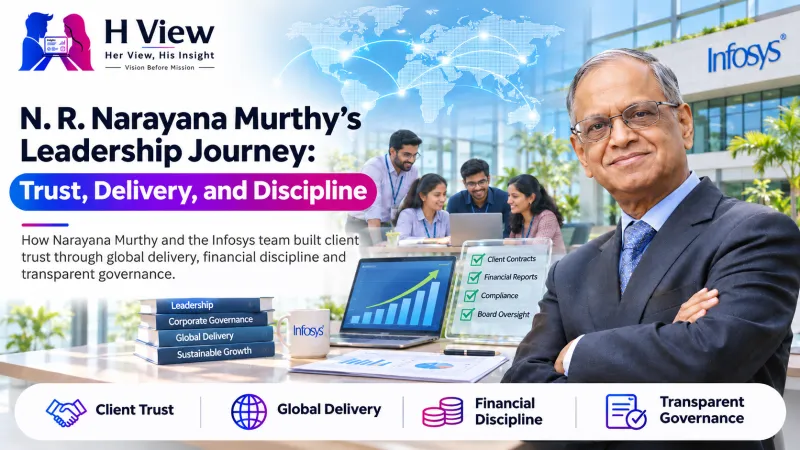
N. R. Narayana Murthy’s Leadership Journey: Trust, Delivery, and Discipline
What can management students learn from Narayana Murthy? Explore Infosys’ early growth, global delivery model, client trust and disciplined governance.
N. R. Narayana Murthy’s leadership journey shows how a small software company can grow by pairing technical skill with client trust, disciplined delivery and transparent governance. Infosys was established in 1981 by Murthy and six other engineers, with initial capital of US$250, according to the company’s history. Their business began when India’s technology sector and global outsourcing market were still developing. The lasting management lesson is not that every startup can follow the same path, but that reliable service, clear principles and the ability to deliver across distance can help a young firm earn a place in demanding markets.
Who is N. R. Narayana Murthy?
N. R. Narayana Murthy is an Indian entrepreneur and the co-founder of Infosys. He helped establish the company in Pune in 1981 with six fellow engineers. Infosys later became one of India’s major technology services companies, serving clients across global markets. Murthy’s role included more than founding the business: Infosys credits him with conceptualising and implementing the Global Delivery Model, a way of coordinating software work across locations so clients could receive quality projects on time and within agreed budgets.
His experience is useful for management students because it connects a founder’s vision with operating choices. Software services depend on people, expertise, client communication and consistent delivery. A company cannot scale only by winning contracts; it must build the processes and culture that allow teams to keep promises. Murthy and his co-founders had to develop those capabilities while the domestic technology ecosystem was much smaller than it is today.
What was the core idea behind Infosys?
The founding idea was to build a professional software services company in India that could solve problems for clients elsewhere in the world. The Global Delivery Model helped make that idea workable. Instead of assuming that all client work had to happen in one office, teams could collaborate across locations and time zones. This distributed approach could improve access to talent and support continuous project progress, but it also required careful communication, clear ownership, documentation and quality checks.
For managers, the model illustrates how an operating design can become a competitive advantage. A slogan such as “we work globally” has little meaning unless teams know who makes decisions, how progress is shared and how problems are escalated. The model also depends on trust: clients must believe that a team they may never meet in person understands their requirements and will protect their interests. Infosys’ approach linked technology delivery with management processes and customer focus.
 Also readRatan Tata’s Leadership Journey: Building Trust Through Change→
How did Murthy help sustain and develop the business?
Infosys grew by building credibility step by step. Its official timeline records that it signed its first client, Data Basics Corporation in New York, in 1981, opened an international office in Boston in 1987 and moved its headquarters to Bengaluru in 1983. Each step expanded the company’s reach, but it also increased the need for dependable systems. A new client relationship is only the beginning; consistent project outcomes, accurate communication and the ability to retain skilled employees determine whether a business can keep growing.
Murthy’s emphasis on professional governance also supported the company’s reputation. Infosys describes its governance philosophy in terms of ethical decisions, fairness and transparency with stakeholders. For a business seeking international customers and public investment, good governance helps people understand how decisions are made and how performance is reported. It does not guarantee that every decision will be right, but it creates a framework for accountability and makes it easier to identify and address problems.
Financial discipline was another part of the early story. Infosys’ published history notes that its founders set principles around earning profits, maintaining liquidity, limiting borrowing and separating company resources from personal use. These choices can feel conservative beside the popular startup narrative of rapid spending, but a young firm with limited capital must protect its ability to keep operating. Growth that exhausts cash before a company has a stable customer base can undermine even a strong product idea.
The company also invested in training, quality and employee development. In software services, knowledge is the product, so managers need ways to help people learn new technologies and work effectively in teams. Training is not a one-time event; clients’ needs and tools change, and a company’s employees must keep pace. A learning culture can help a business adapt, but it must be matched with project planning so that employee development supports both future capability and current delivery.
Why was the journey difficult?
Building an export-oriented software business from India in 1981 meant working with limited infrastructure and a changing regulatory environment. The founding team had to win trust from customers who were taking a chance on a comparatively young provider. Communication across countries introduced practical challenges, and delivering work at a distance demanded strong coordination. A company could not rely on brand recognition at the start; it had to demonstrate competence through each project and relationship.
The shift from a small founding group to a large organisation also creates a new kind of challenge. Founders may personally know every employee and client in the early years, but that approach cannot scale indefinitely. The organisation needs managers, shared procedures and ways to preserve its culture as new teams join. Leaders have to delegate without losing sight of quality or values. This transition is difficult because the systems that enable growth can also make an organisation feel less personal if leaders stop listening.
Management students should be careful not to turn Murthy’s story into a claim that hard work alone guarantees success. Infosys’ growth came from a team of founders, employees, client relationships and changes in the wider technology market. Murthy’s leadership mattered, but the business was not built by one person acting alone. Recognising the contribution of co-founders and teams is itself a management lesson: durable companies distribute knowledge and responsibility rather than keeping every decision with a single leader.
What can management students learn?
| Lesson | Practical application |
|---|---|
| Make trust visible | Set realistic commitments, report progress honestly and communicate risks early. |
| Design for delivery | Define ownership, quality checks and escalation routes before expanding a service. |
| Spend with discipline | Protect cash and connect borrowing or investment to a clear business need. |
| Build people capability | Invest in training and knowledge sharing so the company can adapt as client needs change. |
| Use governance as a tool | Make decisions traceable and treat employees, clients, investors and communities fairly. |
These lessons can be applied by a student team or a small service company. Before promising a deadline, the team can check its capacity and name a person responsible for each task. It can keep a simple record of decisions, share progress with the client and raise delays before they become surprises. A group that does these small things consistently is already practicing the kind of delivery discipline that large organisations need.
Her View
From a team perspective, a service business grows when employees are treated as knowledge partners rather than replaceable capacity. Clear learning paths, fair processes and open communication can help staff build confidence and contribute ideas. Professional standards should protect people as well as clients: expectations need to be clear, and managers should listen when a process creates unnecessary pressure or mistakes.
His Insight
The strategic lesson is that a business model can be built from a way of working, not only from a product. Infosys’ delivery approach showed how distributed talent, communication and process could be combined to serve clients. But systems are not valuable by themselves; they must solve real customer problems. Managers should keep asking whether their operating model is improving quality, speed, cost or reliability for the people who pay for the service.
 Also readKiran Mazumdar-Shaw’s Leadership Journey: Building Biocon Through Science→
H View Verdict
Narayana Murthy’s journey gives management students a case study in trust-led growth, distributed work, financial discipline and corporate governance. The company’s founding scale was small, yet its ambition was global; it made progress by developing the habits and systems required to earn customer confidence. The strongest takeaway is to make promises that the team can deliver, then build the people and processes needed to keep delivering as the organisation grows.
Self-assessment: What should students take away?
- Why did Infosys need a delivery model that could coordinate teams across locations?
- What behaviours help a small company earn trust from its first international customers?
- How can financial discipline protect a young company’s ability to survive?
- What governance practices would help a student venture remain fair and accountable?
- How should a founder change their leadership as a team grows beyond the early founding group?
Frequently asked questions
When was Infosys founded, and by whom?
Infosys was established in 1981 by N. R. Narayana Murthy and six other engineers in Pune, India. The company’s history states that its initial capital was US$250.
What is the Global Delivery Model?
It is an approach to collaborative software development in which teams can work across locations and time zones. Infosys credits Murthy with conceptualising and implementing the model, which became important to the Indian software services industry.
What management principles are associated with Narayana Murthy?
His leadership is associated with client focus, professional governance, transparency, disciplined delivery and investment in people and quality. These principles are most useful when turned into daily practices and measurable commitments.
Why is his story relevant to management students?
It shows how a small company can develop a global service model by building credibility, coordinating talent and maintaining clear governance. It also highlights the difficulty of scaling culture and systems as a team grows.
Sources
H View stories follow our editorial policy. Spotted an error? Tell us and we will correct it.
Rate this article
One tap is enough. No comment needed.
Was this article helpful?
Your answer goes straight to our editors.










Comments0
No comments yet. Start the conversation.