
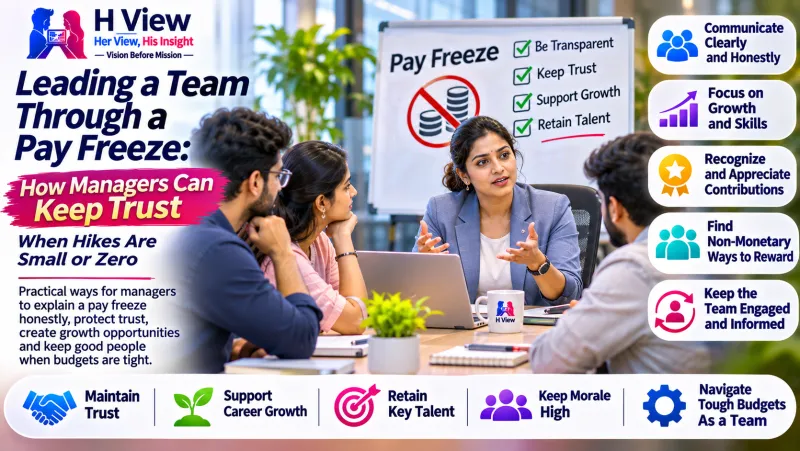
Leading a Team Through a Pay Freeze: How Managers Can Keep Trust When Hikes Are Small or Zero
One in three Indian tech workers in a recent survey got no hike or a pay cut this year. Here is how managers can deliver that news honestly, protect trust and keep good people when money is tight.
A pay freeze tests a manager more than a good year ever does. You often cannot change the number, but you can change how it is explained, what else your team gets, and whether people trust you afterwards. Honest communication, real growth opportunities and fair workloads matter most when money is tight.
How common are small or zero hikes this year?
Quite common in tech. A survey by the professional community Blind of 2,178 India-based professionals, run from 15 to 26 October 2026, found that 35% received no hike or a pay cut. 59% received a hike of 5% or less, up from 34% in 2025, and 63% said they were dissatisfied. These figures were summarised by OffCampusJobs4u; it is an anonymous, self-reported survey, so treat it as a signal rather than an exact measure.
Among the reasons respondents gave, 41% pointed to company finances or cost-cutting and 18% to AI and automation.
How should a manager explain a pay freeze?
- Tell people early and in person. A one-line email on appraisal day feels like hiding.
- Explain the reason you are allowed to share. "The company froze hikes across the board because revenue fell" is very different from silence.
- Separate pay from performance. If someone performed well, say so clearly, in writing. A freeze should not be read as a poor rating.
- Do not over-promise. "I will fight for you next cycle" is fine. "You will definitely get 20% next year" is not, unless you control it.
- Invite questions and listen. Frustration is reasonable. Let people say it without arguing.
 Also readWhy Employee Retention Is a Better Leadership Measure Than Headcount Growth→
What can you offer when you cannot offer money?
- Visible growth: a stretch project, a client-facing role or leading a small initiative builds a stronger resume.
- Learning time: protected hours each week for a certification or a new skill, including AI tools.
- Flexibility: where the role allows, more control over working hours or remote days.
- Recognition: specific praise in front of senior leaders, and credit on work that gets noticed.
- A clear path: write down what it takes to reach the next level and review it every quarter.
What mistakes make a pay freeze worse?
- Adding more work to the same people without acknowledging it.
- Celebrating leadership bonuses or expensive events in the same month.
- Treating anyone who looks for other jobs as disloyal.
- Avoiding one-to-one meetings because the conversations are uncomfortable.
 Also readMicromanagement: Why Managers Do It, What It Costs Teams and How to Build Trust Instead→
How do you keep your best people?
Assume your strongest performers are getting calls from recruiters. Meet them individually, ask what would make them stay for the next year, and act on the parts you control. If someone does leave, part well. Good people often return, or refer others.
For managers, the habit of explaining decisions openly is the same skill that builds trust in any tough period. We cover it more in our Leadership section.
Frequently asked questions
Should a manager share the company's financial reasons?
Share whatever you are permitted to share. Even a general reason, such as company-wide cost control, helps people understand that the decision is not personal.
Is it unprofessional to be honest that I disagree with the freeze?
You can acknowledge that it is disappointing without criticising leadership. Saying "I know this is hard, and I have shared the team's concerns" is honest and professional.
How often should I meet team members during a freeze?
Keep regular one-to-ones, at least every two weeks, so concerns surface early instead of in an exit interview.
Can non-cash benefits really replace a hike?
Not fully. They help people grow and feel valued, but be honest that they do not replace pay.
H View stories follow our editorial policy. Spotted an error? Tell us and we will correct it.
Rate this article
One tap is enough. No comment needed.
Was this article helpful?
Your answer goes straight to our editors.












Comments0
No comments yet. Start the conversation.