
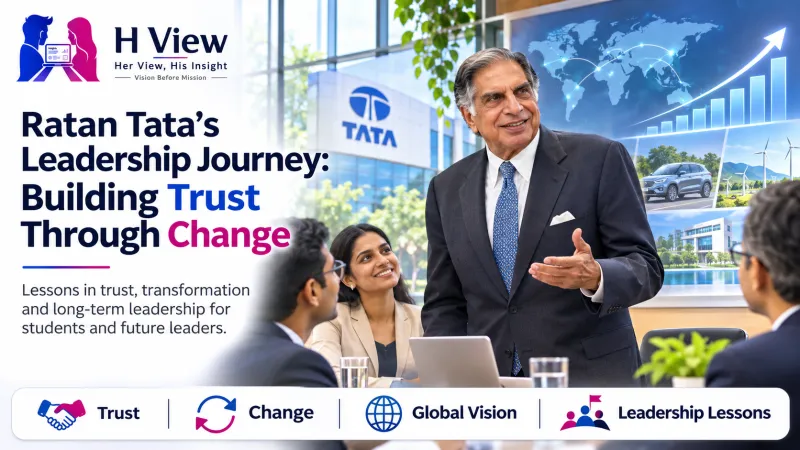
Ratan Tata’s Leadership Journey: Building Trust Through Change
What can management students learn from Ratan Tata? Explore how he led change, developed Tata companies, took calculated risks and kept trust central to business.
Ratan Tata’s management legacy offers a clear lesson for students: a leader can modernise a large organisation while keeping trust, long-term thinking and public responsibility at the centre of decisions. When he became chairman of Tata Sons in 1991, India was opening its economy and the group needed to adapt to a faster, more competitive environment. Tata’s response combined a stronger group identity, investment in new capabilities and a willingness to take calculated risks. His career also shows that transformation is difficult: it involves resistance, uncertain bets and the discipline to learn when a plan does not work.
Who was Ratan Tata?
Ratan Naval Tata was an Indian industrialist and philanthropist who led Tata Sons from 1991 to 2012. He joined Tata companies decades earlier, working in operating roles before taking on senior leadership. Tata’s official biography records that he joined the Tata Sons board in 1974, chaired Tata Industries from 1981, and took over as Tata Sons chairman on March 25, 1991. These milestones matter because they show that his leadership was built through years of exposure to the group’s businesses, rather than appearing suddenly with the top position.
His appointment followed the long chairmanship of J. R. D. Tata. Ratan Tata inherited a collection of companies with different businesses, leaders and priorities at a time when economic liberalisation was changing the competitive landscape. His task was not simply to protect what already existed; he had to help the group become more coordinated and globally relevant without losing the values associated with its name. That balance between renewal and continuity is one reason management students still study his journey.
What was his central management idea?
One of Tata’s most important ideas was to make the group act with a clearer shared purpose. The companies operated independently, but a recognisable group identity could help them work to common standards and speak with more consistency to employees, customers and partners. He encouraged greater coordination and stronger accountability, while also promoting a more professional approach to management. The aim was not to make every business identical; it was to help each company compete while contributing to a larger institution.
This distinction is useful for future managers. A common purpose does not require the same product, process or customer promise everywhere. It gives teams a set of principles for making choices when they face pressure. Tata Group describes its core values as integrity, responsibility, excellence, pioneering and unity. In practical terms, values become meaningful only when they influence hiring, product quality, risk decisions and how a company responds when things go wrong. A slogan on a wall cannot substitute for consistent behaviour from senior leaders.
 Also readLeading a Team Through a Pay Freeze: How Managers Can Keep Trust When Hikes Are Small or Zero→
How did he sustain and develop the business?
Tata backed a long-term international growth strategy. Beginning with Tata Tea’s acquisition of Tetley in 2000, Tata companies made a series of overseas acquisitions, including Corus by Tata Steel and Jaguar Land Rover by Tata Motors in 2008. These transactions expanded the group’s reach and brought it into new markets, but they also demanded careful integration, financial discipline and respect for the capabilities of the acquired companies. Buying a well-known brand was only the opening step; creating durable value required the organisation to keep serving customers and investing in the business.
The Jaguar Land Rover acquisition is a useful management case because it carried real risk. Tata Motors bought the British car maker during a period of global uncertainty, and the deal drew questions about whether an Indian company could manage premium global brands. The lesson is not that every company should pursue a large acquisition. Rather, a strategic move should fit a clear long-term purpose, have a credible financing plan and leave enough room for the business to keep innovating after the announcement has passed. Ambition must be matched by the ability to execute.
He also supported projects that tried to solve practical problems at scale. The Tata Nano, launched in 2008, was conceived as an effort to make car ownership more accessible. It became a widely discussed product, but its commercial performance did not match the original ambition. This is an important part of the story for students: a bold idea can be socially appealing and technically possible yet still struggle if customer perceptions, positioning, distribution or the market context do not align. Leaders must listen to evidence, diagnose the gap and adjust instead of defending a concept simply because it began with good intentions.
Why was leadership at this scale difficult?
Leading a group with diverse companies requires alignment without removing initiative. Senior managers may disagree over priorities, and an acquisition can create new questions about culture, decision rights and performance. A chairman also has to make choices whose results may take years to appear. The pressure to deliver short-term numbers can conflict with investments in people, technology or new markets. Ratan Tata’s period in office included both visible expansion and difficult business outcomes, which is why a balanced study of his leadership should include successes as well as projects that did not meet expectations.
Another challenge was carrying the weight of a respected name. A trusted brand can open doors, but it also raises expectations. Every company associated with it is judged not only on earnings but also on conduct. Tata Group’s formal values and code of conduct set standards around ethics and responsibility; living up to those standards across a large, varied organisation takes systems, example and follow-through. For managers, reputation is an asset that can be lost through a single careless decision, so protecting it must be part of everyday operations.
What can management students learn from his journey?
| Management lesson | What it means in practice |
|---|---|
| Build shared direction | Give different teams common principles and clear goals while allowing them to adapt to their customers. |
| Take calculated risks | Connect expansion to a strategy, understand downside scenarios and plan how the business will execute afterward. |
| Respect evidence | Review customer response honestly and revise a product or plan when results do not support the original assumption. |
| Protect trust | Make ethics and responsibility part of daily decisions, not just public statements. |
| Think beyond the quarter | Balance near-term performance with capability building and long-term relevance. |
Students should also separate leadership principles from personality imitation. Ratan Tata’s quiet public style may not fit every leader, and the scale of Tata companies is unlike that of a small startup. What can travel across settings is the habit of asking whether a decision strengthens the organisation over time, treats people fairly and serves a genuine customer need. A small business can apply the same discipline through clear ownership, careful spending, honest communication and a willingness to learn from a failed launch.
Her View
From a people-centred perspective, Tata’s journey reminds managers that growth is not only a question of size. Employees need to understand why change is happening and how they can contribute to it. When leaders communicate a purpose and behave consistently, teams are more likely to trust a difficult transition. But values must be accompanied by fair processes and opportunities to speak up; otherwise, they remain distant from employees’ daily experience.
His Insight
The strategic lesson is to match bold intent with operating discipline. Global acquisitions, new products and technology shifts can create opportunity, but leaders must define the capabilities they need, set realistic measures and keep reviewing assumptions. The Nano story shows why a promising idea must be tested against how customers actually see and use it. Persistence is valuable when it supports learning; it becomes wasteful when it prevents a team from changing course.
 Also readLeadership Is a Daily Practice: 7 Habits That Build Trust at Work→
H View Verdict
Ratan Tata’s leadership cannot be reduced to a list of famous acquisitions. His more useful lesson for management students is how to connect a long-term direction with organisational values, invest in change and accept that not every ambitious effort will succeed. The strongest leaders protect the trust that allows an organisation to keep learning. Students can use this case to ask how their own decisions would affect customers, employees, communities and the future health of a business.
Self-assessment: What should students take away?
- Why did the Tata Group need stronger coordination as India’s economy changed?
- What checks should a company complete before making a major international acquisition?
- What does the Nano’s market response teach about customer perception and product positioning?
- How can a manager show that values influence real business decisions?
- Which lesson from Ratan Tata’s leadership could you apply to a student team or early-stage business?
Frequently asked questions
What management style did Ratan Tata follow?
His leadership is often associated with long-term thinking, professional management, ethical conduct and a stronger shared identity across the Tata Group. Those themes should be understood through decisions and organisational systems, not treated as a single fixed style.
What was Ratan Tata’s role in the global expansion of Tata companies?
During his chairmanship, Tata companies pursued major international acquisitions, including Tetley, Corus and Jaguar Land Rover. The businesses were acquired by different Tata companies, and each deal required its own integration and operating strategy.
What can students learn from the Tata Nano project?
The Nano shows that a technically ambitious and socially appealing product still needs a clear market position, customer confidence and strong execution. Leaders should evaluate what customers value and adapt when the evidence does not support the initial plan.
Why is Ratan Tata’s journey relevant to management students?
His career offers case studies in organisational change, global strategy, brand trust, risk-taking and learning from mixed outcomes. These are useful topics for students preparing to make decisions in organisations of any size.
Sources
H View stories follow our editorial policy. Spotted an error? Tell us and we will correct it.
Rate this article
One tap is enough. No comment needed.
Was this article helpful?
Your answer goes straight to our editors.









Comments0
No comments yet. Start the conversation.