
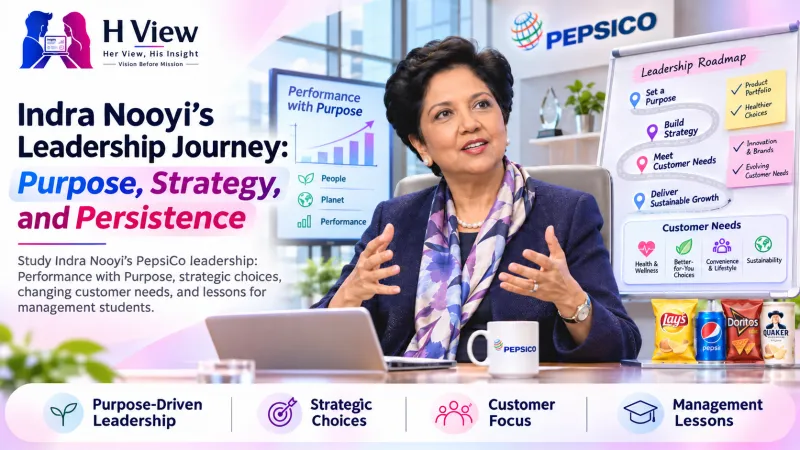
Indra Nooyi’s Leadership Journey: Purpose, Strategy, and Persistence
Indra Nooyi’s PepsiCo journey offers management students lessons in long-term strategy, customer change, purpose-led business, and the effort needed to turn ideas into action.
Indra Nooyi’s leadership at PepsiCo shows management students how a CEO can connect long-term business strategy with changing customer needs and wider responsibilities. Her work on “Performance with Purpose” asked the company to grow while improving its product choices, environmental practices, and support for people. The idea was ambitious, but carrying it out inside a global company meant years of negotiation, investment, measurement, and difficult trade-offs.
Joined PepsiCo: 1994 · Became CEO: 2006 · Became chair: 2007 · Leadership themes: long-term strategy, consumer change, purpose, and execution.
Who is Indra Nooyi?
Indra Nooyi was born in Chennai and built her education and early career in India before taking senior roles in the United States. She studied at Madras Christian College, earned an MBA from the Indian Institute of Management Calcutta, and later completed a master’s degree in public and private management at Yale. Before joining PepsiCo, she worked in strategy roles at Boston Consulting Group, Motorola, and Asea Brown Boveri, experiences that gave her a wide view of how businesses compete and reorganize.
Nooyi joined PepsiCo in 1994 in corporate strategy. Over time, she became chief financial officer and president before the board named her CEO in 2006; she took on the role of chair in 2007. She led a company with a large, varied portfolio of food and beverage brands and operations around the world. That scale helps explain why her work involved more than making a single product or campaign successful. She had to align financial plans, consumer expectations, manufacturing, marketing, people, and environmental goals across many business units.
What was her main idea for managing PepsiCo?
Nooyi’s best-known management idea was “Performance with Purpose.” It connected business growth with three broad areas: products, the environment, and people. PepsiCo said the initiative included developing more nutritious choices, reducing environmental impact, and supporting employees and communities. The idea asked the company to think about the future of its business while still delivering results today.
This was a demanding choice for a company whose sales depended on popular snacks and drinks. Consumers wanted taste, convenience, affordability, and choice; public health concerns and environmental pressures were also becoming harder to ignore. A company could not simply tell customers what they should buy and expect loyalty to follow. Leaders had to examine product design, ingredients, packaging, operations, and how changes were explained to customers and investors.
A purpose statement becomes a business strategy only when it changes priorities, budgets, products, and the way progress is measured.
 Also readSatya Nadella’s Leadership Journey: Lessons in Learning and Change→
How did Nooyi manage strategy and business ideas?
Nooyi’s strategy work at PepsiCo involved deciding how the company could remain competitive as consumer preferences changed. A portfolio built for one generation may not automatically fit the next. Leaders have to understand which products people still value, where the market is moving, and how to test new offers without damaging the strengths that already support the business.
Her approach was not to abandon PepsiCo’s core brands. Instead, the company worked on expanding its range and adapting products and operations over time. That meant food scientists, procurement teams, marketers, factory managers, finance leaders, and sales teams all had roles in the plan. In management language, the idea had to move from corporate strategy into execution. For students, this is an important distinction: a strategic presentation can be approved in one meeting, but the daily work of changing a large business takes years.
Nooyi also brought her financial background into strategic decisions. Strong ideas still need a clear view of costs, returns, risks, and time. A company that invests in a long-term shift has to decide how much it can spend, how to track progress, and what evidence would show that the plan is helping customers and the business. A good manager does not treat purpose and performance as separate boxes; the work is to make them reinforce one another where possible, while being honest about trade-offs.
| Decision area | Management lesson |
|---|---|
| Product portfolio | Adapt to changing customers while caring for brands people already trust. |
| Long-term goals | Translate broad aims into actions teams can own and measure. |
| Business performance | Review financial results and wider effects together, not in isolation. |
How did she sustain and develop the business?
Sustaining PepsiCo required serving customers consistently while investing in products and systems for the future. The company had to keep thousands of products available in different markets, understand local tastes, maintain reliable supply chains, and compete for shelf space. At the same time, it faced pressure to improve the nutritional profile of some products and reduce the impact of its operations. These goals touched different teams and could not be completed by the chief executive alone.
Nooyi spent much of her career building agreement around strategy. She had to explain why the company needed to prepare for shifts that might unfold over many years, while employees and investors still expected near-term results. In a large business, people may support the same goal but disagree about how quickly to move or which changes should come first. Sustained leadership means hearing those concerns, making decisions, setting responsibilities, and reviewing whether the work is producing progress.
Her long service at PepsiCo also reflects a kind of effort that is easy to overlook: learning the company from inside before leading it. She joined in 1994, became CEO in 2006, and served in the role for 12 years. During that time, her responsibilities included strategy, finance, people, products, and communication with a broad set of stakeholders. The position was public, but much of the work happened through preparation, difficult conversations, and repeated follow-through.
Why was it not easy for her to reach this position?
Nooyi’s journey was difficult because she was navigating several demanding transitions at once. She moved from India to build a career in the United States, worked in highly competitive strategy roles, and rose through a global company where major decisions carried consequences for employees, investors, customers, and suppliers. A senior title does not remove the pressure of being accountable for choices that can affect thousands of people.
She also led in an industry facing criticism and changing expectations. Food and beverage companies must balance taste, price, convenience, nutrition, packaging, and responsible operations. Moving too slowly can leave a company unprepared; moving too quickly without customer acceptance can weaken the business. Nooyi’s challenge was to keep PepsiCo financially strong while encouraging it to prepare for a different future. Those tensions are why “purpose” alone was not enough; the company needed products customers would actually choose and operations capable of supporting them.
Leadership at this level can also involve personal costs and barriers that do not appear in annual reports. Nooyi has spoken publicly about balancing work and family, and her memoir examines the demands placed on working parents. For management students, this adds another lesson: organizations are shaped by people’s lives, not only by charts and targets. A thoughtful leader should consider whether workplace expectations make it possible for talented employees to stay, contribute, and grow.
What can management students learn from Indra Nooyi?
First, look beyond the next quarter without ignoring the current business. Nooyi’s work shows why leaders need to prepare for changes in customer needs, social expectations, and the operating environment. Second, make strategy concrete. If a team cannot explain what it should do differently next week, the strategy may still be too broad. Third, bring more than one perspective into decisions: finance, customer understanding, operations, and people all contribute useful evidence.
Students can put these lessons into practice in a small project. Choose a product or service and ask what customers value, what is changing, and what the organization can improve without losing what already works. Set one measurable objective, identify who must contribute, and check results at agreed intervals. This process makes it easier to distinguish a meaningful strategy from an attractive slogan.
Purpose-led management is stronger when people can see how it affects daily choices. Employees need clear expectations and a fair chance to contribute, especially when a company asks them to change established ways of working.
His InsightNooyi’s story shows that a leader’s idea has to survive contact with operations, customers, and financial reality. Persistence matters, but so does adjusting the plan when the evidence changes.
 Also readLeadership Lessons from Our Heroes: From Challenger to Purpose-Driven – Bringing the Six Leadership Archetypes Together→
H View verdict
Indra Nooyi’s journey is valuable for management students because it shows the work behind a long-term business idea. She connected business performance with product choices, environmental concerns, and people, then had to guide a large organization through the practical decisions those ambitions required. Her example does not suggest that every company should copy PepsiCo’s exact plan. It teaches students to understand their customers, define a direction, build support, measure progress, and keep working through the trade-offs.
Frequently asked questions
When did Indra Nooyi become PepsiCo’s CEO?
PepsiCo named Nooyi CEO in 2006. She became chair of the board in 2007 and stepped down as CEO in October 2018.
What does Performance with Purpose mean?
It was PepsiCo’s approach to pursue business growth while working on product choices, environmental impact, and the development of employees and communities.
What management lesson can students learn from Indra Nooyi?
Students can learn to connect long-term strategy with practical execution, involve different teams, and measure progress while remaining attentive to customers and financial realities.
Why was leading PepsiCo difficult?
PepsiCo operated across many markets and product categories. Nooyi had to respond to changing customer expectations and environmental concerns while keeping the company competitive and financially strong.
Self-assessment: What can you learn from her journey?
- How did Performance with Purpose connect business growth with wider responsibilities?
- Why is a strategy difficult to execute across a large company?
- What trade-offs did PepsiCo have to manage as customer expectations changed?
- How can a manager test whether a purpose statement is changing daily decisions?
- Why should financial and customer evidence both matter when reviewing a new idea?
Suggested answers: It linked growth with products, environmental practices, and people; many teams and markets must translate a broad plan into daily work; the company had to balance taste, price, nutrition, packaging, and near-term performance; managers can check budgets, product plans, ownership, and measurable outcomes; and both forms of evidence show whether an idea is useful, viable, and responsible.
Sources
- PepsiCo: CEO transition announcement, 2018
- PepsiCo: Performance with Purpose and sustainability report
- Indra Nooyi: biography and career
- Related H View article: Sundar Pichai’s leadership journey
Cover photo: Indra Nooyi, courtesy of PepsiCo via UCLA Newsroom.
H View stories follow our editorial policy. Spotted an error? Tell us and we will correct it.
Rate this article
One tap is enough. No comment needed.
Was this article helpful?
Your answer goes straight to our editors.









Comments0
No comments yet. Start the conversation.