
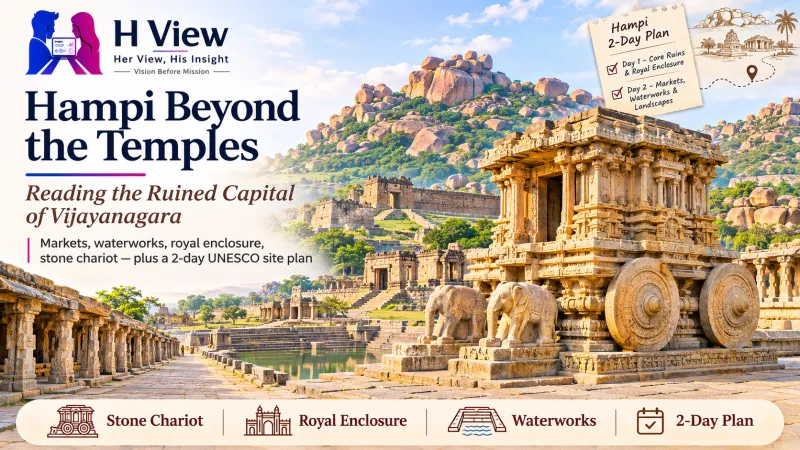
Hampi Beyond the Temples: Reading the Ruined Capital of Vijayanagara
Hampi was once one of the richest cities on earth. Its temples are famous, but its markets, aqueducts and palaces tell the story of how a medieval capital actually lived.
Hampi, in Karnataka’s Vijayanagara district, is the ruined capital of the Vijayanagara empire, founded in 1336 and sacked after the Battle of Talikota in 1565. A UNESCO World Heritage Site since 1986, it preserves not just temples but an entire medieval city: bazaars, royal platforms, aqueducts, stepwells, elephant stables and fortifications spread across a boulder landscape on the Tungabhadra.
Site card
| Founded | 1336, by brothers Harihara I and Bukka Raya I (Sangama dynasty) |
| Peak | Early 16th century under Krishnadevaraya (r. 1509–1529) |
| Fall | Sacked after the Battle of Talikota, 1565 |
| UNESCO | Group of Monuments at Hampi, inscribed 1986 |
| River | Tungabhadra |
| Nearest railhead | Hosapete (Hospet), about 13 km |
Why look at Hampi beyond its temples?
Most visitors come for the Virupaksha temple and the Vittala temple’s stone chariot. But Hampi is rare because the whole city plan survives in ruins. Foreign travellers of the time, including the Portuguese visitors Domingo Paes and Fernão Nunes, described a busy, wealthy capital with markets selling gems and horses. Walking Hampi with that in mind turns scattered stones into streets, homes and workplaces.
What were Hampi’s great bazaars?
Long colonnaded streets run in front of major temples: Hampi Bazaar before Virupaksha, Vittala Bazaar, Krishna Bazaar and the Achyutaraya Bazaar. The pillared pavilions on both sides were shops and rest houses. Imagine them roofed and busy with traders, pilgrims and processions, and you see how temple and commerce were bound together in Vijayanagara life.
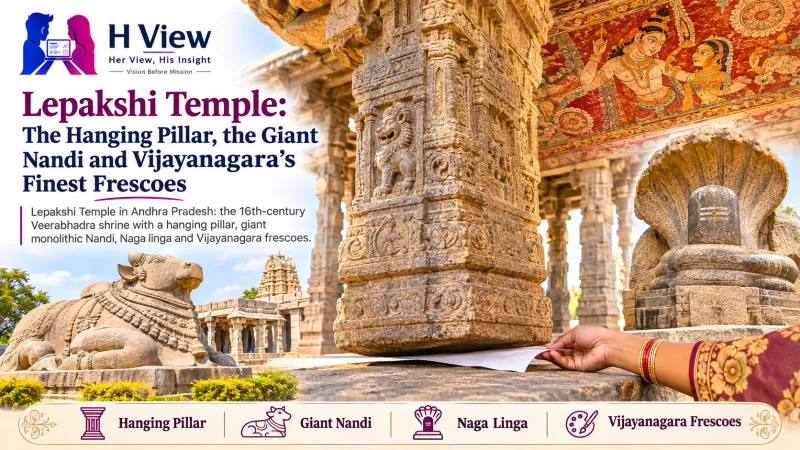 Also readLepakshi Temple: The Hanging Pillar, the Giant Nandi and Vijayanagara’s Finest Frescoes→
What is in the Royal Centre?
| Monument | What it was | Look for |
|---|---|---|
| Mahanavami Dibba | A tall stone platform used for royal ceremonies during the Mahanavami (Dasara) festival | Friezes of processions, hunting, horses and dancers |
| Stepped tank | A finely built geometric stepwell | Precisely cut steps in a pyramid pattern |
| Queen’s Bath | A pool in an arcaded building with Indo-Islamic arches | Balconies over the water |
| Lotus Mahal | An elegant pavilion in the Zenana enclosure | Lotus-shaped arches blending styles |
| Elephant Stables | A long building with domed chambers for royal elephants | Alternating dome designs |
| Hazara Rama temple | The royal chapel | Ramayana panels running along the walls |
How did Hampi manage water?
For a dry, rocky region, Hampi’s water engineering was remarkable. Channels and aqueducts carried water from the Tungabhadra and reservoirs to tanks, baths and fields. Stone aqueducts and the Royal Centre’s stepped tank survive, and some ancient canals in the region still irrigate farmland today. It is a reminder that great capitals depended on engineers as much as kings.
What is the stone chariot, and why is it on the ₹50 note?
In the courtyard of the Vittala temple stands a shrine to Garuda built in the form of a chariot, its wheels carved to look as if they could turn. It has become the emblem of Hampi, and since 2018 it appears on the back of the ₹50 banknote. The same temple’s mandapa has slender stone pillars that ring with musical tones when tapped; visitors are no longer allowed to strike them, to protect them.
What happened to Hampi in 1565?
In January 1565, Vijayanagara’s army, led by Aliya Rama Raya, was defeated at the Battle of Talikota by an alliance of the Deccan Sultanates. Rama Raya was killed, and the victors spent months plundering and destroying the capital. The city was never reoccupied as a capital, which is why so much of its layout survives, frozen in ruin.
1336 — Vijayanagara founded by Harihara I and Bukka Raya I.
1509–1529 — Krishnadevaraya’s reign, the empire’s height.
1565 — Battle of Talikota; the city is sacked.
1986 — Inscribed as a UNESCO World Heritage Site.
1999–2006 — On UNESCO’s List of World Heritage in Danger, due to concerns about construction nearby.
2018 — Stone chariot features on the new ₹50 note.
 Also read10 Temples in India Everyone Should Visit at Least Once→
How should you plan two days in Hampi?
- Day 1, Sacred Centre: Virupaksha temple at sunrise, Hemakuta hill, Hampi Bazaar, then walk the riverside path to the Vittala temple.
- Day 1 evening: sunset from Hemakuta hill or Matanga hill (check safety advice and go in a group).
- Day 2, Royal Centre: Mahanavami Dibba, stepped tank, Queen’s Bath, Lotus Mahal, Elephant Stables and Hazara Rama temple.
- Get around by bicycle, e-rickshaw or with a licensed guide.
- Visit between October and February to avoid extreme heat.
Her View: Stand in the Queen’s Bath and picture the women of the court here. Hampi is a place to imagine daily life, not just admire stone.
His Insight: Hampi shows that a capital is an economy: markets, horses, water and trade. When that system broke in 1565, the city emptied almost overnight.
Frequently asked questions
Why is Hampi famous?
It is the ruined capital of the Vijayanagara empire and a UNESCO World Heritage Site, with temples, palaces, markets and waterworks across a dramatic boulder landscape.
When was Hampi destroyed?
After the Battle of Talikota in 1565, when the victorious Deccan Sultanates sacked the city.
Which monument is on the ₹50 note?
The stone chariot at Hampi’s Vittala temple, featured since 2018.
How many days do you need in Hampi?
Two days cover the main Sacred and Royal Centres; three allows a more relaxed pace.
Sources and how this article was researched
This is a desk-research article based on the sources below.
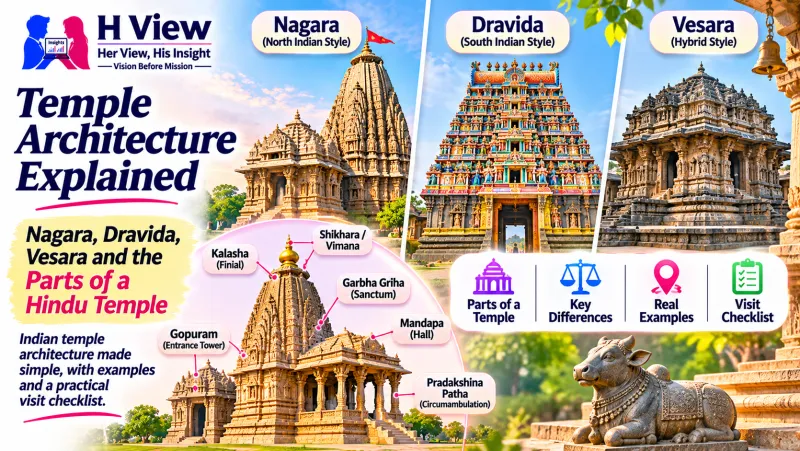
Part of H View’s Devotion & Heritage series. See also: Lepakshi, another Vijayanagara masterpiece, and Temple Architecture Explained.
H View stories follow our editorial policy. Spotted an error? Tell us and we will correct it.
Rate this article
One tap is enough. No comment needed.
Was this article helpful?
Your answer goes straight to our editors.









Comments0
No comments yet. Start the conversation.