
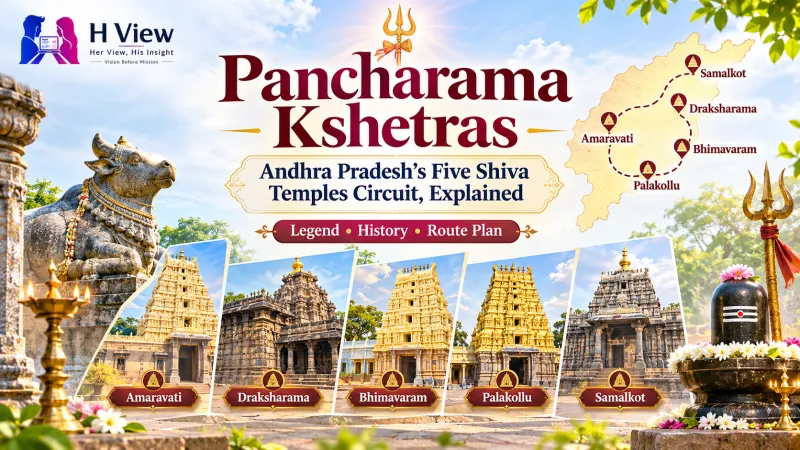
Pancharama Kshetras: Andhra Pradesh’s Five Shiva Temples Circuit, Explained
One legend, one shattered linga and five temples across coastal Andhra. A practical guide to the Pancharama circuit, popular in the holy month of Karthika.
The Pancharama Kshetras are five ancient Shiva temples in Andhra Pradesh: Amararama (Amaravati), Draksharama, Somarama (Bhimavaram), Ksheerarama (Palakollu) and Kumararama (Samalkot). Tradition says each holds a piece of one linga broken by Kartikeya, and many devotees visit all five in a single day, especially during the holy month of Karthika.
What is the legend of the Pancharamas?
The story, told in the Skanda Purana tradition, concerns the demon Tarakasura, who wore a powerful Shiva linga around his neck that made him nearly invincible. In battle, Kartikeya (Kumara Swamy), son of Shiva, shattered the linga with his weapon. Its pieces fell at five places, and the gods installed and worshipped them there. Each place became an “arama”, a sacred grove or abode, giving the circuit its name: Pancharama, the five aramas.
The five at a glance
| Arama | Town | Shiva as | Goddess | Tradition says installed by |
|---|---|---|---|---|
| Amararama | Amaravati, on the Krishna | Amaralingeswara | Bala Chamundika | Indra |
| Draksharama | Draksharama, near Ramachandrapuram | Bhimeswara | Manikyamba | Surya |
| Somarama | Gunupudi, Bhimavaram | Someswara | Rajarajeswari | Chandra |
| Ksheerarama | Palakollu | Ksheera Ramalingeswara | Parvati | Vishnu (as Rama, by one account) |
| Kumararama | Samalkot (Samarlakota) | Kumara Bhimeswara | Bala Tripura Sundari | Kartikeya |
What makes each Pancharama temple distinct?
Amararama, Amaravati
On the banks of the Krishna, in the historic town of Amaravati, once a great Buddhist centre. The tall linga here is a striking feature, and the temple’s setting by the river makes it one of the most peaceful of the five.
Draksharama
The largest and among the most historically important. Its two-storeyed structure and many inscriptions link it to the Eastern Chalukyas of Vengi, and the temple is also counted among the Ashtadasha Shakti Peethas through Goddess Manikyamba. The linga is tall and rises through two levels of the sanctum.
Somarama, Bhimavaram
Associated with the Moon god, Chandra. Devotees believe the linga’s colour changes with the phases of the moon, appearing darker around the new moon and lighter around the full moon. This is a cherished belief that visitors can observe for themselves.
Ksheerarama, Palakollu
Named after milk (ksheera); tradition says Shiva’s arrow struck the earth here and a spring of milk emerged. Its tall white gopuram dominates the town of Palakollu.
Kumararama, Samalkot
Closely linked to Draksharama in architecture; both are associated with Eastern Chalukya king Bhima. The two-storey sanctum and long pillared corridors make it a fine example of Chalukyan building in coastal Andhra. It is protected by the Archaeological Survey of India.
 Also readLepakshi Temple: The Hanging Pillar, the Giant Nandi and Vijayanagara’s Finest Frescoes→
Can you visit all five Pancharamas in one day?
Yes, and it is a popular tradition, especially on Karthika Mondays. Distances are manageable but the day is long, so start before dawn. APSRTC typically runs Pancharama package bus tours during Karthika; check current schedules and booking on its official site.
| Sample route (from Vijayawada) | Approx. timing |
|---|---|
| 1. Amararama, Amaravati | Early morning darshan |
| 2. Somarama, Bhimavaram | Late morning |
| 3. Ksheerarama, Palakollu | Midday |
| 4. Draksharama | Afternoon |
| 5. Kumararama, Samalkot | Evening |
Distances total roughly 400–450 km by road, depending on the route. Many travellers base themselves in Rajahmundry or Kakinada and split the circuit over two days for a calmer experience.
How should you prepare for the circuit?
- Check temple timings; many close in the afternoon for a few hours.
- Hire a car or book a package, as public transport links between towns are slower.
- Carry water and light food; Karthika fasting days get crowded.
- Dress traditionally for smooth entry at all five temples.
- Allow time at Draksharama, the largest of the five.
Her View: A circuit turns a temple visit into a story with chapters. By the fifth temple, the legend of the broken linga feels whole again.
His Insight: The Pancharamas map the fertile Godavari-Krishna delta, the heartland of Eastern Chalukya power. Pilgrimage routes often trace old political geography.
 Also readSrikalahasti Temple: The Vayu Linga, the Hunter Kannappa and the Rahu-Ketu Puja→
Frequently asked questions
What are the five Pancharama temples?
Amararama (Amaravati), Draksharama, Somarama (Bhimavaram), Ksheerarama (Palakollu) and Kumararama (Samalkot).
When is the best time to visit the Pancharamas?
The month of Karthika (October–November) is most auspicious, especially Mondays. October to February has the most comfortable weather.
Can all five Pancharamas be covered in one day?
Yes, with an early start and a car or package tour, though two days is more relaxed.
Is Draksharama a Shakti Peetha?
Yes. Goddess Manikyamba at Draksharama is counted among the Ashtadasha Shakti Peethas.
Sources and how this article was researched
This is a desk-research article. Legends are presented as tradition.
Part of H View’s Devotion & Heritage series. See also: Srisailam and Simhachalam.
H View stories follow our editorial policy. Spotted an error? Tell us and we will correct it.
Rate this article
One tap is enough. No comment needed.
Was this article helpful?
Your answer goes straight to our editors.








Comments0
No comments yet. Start the conversation.