
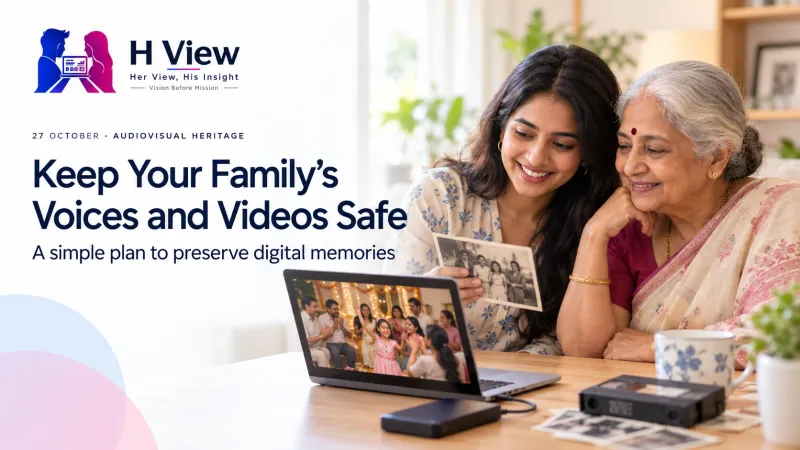
Your Family’s Old Videos Could Disappear. How Can You Preserve Them?
For World Day for Audiovisual Heritage, protect the recordings that matter: family voices, wedding videos, school performances and the stories behind them.
You can preserve family videos by keeping the best available originals, making separate copies and checking that those copies still play. Clear names and a little context help the next person understand them. World Day for Audiovisual Heritage on 27 October is a useful reason to begin with one recording that matters.
Think of a short video in which a grandparent calls your name, a school performance filmed from the back row or a wedding recording that includes people no longer with the family. Such files may look ordinary beside thousands of photographs, until the phone breaks or the only account holding them becomes inaccessible. Their value rarely fits the amount of storage they occupy.
Why does 27 October matter?
UNESCO marks 27 October as World Day for Audiovisual Heritage, drawing attention to recorded sound and moving images as part of our shared memory. UNESCO means the United Nations Educational, Scientific and Cultural Organization. Its focus includes the cultural and linguistic diversity carried by recordings and the importance of keeping that material accessible.
Families have a smaller but meaningful version of that responsibility. A voice recording may preserve the way someone spoke Telugu, a local expression or the story behind a festival tradition. Keeping it does not require turning the household into an archive overnight, but it does require more than assuming the file will always be where it is today.
What can go wrong when a recording is still visible?
Being able to see a thumbnail is not the same as having a dependable copy. The file might exist only on an old phone, inside a messaging account or on a drive that nobody has opened recently. A family can also lose access to an account even when the service itself continues operating.
Start by asking where the actual recording is stored and whether it can be exported as a usable file. A link in a conversation is not necessarily an independent copy, and a folder named backup does not prove that its contents are complete. The useful check is opening the saved recording from its intended storage location and confirming the picture and sound.
A memory needs more than a visible thumbnail
This is a starting routine for a household collection. Irreplaceable or damaged physical media may need specialist help.
 Also readHanuman Ansh Part 2 Could Reveal the Most Important Chapter of Neem Karoli Baba’s Life→
Which version should you keep?
The Library of Congress video guidance recommends preserving the highest-quality available version with useful descriptions. A small copy downloaded from a social post may contain less information than the source recording. If the original still exists, keep it before making convenient versions for sharing.
Imagine a family with a wedding videographer's original file, a shorter edited video and a forwarded messaging copy. These versions serve different purposes, so naming them clearly is better than assuming the smallest one replaces everything else. The original can remain the preservation copy, while the shorter version becomes the easy-to-share copy.
Keep preservation and everyday sharing separate
| Version | Useful purpose | What to remember |
|---|---|---|
| Best available original | It retains the source material you may need later. | Keep it unchanged and make edits on a separate copy. |
| Edited family version | It makes an occasion easier to watch and share. | Record what was changed and retain the source where possible. |
| Compressed sharing copy | It reduces file size for convenient delivery. | Do not assume it contains all the detail of the original. |
| Enhanced version | It may make an old recording easier to view or hear. | Label the processing and keep the unaltered source alongside it. |
These are suggested household labels rather than compulsory archival terminology. Their purpose is to stop one convenient copy from silently replacing every other version.
Our guide to compressing video for WhatsApp and email is useful when preparing a sharing copy. Keep the preservation decision separate from the delivery decision, because saving space for a message and retaining source information are different goals.
Is cloud synchronisation the same as an independent backup?
Synchronisation keeps selected content or changes aligned across connected devices and services. That convenience can also mean an unwanted change reaches more than one place. An independent backup is useful because it provides a separately recoverable copy, rather than depending entirely on the current synchronised state.
Specific services handle deletion differently, so read the rules before clearing a device. For example, Google Photos explains deletion behaviour across backed-up content and connected devices. Do not test an unfamiliar delete command on your only copy of a family recording.
A practical household arrangement can include the working file on a computer, an additional copy on an external drive and a protected copy elsewhere. Keep at least one copy away from the same physical location, and avoid leaving every copy continuously dependent on one account. This is a suggested arrangement to reduce shared risks, not a guarantee against every kind of loss.
How do you make a recording understandable years later?
A filename such as VID_0048 says little to someone who did not record the event. A name such as 2024-08-grandmother-birthday-vijayawada-original is more useful, provided the details are accurate. When the date is uncertain, write approximate or unknown instead of turning a guess into a fact.
Add a small text note containing the names of people, the occasion, the location if appropriate and who supplied the recording. This descriptive information is often called metadata, meaning information about the file rather than the recording itself. A short explanation of who is speaking can be more valuable to a future family member than a decorative title added to the video.
The Library of Congress audio guidance also discusses exporting and describing recordings and checking saved copies over time. A voice note can deserve the same care as a long video. If you create an MP3 listening copy using our audio-extraction guide, label it clearly and retain the source video as well.
What about old tapes and videos that will not open?
A cassette, camera tape or optical disc may need suitable equipment to transfer its contents. If the material is damaged or especially important, ask a reputable preservation or transfer specialist about the process before experimenting. Keep the physical source after a transfer where practical, because a digital copy still needs checking.
For an existing digital file that does not play, preserve an untouched copy before attempting conversion. A conversion may help compatibility but cannot guarantee recovery of missing or damaged information. Our MOV-to-MP4 guide discusses a sharing task, which should be performed on a copy rather than overwriting an irreplaceable source.
A student activity: preserve one family memory
Choose one recording with the family's permission and make the task small enough to complete carefully. Ask the person who understands it to explain the context before that information is forgotten. The exercise is about preserving meaning and access, rather than collecting as many private files as possible.
- Locate the best available source. Ask whether a camera file or original export exists before choosing a forwarded copy.
- Make a clearly named preservation copy. Keep it separate from anything you edit, compress or enhance.
- Create another copy in a separate place. Confirm that it is independently accessible rather than simply another link to the same file.
- Check the recording and write its context. Listen and watch for obvious problems, then add a short note identifying what is known and uncertain.
- Agree on a future check. Assign someone to revisit playback and access instead of assuming the task is permanently finished.
Preserving a memory also means respecting people
Keep it accessible to the family
- Explain where the agreed copies are stored and who can access them.
- Keep recovery arrangements in a secure place rather than inside a public folder.
Choose sharing deliberately
- Ask before publishing recordings of relatives or children.
- A private archive does not need to become a public social-media post.
Access and public exposure are different decisions. Agreeing to preserve a recording does not automatically mean agreeing to publish it.
 Also readWhy Indian Festivals Have Become Major Digital Shopping Events→
Her View
The most precious part of a recording may be the imperfect moment nobody planned to capture. A laugh, an accent or an ordinary conversation can carry more meaning than a carefully edited highlight. Families should be able to preserve that intimacy without feeling that every memory needs improvement or a public audience.
His Insight
A preservation plan is only useful when someone can retrieve the file and understand it. Keep the system simple enough that another family member can follow it, and check that a second copy is genuinely usable. A complicated collection that depends on one person's memory remains fragile even when it contains many files.
H View Verdict
Use 27 October to protect one meaningful recording and establish a repeatable routine. Preserve the source, keep separate copies, describe the context and return to check access over time. That modest effort gives family voices and experiences a better chance of remaining understandable to the next generation.
Frequently Asked Questions
Should I keep the original after compressing a video?
Keep the best available original when the recording has long-term value. A smaller sharing copy serves a different purpose and may contain less information.
Are two folders on the same phone enough?
Both folders can be lost if the phone fails or disappears. Separate copies should not all depend on the same device or location.
Can cloud storage be part of the plan?
A protected cloud copy can be useful alongside other copies. Understand the account, deletion and recovery arrangements rather than assuming synchronisation protects every previous version.
Does converting a file improve its quality?
Changing the format does not automatically restore lost information. Keep the source and check any converted version before depending on it.
Do I need to publish recordings to preserve them?
A private family collection can preserve a recording without making it public. Obtain permission and decide separately who should be able to view or hear it.
H View stories follow our editorial policy. Spotted an error? Tell us and we will correct it.
Rate this article
One tap is enough. No comment needed.
Was this article helpful?
Your answer goes straight to our editors.









Comments0
No comments yet. Start the conversation.