
The Digital Marketing Funnel Explained: From Stranger to Loyal Customer
What a digital marketing funnel is, its five stages from awareness to loyalty, and how Indian small businesses can find and fix where customers drop off.
A digital marketing funnel is the path a person takes online from first hearing about your business to buying from you and coming back again. It usually has five stages: awareness, interest, consideration, conversion and loyalty. Knowing your funnel tells you what to say to each person, and where you are losing customers.
What is a digital marketing funnel?
Think of a funnel used to pour oil into a bottle. It is wide at the top and narrow at the bottom. Many people see your business, fewer take an interest, and only some of them buy. A digital marketing funnel is simply a map of that narrowing, built for the online world of Google searches, Instagram reels, WhatsApp chats and websites.
The idea itself is old. Advertising pioneer E. St. Elmo Lewis is widely credited with the AIDA model (Attention, Interest, Desire, Action), which described the steps a buyer moves through more than a century ago. Today's digital funnel keeps that core thinking and adds one important stage at the end: keeping the customer you worked so hard to win.
What are the stages of the digital marketing funnel?
Different books use different names, but most models describe the same journey. Here is a simple five-stage version that works for most Indian small businesses.
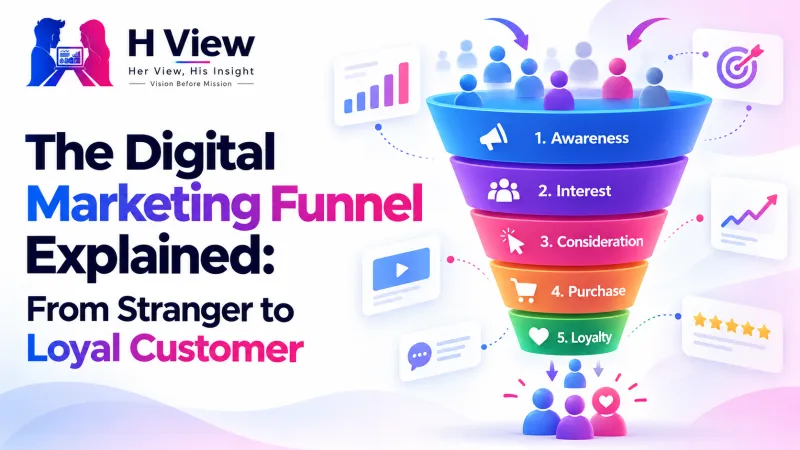
The five stages of a digital marketing funnel
Each stage is smaller than the one above it. Your job is to help more people move down.
Each stage needs a different kind of message:
| Stage | What the customer thinks | What works well |
|---|---|---|
| Awareness | "I have a problem" or "This looks interesting" | Reels, helpful blog posts, Google Business Profile, local search |
| Interest | "Tell me more" | Useful posts, how-to videos, a clear website, a WhatsApp catalogue |
| Consideration | "Is this the right choice for me?" | Reviews, price lists, comparisons, before-and-after photos, FAQs |
| Conversion | "I am ready, how do I buy?" | Simple booking or order steps, UPI payment, quick replies |
| Loyalty | "Should I go back? Should I tell a friend?" | Thank-you messages, offers for regulars, asking for a review |
Marketers also use the short forms TOFU, MOFU and BOFU, which stand for top, middle and bottom of the funnel. Awareness is the top, interest and consideration are the middle, and conversion is the bottom.
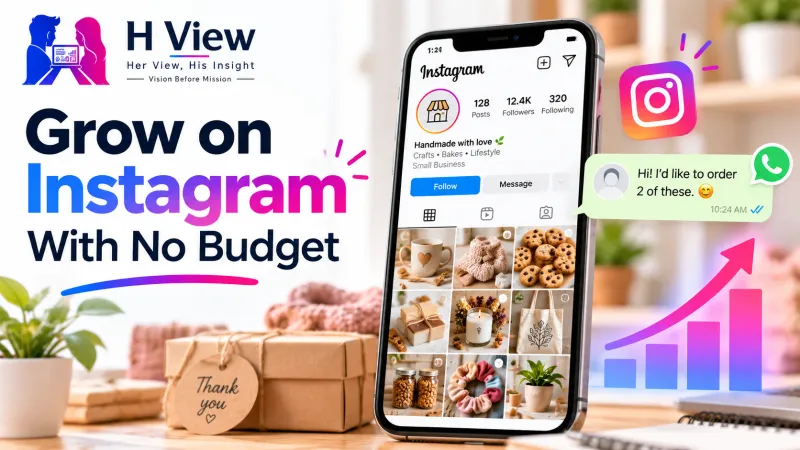 Also readInstagram for Small Businesses: What to Post When You Have No Marketing Budget→
How does a stranger become a loyal customer? A real-life example
Let us follow Meera, who lives in Hyderabad and wants a cotton saree for a family function. Here is how a small boutique could guide her through its funnel.
Meera's journey with a local boutique
The same flow works for a coaching centre, a clinic or a kirana store that takes orders on WhatsApp.
Notice that no single post did all the work. The reel created awareness, the profile built interest, the reviews helped her decide, the easy WhatsApp ordering closed the sale, and the after-sale message made her a repeat customer.
A coaching centre's funnel might be: an exam-tips video, a free mock test, a demo class, admission, and a referral discount.
Why is the real customer journey messier than a funnel?
Real people do not move in a straight line. They jump back and forth, leave for a week, then return after seeing a friend's post. Google's consumer insights team studied this in its research report Decoding Decisions: Making sense of the messy middle, run with The Behavioural Architects.
The research describes the space between the first trigger and the final purchase as the "messy middle". In this space, shoppers loop between two modes: exploration, where they widen their options, and evaluation, where they narrow them down.
Inside Google's messy middle research
Source: Google and The Behavioural Architects, Decoding Decisions (2020)
The study also highlighted six behavioural factors that influence choices in the messy middle:
- Category heuristics: quick shortcuts, such as checking the specifications that matter most.
- Power of now: the longer people wait for a product, the weaker the pull to buy.
- Social proof: reviews and recommendations from others.
- Scarcity bias: limited stock makes a product feel more desirable.
- Authority bias: trust in experts or credible sources.
- Power of free: a free gift or free delivery can sway a decision.
So treat the funnel as a map, not a rulebook. It helps you plan content for each stage, while remembering that customers may skip steps or circle back.
Which content works at the top, middle and bottom?
A common mistake is to post only "Buy now" offers, which speak only to the small group at the bottom. A healthy plan has something for every stage.
Content for each part of the funnel
Top: get noticed
- Helpful reels and short videos
- Blog posts that answer common questions
- An updated Google Business Profile
Middle: build trust
- Customer reviews and testimonials
- Price ranges and service details
- Behind-the-scenes posts and FAQs
Bottom: make buying easy
- Clear call to action
- Quick WhatsApp replies and UPI payment
- Thank-you message and repeat offer
Spread your effort across all three, not only on sales posts.
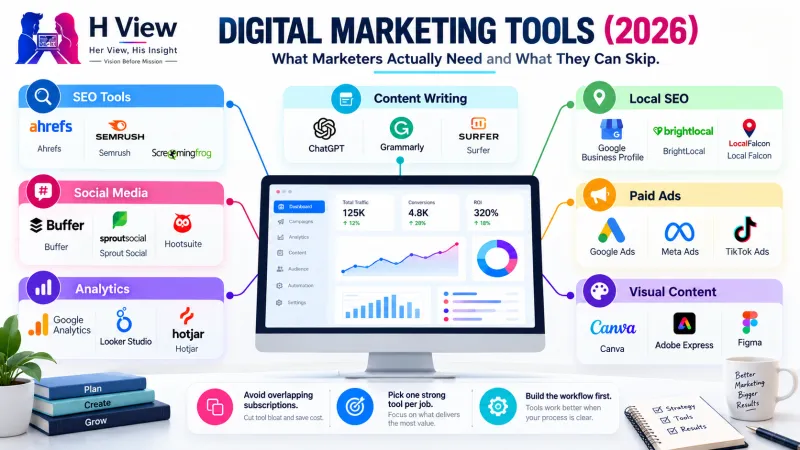
For top-of-funnel visibility, start with the basics we covered in our guides on Google Business Profile for small businesses in India and what to post on Instagram with no budget. If you want to write blog posts that people actually find, our guide to keyword research for beginners shows how to discover what customers search for.
How do you build and measure your own funnel?
You do not need expensive software. A notebook or simple spreadsheet is enough to start.
Your first funnel checklist
- Write down where new customers first hear about you today
- List one piece of content for each of the five stages
- Make the "buy" step as short as possible: fewer clicks, fewer questions
- Ask every new customer how they found you, and note the answer
- Send a thank-you message after each sale and ask for a review
- Check your numbers monthly and fix the stage with the biggest drop
Start small. One fixed leak is worth more than ten new campaigns.
Once your website has traffic, you can measure the funnel properly. Google Analytics 4 has a funnel exploration report that lets you visualise the steps users take to complete a task and see where they drop off. You can define up to 10 steps, for example: visited the home page, viewed the services page, opened the contact form, submitted the form.
If 500 people view your services page but only 10 open the contact form, the leak is clear. Maybe the page has no price range, or the button is hard to find on a phone. Fixing that one step often helps more than spending extra on ads to bring new visitors to the top.
 Also readGoogle Business Profile for Small Businesses in India: How to Show Up When Customers Search Nearby→
Her View
Behind every stage of the funnel is a real person with real doubts. The mother choosing a coaching centre for her child is anxious about fees and results. The first-time patient searching for a clinic wants to feel safe. When we see customers as people who need reassurance, not as "leads", our content becomes kinder and more useful. A warm reply, an honest price and a simple thank-you note do more for loyalty than any discount. The funnel works best when it is built on respect.
His Insight
The funnel is a measurement tool first. Count the people at each stage, even roughly, and find the stage with the biggest drop. That is where your next rupee and next hour should go. Most small businesses spend heavily on awareness while losing customers at the conversion step through slow replies, confusing forms or missing prices. Track one number per stage, review it monthly, and change one thing at a time so you know what worked.
H View Verdict
A digital marketing funnel turns scattered marketing into a clear plan. Use it to make sure you have something for strangers, something for people who are comparing, and something for customers who have already bought. Accept that real journeys are messy, measure where people drop off, and fix the biggest leak first. For the wider picture, read our guide to digital marketing in 2026.
Want this done for your business?
If mapping your customer journey and fixing the leaks in your funnel feels like a lot to manage alongside running your business, the H View team can help. H View studies how your business works today and builds the right digital platform for it, from search visibility to turning manual work into automated systems.
- Website SEO
- GEO and AI search visibility
- Websites and apps
- CRM and ERP
- Management portals
- Automation and digitisation
Frequently Asked Questions
What are the 5 stages of a digital marketing funnel?
The five common stages are awareness, interest, consideration, conversion and loyalty. Some models use fewer stages, such as top, middle and bottom of the funnel. The names matter less than making sure you have content and a clear next step for each stage.
Is the AIDA model the same as a marketing funnel?
AIDA (Attention, Interest, Desire, Action) is one of the earliest funnel models and is widely credited to E. St. Elmo Lewis. Modern digital funnels build on it and usually add a loyalty stage after the purchase.
Does a small business really need a marketing funnel?
Yes, even a small shop benefits from thinking in funnel stages. It shows whether you lack visibility, trust or an easy way to buy. You can start with a simple notebook and a question to each customer about how they found you.
How can I see where people drop out of my funnel?
On a website, the funnel exploration report in Google Analytics 4 shows how many users complete each step you define and where they leave. Offline or on WhatsApp, you can keep a simple count of enquiries, quotes sent and orders confirmed. The step with the biggest drop is the one to fix first.
H View stories follow our editorial policy. Spotted an error? Tell us and we will correct it.
Rate this article
One tap is enough. No comment needed.
Was this article helpful?
Your answer goes straight to our editors.

Comments0
No comments yet. Start the conversation.