
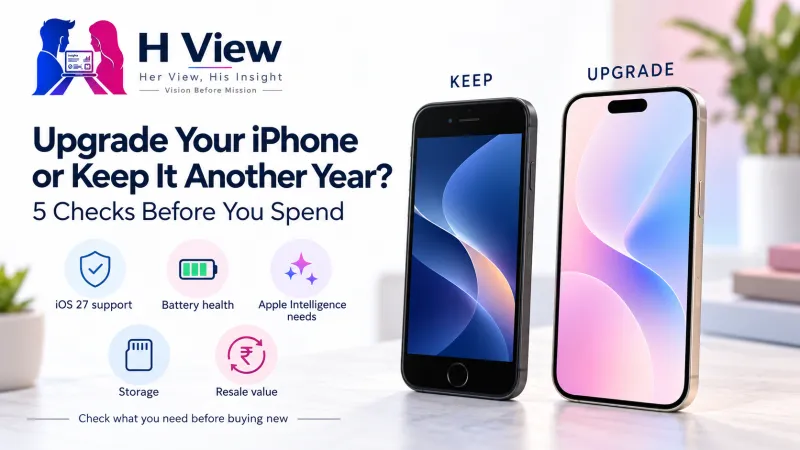
Should You Upgrade Your iPhone or Keep It Another Year? 5 Checks Before You Spend
iOS 27 supports every iPhone from the iPhone 11 onward, so many people can wait. Five quick checks to decide whether to upgrade now or keep your iPhone another year.
Should you upgrade your iPhone? Keep it another year if it runs iOS 27, its battery health is above about 80% or you will replace the battery, and storage and camera still suit you. Upgrade if it is an iPhone 11 or second-generation SE, the battery is worn and you would not repair it, or you want Apple Intelligence, which needs an iPhone 15 Pro or newer.
The new iPhone launch season always makes a perfectly good phone feel old. Friends post unboxing videos, sale banners shout about exchange bonuses, and suddenly your two- or three-year-old iPhone seems slower than it did last week. Before you spend ₹80,000 or more, run through a few honest checks. Most of them take less than five minutes in Settings.
Will your iPhone still get updates?
Yes, if it is an iPhone 11 or newer. Apple released iOS 27 on September 14, 2026, and it supports the same iPhones as iOS 26, according to MacRumors. No model was dropped this year.
| iOS 27 supports | Models |
|---|---|
| iPhone 18 series | 18 Pro, 18 Pro Max, Duo |
| iPhone 17 series | 17e, 17, 17 Pro, 17 Pro Max, Air |
| iPhone 16 series | 16e, 16, 16 Plus, 16 Pro, 16 Pro Max |
| iPhone 12 to 15 series | All models |
| iPhone 11 series | 11, 11 Pro, 11 Pro Max |
| iPhone SE | 2nd generation and later |
One catch: the iPhone 11 series and the second-generation SE are the oldest phones on the list. Apple has not said when they will lose support, but the oldest models are usually the first to be dropped. If you own one, plan your upgrade within the next year rather than waiting for the phone to fall off the list.
Do you need Apple Intelligence?
Apple Intelligence features, including the new Siri AI, need an iPhone 15 Pro or newer, and Siri AI launched in English first (MacRumors). So an iPhone 13, 14 or standard 15 gets iOS 27, but not these AI tools. Be honest with yourself here. If you have not missed AI features so far, this alone is not a reason to spend a lakh.
 Also readBuying a Phone Under ₹20,000? 7 Compromises to Check Before You Pay→
How is your battery really doing?
Go to Settings > Battery > Battery Health. You will see the maximum capacity and, on newer models, the cycle count.
- Older iPhones are designed to keep about 80% of their original capacity at 500 full charge cycles
- Apple says the iPhone 15 line-up keeps 80% after at least 1,000 cycles (Engadget)
- Below 80%, you will notice shorter battery life and, on some models, slower performance at peak loads
A worn battery is the most common reason an iPhone feels "old". A genuine battery replacement at an Apple Store or Apple Authorised Service Provider costs a fraction of a new phone and can make the next year feel very different. Check the current price for your model on Apple's support site before deciding.
Keep or upgrade: a quick checklist
Decide in five checks
Keep it another year
- iPhone 12 or newer
- Battery health above about 80%, or you will replace it
- At least 20% storage free
- Camera still meets your needs
- No cracked screen or water damage
Time to upgrade
- iPhone 11 series or SE (2nd gen)
- Battery worn and repair not worth it
- Storage always full even after clean-ups
- You need Apple Intelligence for work
- Physical damage that is costly to fix
Storage is often fixable. Before blaming the phone, try our guide to freeing up iPhone storage.
If you do upgrade, which iPhone makes sense?
You do not have to buy the newest Pro. The iPhone 18 Pro sells for around ₹1.65 lakh, as we covered in our piece on the iPhone 18 Pro craze. Older models often get cheaper after each launch, and our guide to older iPhone prices explains which ones are better value. If you want Apple Intelligence on a budget, look at the iPhone 15 Pro or later; if you do not, an iPhone 16 or 17 can last years.
Also think about exchange. Your current iPhone has the highest resale value while it is still on the latest iOS and has a healthy battery. Waiting until it is very old reduces what you will get for it.
Her View
An iPhone often gets passed down in Indian families, from a working professional to a parent, from an older sibling to a younger one. If your phone is still on iOS 27 with a decent battery, handing it down after a battery change can be a thoughtful upgrade for someone else, while you take your time choosing your next phone.
 Also readBuy a Phone This Diwali or Wait for Black Friday 2026? A Simple Way to Decide→
His Insight
Put a number on it. A new iPhone at ₹80,000 used for four years costs about ₹20,000 a year. A battery replacement that buys you one more good year is usually far cheaper than that. If the maths favours keeping it, keep it, and put the difference aside so your next upgrade does not need an EMI.
H View Verdict
Most iPhone 12 to 15 owners can comfortably keep their phones another year, especially after a battery replacement, since all of them get iOS 27. Upgrade now if you have an iPhone 11 or second-generation SE, if repairs cost too much, or if you genuinely need Apple Intelligence. Check Settings first, not sale banners.
Frequently Asked Questions
Which iPhones support iOS 27?
iOS 27 supports the iPhone 11 series and newer, plus the second-generation iPhone SE and later. It supports the same models as iOS 26.
Which iPhones get Apple Intelligence?
Apple Intelligence and Siri AI need an iPhone 15 Pro or newer.
When should I replace my iPhone battery?
Consider it when Battery Health shows maximum capacity below about 80% or a service message appears. A replacement can make an older iPhone feel much better.
Is it worth upgrading from an iPhone 13 or 14?
Only if you need Apple Intelligence, a better camera or more storage. Both models get iOS 27, so many owners can wait another year.
H View stories follow our editorial policy. Spotted an error? Tell us and we will correct it.
Rate this article
One tap is enough. No comment needed.
Was this article helpful?
Your answer goes straight to our editors.










Comments0
No comments yet. Start the conversation.