

Entry-Level Job—but Experience Required? The Fresher Trap Nobody Is Fixing
A fresher opens a job portal and finds an attractive vacancy. The title says Entry-Level,…
 Satya Hemanth August 9, 2026
  By Satya HemanthUpdated September 20, 20267 min read42 views
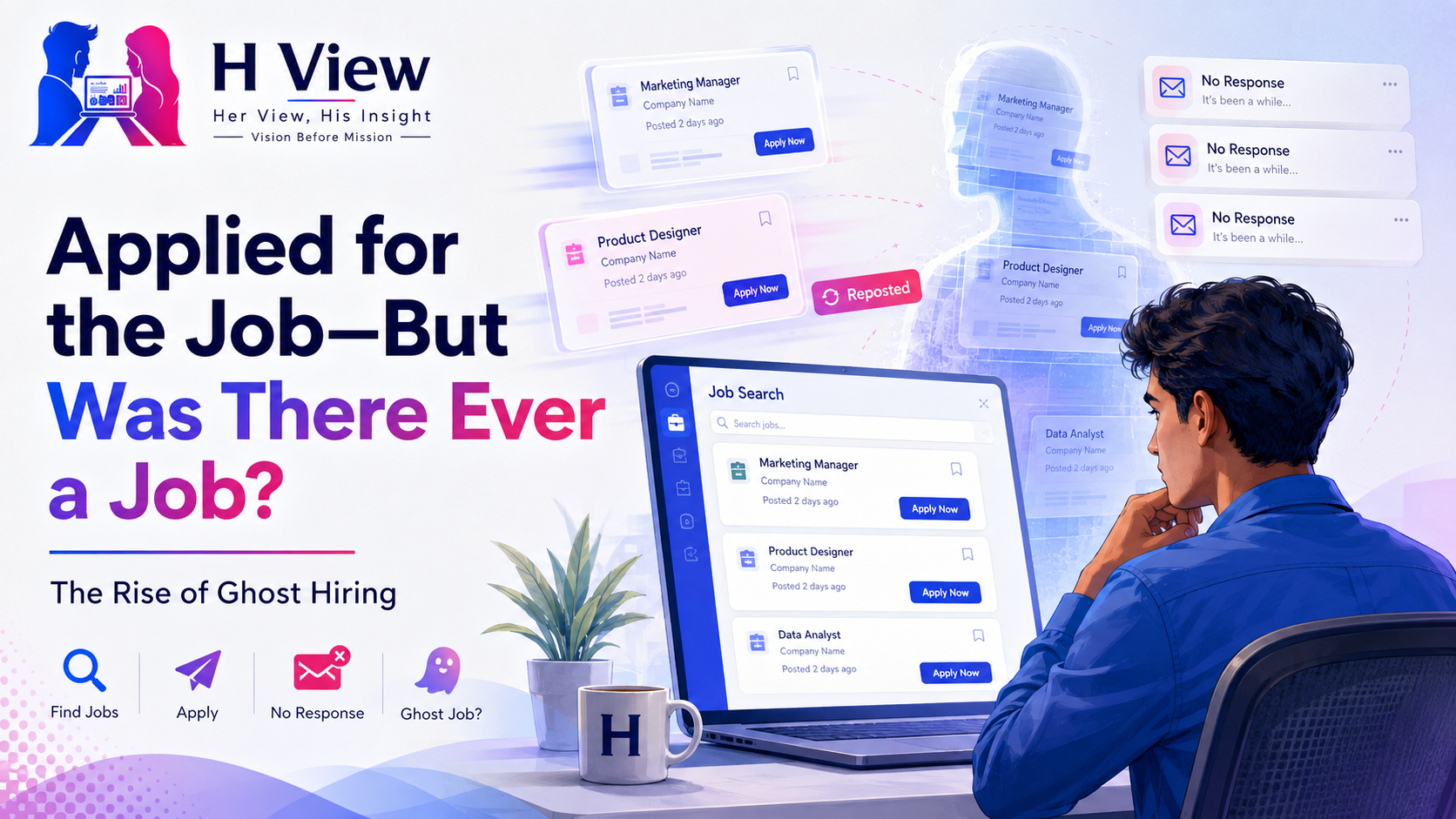
You find a job that perfectly matches your profile.
The company looks genuine. The role is clearly described. The vacancy was posted only a few days ago, so you carefully update your resume, write a cover letter and submit the application.
Then nothing happens.
No rejection. No assessment. No interview.
A few weeks later, the exact same vacancy appears again.
For job seekers already dealing with repeated rejection, this creates a disturbing question:
Was the company actually hiring anyone at all?
This is where the term ghost job enters the conversation.
A ghost job generally refers to a vacancy advertised even though the employer may not currently intend to fill it. The role may have been paused, already filled, kept open for future hiring or posted primarily to collect resumes.
The issue has become increasingly visible in India. Recent reporting has highlighted growing frustration among applicants who repeatedly see vacancies that appear active but result in little or no visible hiring activity.
Ghost hiring does not mean every unanswered application is fake.
But it does mean job seekers should understand that an online vacancy is not always the same thing as an immediate hiring requirement.
The reasons are not always malicious.
A company may expect to hire later and wants a ready list of candidates.
Instead of beginning recruitment from zero when a position opens, recruiters maintain a pool of possible applicants.
Budgets change. Projects are delayed. Clients cancel work. A position that was approved when the advertisement went live may later be frozen.
The listing may remain online even though interviews have stopped.
A company might advertise externally while also considering an employee for the position.
If the internal candidate receives the role, hundreds of outside applicants may never progress.
Recruitment systems can automatically repost or distribute vacancies across multiple job portals.
A position may remain visible long after hiring has finished.
Some employers may use advertisements to measure salary expectations, available skills or potential candidates for upcoming expansion.
Research into ghost-job postings has suggested that talent-pipeline building and the very low cost of maintaining online advertisements may contribute to the practice. One study estimated that as many as 21% of advertisements in its dataset could potentially fit the ghost-job category. That figure comes from a specific research dataset and should not be treated as the percentage of all jobs everywhere.
It is easy to see every silent vacancy as deliberate deception.
Real recruitment is often more complicated.
A hiring manager may receive approval for five people and later be allowed to hire only two. A project may disappear. A client may postpone a contract. An employee may decide not to leave after all.
Recruiters may therefore have started the hiring process genuinely.
Even a repeatedly advertised position does not automatically prove wrongdoing.
Companies also need talent pipelines for positions where turnover is frequent or hiring happens throughout the year.
There is nothing inherently wrong with collecting expressions of interest for future roles—provided candidates understand that the opportunity may not represent immediate employment.
The problem begins when an advertisement looks exactly like an active vacancy even though the employer has little or no immediate intention to hire.
A candidate may spend an hour:
Multiply that across dozens of questionable postings and the result is significant wasted time and emotional exhaustion.
Ghost jobs can also distort how candidates understand the labour market.
If someone sees hundreds of apparently available positions, they may believe employment is booming—and then blame themselves when none produces a response.
Employers benefit from being more transparent.
A listing could clearly state:
“Talent pipeline—future opportunities.”
That one sentence changes the candidate’s expectations completely.
None of these signs proves that a vacancy is a ghost job, but they justify additional investigation.
If the identical role appears every few weeks for many months, check whether the organisation is actually expanding or repeatedly hiring for that position.
Roles remaining continuously advertised for months may represent evergreen recruitment rather than one immediate opening.
A vague advertisement seeking almost every skill in the industry may be collecting general profiles.
A third-party portal may still display an expired listing.
Always check the employer’s official careers page.
A listing with little information about team, location or reporting structure may deserve additional verification.
This may be legitimate during rapid growth—but if little evidence of actual hiring exists, research further before spending significant time on each application.
This distinction is important.
A genuine vacancy can still produce no response because:
Candidate ghosting itself is also common. LinkedIn-related reporting in 2025 cited survey findings suggesting a substantial share of job seekers had experienced being ghosted during recruitment.
Therefore, do not label every company fraudulent simply because it did not reply.
Instead, change how much time you invest before verifying the vacancy.
Whenever possible, apply directly through the employer rather than an old listing copied elsewhere.
A position appearing as “new” on one portal may have existed elsewhere for months.
LinkedIn employee updates, recruiter posts and company announcements can sometimes reveal whether teams are genuinely expanding.
Applying early does not guarantee selection, but it reduces the chance that the recruitment cycle is already near completion.
A thoughtful message to the relevant recruiter can sometimes confirm whether hiring is active.
Reserve deep customisation for roles that strongly match your profile and appear genuinely active.
A simple system can protect both time and energy.
Recently posted, official company listing, strong skill match and clear role.
Spend time customising your resume.
Legitimate company and reasonable match, but vacancy status is less clear.
Apply with a targeted base resume.
Repeatedly reposted, vague or very old vacancies.
Apply only when it takes minimal additional effort unless you can confirm active recruitment.
This does not eliminate ghost jobs.
It prevents them from consuming your entire job-search day.
No.
Future hiring pools can help both employers and candidates.
The problem is the label.
If a company is collecting applications for future opportunities, say so.
If the position is currently frozen, pause the advertisement.
If the job has already been filled, remove it.
Job seekers are making career decisions based on the signals companies publish.
Those signals should be as accurate as reasonably possible.
Sometimes you did everything correctly.
Your resume matched. Your application was submitted on time. Your skills were relevant.
And there still may never have been an immediate vacancy waiting at the other end.
That possibility should not make you distrust every job advertisement.
It should make you more selective.
Verify the employer’s careers page. Watch for repeatedly recycled vacancies. Prioritise recent openings and diversify your search through referrals, recruiters and direct applications.
Most importantly, do not measure your ability entirely by the number of unanswered applications.
Sometimes the question is not:
“Why didn’t they select me?”
It may be:
“Were they actually selecting anyone?”
A ghost job is generally a vacancy advertised without a current intention to hire someone immediately, although definitions vary.
Not necessarily. Some represent genuine future hiring plans, paused positions or talent-pipeline recruitment rather than scams.
Possible reasons include ongoing recruitment, high turnover, future talent pipelines, automated reposting or a position that has been repeatedly paused.
Check the company’s official careers page, posting date, recruiter activity and whether the role has recently been discussed publicly.
No. Genuine vacancies can also receive huge application volumes or be filled before every candidate receives a response.
No. Use job portals alongside direct company applications, referrals, recruiter outreach and professional networks.
Satya Hemanth is the founder of H View and writes on careers, sports, leadership, digital trends, and practical decision-making. His articles focus on clear explanations, real-world examples, and useful insights for students, young professionals, and everyday readers.
Share your real experience and help other readers decide better.
No community views yet. Be the first to share yours.
A fresher opens a job portal and finds an attractive vacancy. The title says Entry-Level,…
Satya Hemanth August 9, 2026 
For generations, the path to a secure career appeared simple: Study hard, complete a degree…
Satya Hemanth August 7, 2026 
Sending hundreds of job applications without receiving a single interview can be deeply frustrating. A…
Satya Hemanth August 6, 2026 
A long employment gap can make job seekers feel that honesty is working against them.…
Satya Hemanth August 4, 2026