
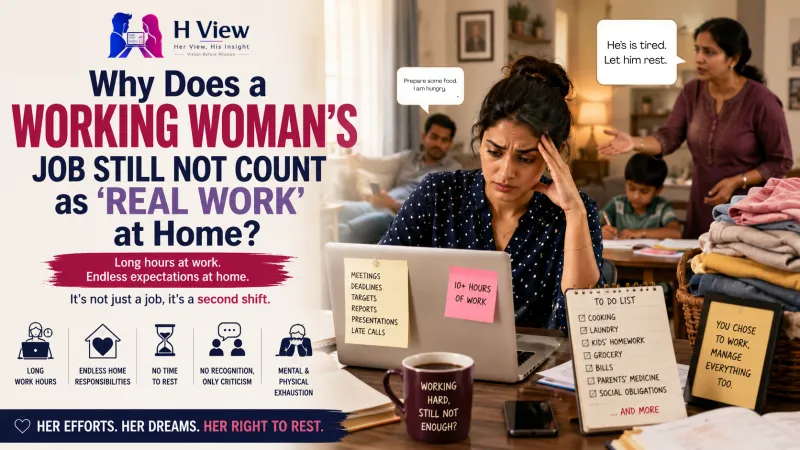
Why Does a Working Woman’s Job Still Not Count as “Real Work” at Home?
A man comes home late after a demanding day at work and people often notice immediately that he is tired. Someone may ask him to sit down, bring him dinner, lower the noise, or tell the children not to disturb him because he has been working all day. His exhaustion is visible, un
A man comes home late after a demanding day at work and people often notice immediately that he is tired. Someone may ask him to sit down, bring him dinner, lower the noise, or tell the children not to disturb him because he has been working all day. His exhaustion is visible, understood, and usually treated as reasonable.
A woman can return home after the same ten-hour day, the same traffic, the same targets, the same meetings, the same pressure from managers, and the same fear of missing a deadline, yet the response can be completely different. Instead of being asked whether she needs to rest, she may be asked why dinner is late, whether the clothes were washed, why something was not purchased, whether she called a relative, or why a household task was left unfinished.
This does not happen in every family, but it happens often enough to reveal a larger problem. Society has accepted that women can work, earn, build careers, and contribute financially, yet many families have not fully accepted that employment also takes a woman's time, energy, concentration, and emotional capacity. Her salary may be welcomed while her exhaustion is still treated as optional.
That contradiction is one of the most frustrating realities facing working women today.
The Eight-Hour Workday Often Exists More on Paper Than in Real Life
Modern work does not always finish when office hours officially end. In target-driven roles, IT companies, agencies, finance, sales, management, healthcare, operations, and many private-sector jobs, the actual day can stretch much further. There are meetings that run late, reports that must be completed before morning, urgent calls from managers, last-minute client changes, commute time, and messages that continue long after someone has left the office.
A woman may technically work from nine to six, but her day does not necessarily occupy only those hours. She may leave home early to beat traffic, spend an hour commuting, work beyond the scheduled time, travel home exhausted, and still receive messages while eating dinner. By the time she finally reaches home, she may already have spent ten or eleven hours mentally connected to work.
Yet families sometimes continue to judge her evening as though she has just returned from a comfortable few hours outside the house. Her professional workload remains invisible because nobody at home saw the meetings, deadlines, pressure, or effort that consumed her day.
Her Salary Is Real, but Her Workload Is Treated as Secondary
One of the strangest contradictions appears when the household depends on a woman's income but still treats her job as less important than a man's.
Her salary may help pay the home loan, school fees, groceries, insurance, medical bills, savings, travel, or family expenses. Everyone benefits from the income. However, when work demands more of her time, the response can quickly change. She may hear that family should come first, that office work will never end, or that she should learn how to manage everything better.
A man's late meeting is often interpreted as responsibility. A woman's late meeting can be interpreted as poor household management.
The difference is not always spoken directly. It appears through expectations. If a husband works late, dinner may wait for him. If a wife works late, she may still be expected to ensure dinner exists.
This is where employment begins to feel unequal even when both partners technically have jobs.
 Also readYou Got the Degree—But Will You Ever Work in That Field? India’s Education-to-Job Mismatch→
Working Women Often Start a Second Shift at Home
For many women, reaching home does not mean the working day has ended. It simply means the location of the work has changed.
There may be dinner to prepare, dishes to manage, children's homework to check, clothes to organise, medicines to remember, groceries to plan, and family needs to handle. Even when domestic help is available, someone often has to supervise what needs to happen.
This is why household work cannot be reduced to cooking and cleaning alone. A large part of it is planning. Someone has to notice that groceries are low, remember that a school payment is due, arrange an appointment, think about what the family will eat tomorrow, or prepare for an upcoming function.
When one person carries most of that responsibility alongside full-time employment, exhaustion is predictable. The problem is not that she needs better time management. Her available time is simply being asked to contain too much.
Why Does a Working Man Receive Care While a Working Woman Receives Questions?
This is one of the most painful double standards because it appears in very ordinary moments.
When a son or husband says he had a terrible day at work, families often instinctively move toward care. He may be encouraged to rest because everyone understands that professional pressure is exhausting.
When a daughter-in-law or wife says exactly the same thing, the response may still include a reminder about what she has not done.
The woman is not asking to be treated as incapable. She is often asking for the same basic recognition given to men: that working for ten hours can make any human being tired.
Support does not have to mean someone waits on her constantly. It can be as simple as another family member preparing dinner, taking responsibility for a task without being asked, allowing her to sit quietly for an hour, or accepting that something can wait until tomorrow.
The difference between support and criticism can completely change how home feels after an exhausting day.
In-Law Expectations Can Make the Pressure Stronger
For many married women, the issue becomes more complicated after entering another household. A daughter-in-law may be professionally successful outside the home but still be evaluated according to traditional expectations inside it.
She can attend important meetings, manage a team, handle clients, and earn a significant salary, yet her competence at home may still be judged through food, household routines, family functions, availability to relatives, and how well she “manages everything.”
This creates an impossible standard. Her professional success does not replace traditional expectations; it is added on top of them.
Some in-laws are highly supportive and actively encourage daughters-in-law to build careers, but others may see employment as something acceptable only as long as it does not change how the household functions. The unspoken expectation becomes: work if you want, but nothing at home should ever appear affected by the fact that you work.
That is not genuine support. It is permission to work only if she can somehow behave as though she does not.
“You Chose to Work” Is Not a Fair Answer
Working women sometimes hear a particularly dismissive argument: if the job is difficult, why work at all?
The same question is rarely asked of men.
A man's job is generally treated as necessary, while a woman's job may still be treated as optional even when her income substantially supports the family. This creates the idea that because she “chose” a career, she should absorb all the additional difficulty without expecting the household to change.
But women work for many of the same reasons men do. They want financial security, professional growth, independence, savings, identity, and the ability to contribute to their families.
Employment is not a hobby simply because the employee is a woman.
If a family benefits from her income, it should also recognise the time and effort required to earn it.
Families Often Notice What Was Missed Before They Notice What Was Managed
A working woman can complete ten things successfully and still be questioned about the eleventh.
She may finish a major presentation, arrange groceries during lunch, pay bills online, check on her parents, organise something for the children, and return home after a long commute. If dinner is late, however, that one unfinished task can become the focus of the evening.
Over time, this can be deeply discouraging.
People need appreciation not because they expect praise for every ordinary responsibility, but because constantly noticing only what went wrong creates the impression that nothing is ever enough. It can make a competent woman feel like she is permanently failing somewhere.
Families often underestimate how powerful simple recognition can be. Hearing “You had a long day, leave this for tomorrow” can sometimes provide more emotional support than a grand gesture.
Household Work Should Be Shared Ownership, Not “Help”
One important shift needs to happen in the language families use.
When a husband cooks dinner or handles the children because his wife is working late, people often say he is “helping her.” That phrase quietly assumes that the work belonged to her in the first place.
If two adults share a household, the responsibility belongs to both.
The division does not need to be perfectly equal every single day. One partner may have a busier week, fall sick, travel, or handle a major project. Healthy households adjust according to circumstances.
The important difference is whether everyone sees domestic life as shared responsibility or as women's work that men occasionally assist with.
When responsibility is genuinely shared, a woman does not need to issue instructions before every task can happen.
Women Are Not Asking Families to Ignore the Home
Supporting working women does not mean pretending household responsibilities no longer exist.
Homes still need to function. Children need care. Elderly parents may require attention. Meals need to be arranged and bills need to be paid.
The question is why one person's career should automatically come with a second unpaid job while another person's career earns them the right to rest.
A family is a team. If one member is temporarily under greater work pressure, the others adjust. That principle should not change depending on gender.
The goal is not to remove responsibility from women. It is to distribute responsibility more fairly.
 Also readCan Hard Work Alone Get You a Government Job? Cutoffs, Categories and the Reality of Selection→
Her View
A working woman does not need applause every evening for doing her job, but she should not have to defend why that job makes her tired. Professional deadlines, difficult managers, long meetings, commuting, targets, and job insecurity affect women in exactly the same way they affect men. Coming home should not mean immediately beginning another shift while everyone else waits to see what she failed to complete. Support can be very ordinary: share the work, notice the effort, allow unfinished tasks to remain unfinished sometimes, and stop treating rest as something a woman must earn only after everyone else's needs are satisfied.
His Insight
Men who want genuinely equal households need to move beyond saying that they support a woman's career. Support becomes meaningful when her career is treated with the same seriousness as his. If she is working late, the household should not stop functioning until she returns. If she has a difficult deadline, another adult should be capable of noticing what needs to be done without waiting for instructions. Equality is not achieved simply because both people earn salaries. It begins when both people's time, fatigue, ambitions, and need for rest are considered equally valuable.
A Working Woman Should Not Have to Earn the Right to Be Tired
The problem is not simply that women have too much work. It is that their exhaustion is often treated differently.
A man can be tired because he worked hard. A woman can work equally hard and still be questioned about what remains unfinished. That difference tells us that society has accepted women in workplaces faster than it has accepted the changes that should follow inside homes.
Women entered offices, industries, management roles, businesses, hospitals, technology companies, banks, and every other part of professional life. Household expectations did not always evolve at the same speed.
That is the conversation families now need to have.
If we genuinely want women to build careers, financial independence, and professional confidence, support cannot stop at saying, “Yes, you are allowed to work.” It has to continue on the difficult days, during late meetings, through deadlines, and when the home is temporarily less organised because the woman responsible for half the household is also carrying a demanding professional life.
A working woman does not need special treatment because she is a woman.
She needs her work to be recognised as work, her fatigue to be recognised as fatigue, and her home to function as a shared responsibility rather than another workplace waiting for her shift to begin.
Frequently Asked Questions
Working women may feel unsupported when their paid job is treated as secondary to household responsibilities. Even after long workdays, they may still be expected to manage cooking, planning, childcare, family obligations, and other domestic tasks without the same level of rest or recognition often given to working men.
Traditional household expectations have changed more slowly than women’s participation in paid work. In many families, women now contribute financially while still remaining the default person responsible for domestic work and emotional management at home.
In some families, men’s employment is still viewed as essential while women’s employment is treated as optional, even when the woman’s income significantly supports the household. This can lead to different expectations around overtime, rest, household duties, and career priorities.
After completing paid work, many women still take responsibility for cooking, cleaning, childcare, planning, groceries, family coordination, and other unpaid tasks. This creates a second shift that extends the working day well beyond office hours.
Some families continue to judge daughters-in-law through traditional expectations around household management, family functions, cooking, caregiving, and availability to relatives. As a result, professional responsibilities may be accepted only if they do not visibly affect domestic expectations.
It does not have to be divided exactly 50–50 every day, but responsibility should be shared fairly. Workload can change depending on deadlines, health, travel, or other circumstances. What matters is that household tasks are seen as shared ownership rather than one partner’s responsibility that the other occasionally “helps” with.
This phrase can dismiss the importance of a woman’s career and imply that any difficulty created by employment is entirely her responsibility. Women work for many of the same reasons men do, including financial security, professional growth, independence, and family contribution.
Support can include sharing household responsibilities without waiting for instructions, recognising when she has had a demanding workday, allowing non-urgent tasks to wait, respecting career deadlines, and treating her need for rest as equally valid.
H View stories follow our editorial policy. Spotted an error? Tell us and we will correct it.
Rate this article
One tap is enough. No comment needed.
Was this article helpful?
Your answer goes straight to our editors.












Comments0
No comments yet. Start the conversation.