
Before Hiring a Website Developer: Nine Questions About Cost, Access and Support
Before choosing a website developer, ask how the work will be scoped, who owns the domain and code, what is included in the quote and how support works after launch. These questions help prevent avoidable surprises.
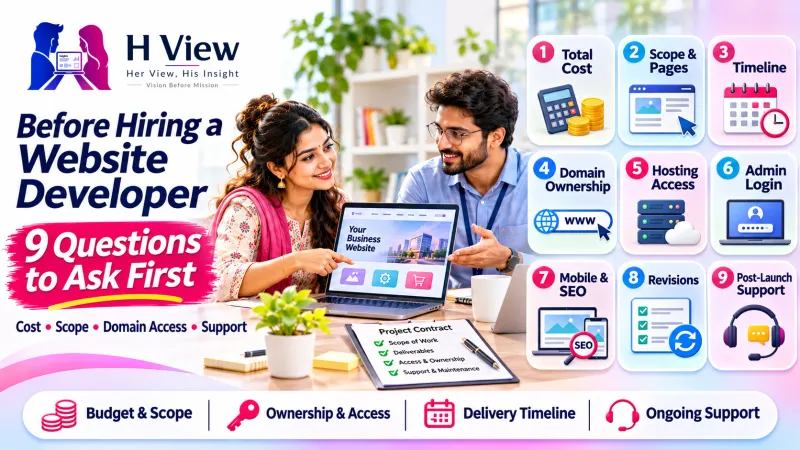
Before hiring a website developer, ask how the project will be scoped, what the quote includes, who owns the domain and code, how you will review progress, and what support is available after launch. These questions help a business compare proposals fairly and avoid finding out too late that an essential feature, account or maintenance task was never included.
Why should you ask more than “How much will the website cost?”
A website quote is only useful when you can compare what each developer has agreed to deliver. One proposal may include copy support, mobile layouts, analytics and training, while another covers only a set of pages and a launch. The lower price may still be the better fit, but the difference should be visible before you make a decision.
Prepare a short brief first: what the business does, who the site is for, which pages are needed, what action visitors should take and what material you already have. Give the same brief to each person you approach. That makes it easier to see whether a quote is complete and whether the developer understood the business need.
Nine questions to ask a website developer
1. What exactly is included in this price?
Ask for the deliverables in writing: page count, design rounds, content entry, forms, integrations, mobile layout, basic analytics, accessibility checks, testing and launch support. Clarify how changes outside the agreed scope are priced. A useful proposal separates what is included from optional work so both sides know what to expect.
2. What do you need from me, and by when?
Ask which copy, images, brand assets, service details and account access the developer needs. Find out who will approve drafts and how quickly feedback is expected. Delays often happen because nobody has agreed who supplies the information or who makes the final decision.
3. Who will own the domain, hosting and website accounts?
The business should understand who controls its domain registrar, hosting, analytics, email and other critical accounts. Ask what credentials or role-based access will be created, and how access will be transferred if the working relationship ends. The account owner should be a business representative, not a shared personal login that nobody can recover.
4. What happens to the code, design files and content?
Ask what rights or licences come with the completed work, which third-party themes or components are used, and whether you can export your content. If the site depends on a paid service, plugin or font, understand renewal costs and what happens if the subscription ends. Get these terms in the agreement rather than relying on a verbal assurance.
5. How will the site work on phones and with accessibility needs?
Ask how mobile layouts will be reviewed and whether the developer checks keyboard navigation, readable contrast, form labels and meaningful image descriptions. Request a preview that you can open on a phone before launch. “Responsive” should mean the actual pages and actions work on smaller screens, not simply that the design shrinks.
6. How will we review progress?
Agree on milestones, where you can see the preview, how feedback should be shared and who can approve each stage. A staging link and a short review checklist can prevent late changes from being mixed with unresolved design decisions. Ask how often the developer will share updates if the project takes several weeks.
7. What will happen to forms, email and leads after launch?
Ask where enquiries will be delivered, who will receive notifications and how a failed form submission will be noticed. Test the complete path before launch, including confirmation messages and mobile links. If leads go to WhatsApp or a CRM, confirm that the integration is set up and that someone will monitor it.
8. What does maintenance and support cost?
Find out who handles updates, backups, security issues, broken links and small content changes. Ask which tasks are covered after launch, how quickly urgent issues are addressed and whether support is charged hourly or through a plan. A website is not a one-time deliverable if the business needs it to keep working over time.
9. What does success look like after launch?
Define a practical goal: visitors should be able to find services, complete a booking, send an enquiry or locate the business. Ask how those actions will be measured and how the team will access the reports. Be cautious of anyone promising a guaranteed ranking or a specific number of leads without understanding the market, budget and follow-up process.
 Also readCRM vs ERP for a Growing Business: What Should You Set Up First?→
How should you compare proposals?
Use the same brief and compare the project scope, timeline, payment schedule, review process, ownership, launch plan and support. Ask each developer to explain assumptions and exclusions. If one proposal is much cheaper, ask what has been left out rather than assuming the person is unreliable; if one is more expensive, ask which added work creates value for your business.
Check relevant examples and ask what the developer personally handled. A portfolio shows presentation, but it does not explain how the person communicates, manages changes or solves problems. A short call can help you understand whether they listen to your goals and explain trade-offs in language you can follow.
Warning signs to take seriously
- The developer refuses to explain who owns the domain or accounts.
- The quote is vague and there is no written scope or payment schedule.
- They promise guaranteed search rankings or sales.
- They avoid showing relevant work or explaining what they contributed.
- They ask for complete payment before agreeing on deliverables and milestones.
- They cannot explain how forms, backups or post-launch support will work.
A warning sign does not automatically prove misconduct, but it is a reason to pause and ask for clarity. A trustworthy professional should be able to explain the plan, limitations and responsibilities without making the client feel foolish for asking.
Her View
Many business owners feel they should understand technical language before they can ask a developer questions. They do not. The person building the site should be able to explain the practical choices, risks and next steps clearly, and the client should feel comfortable asking for an example or a simpler explanation.
His Insight
A clear agreement protects both the business and the developer. It gives the client a way to review progress and gives the developer a shared definition of finished work. Treating scope, access and support as part of the project from the beginning usually saves time when the site is ready to launch.
 Also readAI Receptionists for Small Businesses: What They Can Do—and When a Person Should Step In→
H View Verdict
Choose a website developer based on fit, clarity and reliability as well as price. Share a useful brief, ask the same questions of every candidate and get scope, ownership, payment terms and post-launch support in writing. Before launch, test the site as a customer would, especially on a phone, and confirm that enquiries reach a real person.
Frequently asked questions
Should my business own its domain name?
Yes, the business should know who controls the domain and how to access it. Keep account recovery details current and document who has permission to make changes.
Should I pay a website developer all at once?
Payment schedules vary, but linking payments to clear milestones can help both parties manage expectations. Review the written agreement and deliverables before paying.
How many website design revisions should be included?
There is no universal number. Ask how many review rounds are included, what counts as a revision and how additional changes are billed.
Can a developer guarantee more customers?
No developer can guarantee business outcomes that depend on many factors such as demand, offer, traffic and customer response. They can commit to specific technical and design deliverables that are within their control.
Sources
H View stories follow our editorial policy. Spotted an error? Tell us and we will correct it.
Rate this article
One tap is enough. No comment needed.
Was this article helpful?
Your answer goes straight to our editors.












Comments0
No comments yet. Start the conversation.