
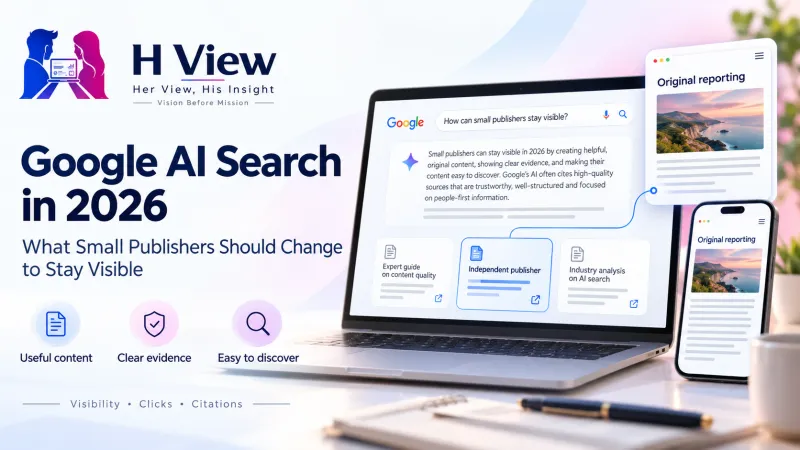
Google AI Search in 2026: What Small Publishers Should Change to Stay Visible
AI Overviews and AI Mode answer many questions before anyone clicks. Here is what small publishers and bloggers should actually change, and what they can safely ignore.
To stay visible in Google AI search, small publishers should focus on what AI summaries cannot replace: original information, first-hand experience, clear answers and pages Google can easily crawl. Google says there are no additional requirements or special optimisations needed for AI Overviews and AI Mode, so the real change is in what you publish, not in secret tricks.
If you run a blog, a niche news site or a small business website, you have probably felt it: impressions in Search Console stay steady or grow, but clicks do not keep pace. Readers get a summary at the top of the page and some of them never scroll down. That can feel unfair when your page was one of the sources. The answer is not panic. It is a sharper strategy.
What does Google say about AI features and websites?
Google's documentation on AI features and your website (last updated 10 December 2025) states: "There are no additional requirements to appear in AI Overviews or AI Mode, nor other special optimizations necessary." It adds that "all existing SEO fundamentals continue to be worthwhile", such as letting crawlers access your site, keeping important content in text and making sure structured data matches what is visible on the page. Traffic from these features is counted in Search Console's Performance report under the "Web" search type, and publishers can use preview controls if they want to limit how their content is shown.
In plain words: there is no "AI SEO" switch. If your basics are weak, AI search will expose that faster. If your content is genuinely useful, AI search can surface it as a source.
What should small publishers change?
What to do more of, and less of
Do more
- First-hand tests, photos and local detail
- Clear one-paragraph answers under question headings
- Updated facts with dates and sources
- Topic clusters with strong internal links
Do less
- Rewriting what every other site says
- Thin "what is X" posts with no new insight
- Keyword stuffing and long intros
- Chasing every trending term outside your niche
- Add what only you can add. A recipe blogger's own photos and failures, a Hyderabad real estate site's locality-level prices, a teacher's classroom experience. AI summaries are built from what already exists online. Original material is what makes your page worth citing and clicking.
- Answer clearly, then go deeper. Put a direct two or three sentence answer at the top of each section, then the detail. This helps both readers in a hurry and systems looking for a clear source.
- Keep facts fresh. Dates, prices, rules and versions go stale fast. Update key pages and show the date of the update.
- Build topical depth. Ten connected articles on one subject beat fifty scattered ones. Our guide to internal linking explains how to connect them.
- Fix technical basics. Fast pages, clean URLs, a sitemap and no blocked resources. If Google cannot crawl or index a page, it cannot use it. Start with technical SEO for beginners.
 Also readGoogle Business Profile for Small Businesses in India: How to Show Up When Customers Search Nearby→
How can you tell if AI search is affecting your traffic?
Google began rolling out separate generative AI performance reports in Search Console on 3 June 2026, according to The Ad Firm's analysis. The rollout is phased, and the reports show impressions only, with no clicks or query-level data, and AI Overviews and AI Mode grouped together. If you have access, export a baseline now, because the report does not keep a long history.
A monthly check-up
Not every drop in clicks is caused by AI. Seasonality, ranking changes and new competitors matter too. Look at patterns over several weeks before drawing conclusions.
Should you diversify beyond Google?
Yes, gently. A newsletter, a WhatsApp channel, YouTube shorts or an active Instagram account give you readers who come to you directly. You do not need all of them. Pick one channel your audience already uses and build it steadily. Our piece on getting mentioned in ChatGPT, Gemini and Google AI covers visibility in other AI assistants as well.
Her View
Small publishers often write from real life: a mother explaining school admissions, a farmer's son explaining crop insurance, a retired teacher explaining exam patterns. That lived experience is exactly what AI cannot invent. Lean into your voice. Your readers come back for you, not just for the answer.
 Also readWordPress, Custom-Built Website or Website Builder: Which Should Your Business Choose?→
His Insight
Measure what you can control. Track impressions, clicks, click-through rate and returning readers for your top 20 pages each month. If a page's impressions hold but clicks fall, test a better title and add something a summary cannot give, such as a calculator, a checklist or local data. Small, repeated improvements beat big redesigns.
H View Verdict
Google AI search rewards the same things good SEO always did, but more strictly. Publish original, clearly structured, up-to-date content on a technically sound site, and build at least one direct channel to your readers. That is how small publishers stay visible in 2026.
Want this done for your business?
If reworking your site for AI search feels like a lot, the H View team can audit your pages and fix what holds them back. H View studies how your business works today and builds the right digital platform for it, from search visibility to turning manual work into automated systems.
- Website SEO
- GEO and AI search visibility
- Websites and apps
- CRM and ERP
- Management portals
- Automation and digitisation
Frequently Asked Questions
Do I need special SEO for Google AI Overviews?
No. Google says there are no additional requirements or special optimisations needed to appear in AI Overviews or AI Mode, and that existing SEO fundamentals still apply.
Where does AI Overview traffic show in Search Console?
Google says it is counted in the Performance report under the Web search type. Since June 2026, Google has also been rolling out separate generative AI reports that show impressions only.
How can small blogs compete with AI answers?
Publish original experience, data and tools that summaries cannot provide, answer questions clearly, keep facts updated and build a direct audience through a newsletter or social channel.
Why are my clicks falling while impressions grow?
Possible reasons include AI summaries answering the query directly, lower rankings, changes in search features or seasonality. Compare query-level data in Search Console over several weeks.
H View stories follow our editorial policy. Spotted an error? Tell us and we will correct it.
Rate this article
One tap is enough. No comment needed.
Was this article helpful?
Your answer goes straight to our editors.










Comments0
No comments yet. Start the conversation.