

Best Digital Marketing Tools in 2026: What Marketers Actually Need and What They Can Skip
Open LinkedIn for a few minutes and you will probably come across a colourful graphic…
 Harika October 6, 2026
  By HarikaUpdated September 20, 202610 min read35 views
For years, digital marketing advice about search sounded relatively straightforward. Find what people are searching for, create a useful page around that subject, make sure Google can crawl it, earn authority, and try to move higher in the results.
That world has not disappeared in 2026, but it has become considerably more complicated.
A person looking for information today might type a traditional query into Google, read an AI Overview, open Google AI Mode, ask ChatGPT a complete question, use Microsoft Copilot, or expect an assistant to compare several sources and simply tell them what it recommends. In one journey, the user may never even see the familiar page of ten blue links that shaped the SEO industry for decades.
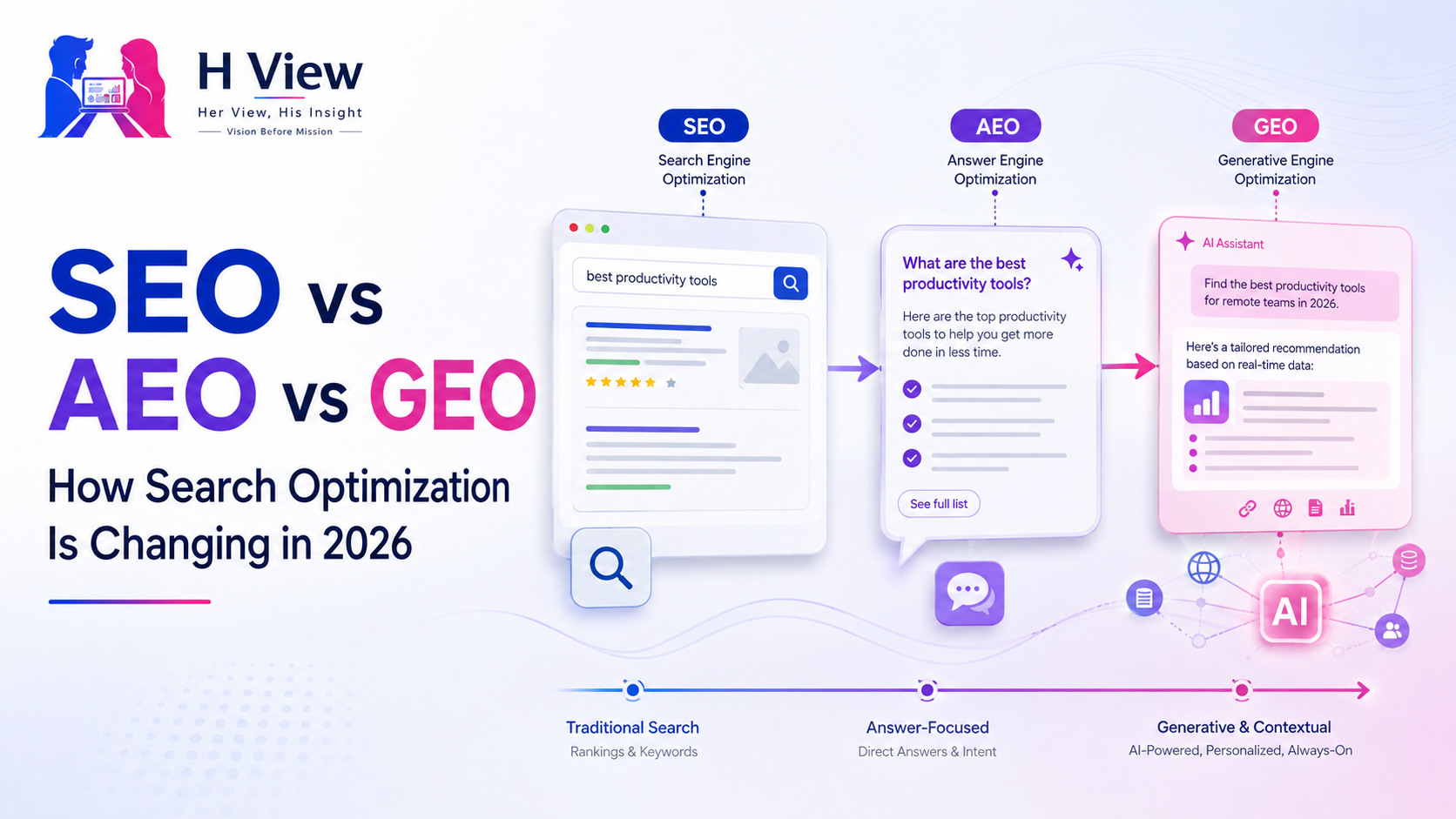
Naturally, marketers have created new terminology for this environment. Alongside Search Engine Optimization (SEO), we now hear about Answer Engine Optimization (AEO) and Generative Engine Optimization (GEO).
The danger is assuming that websites suddenly need three unrelated strategies.
They do not.
The more useful way to understand the change is that online content now has to succeed at three different moments: being discovered, being understood as a useful answer, and being considered trustworthy enough to influence or support an AI-generated response.
That distinction matters far more than the acronym attached to it.
Traditional SEO is still the foundation.
Search engines still need to discover a page, crawl it, understand what it contains and decide whether it is relevant and useful. Technical issues such as indexing, internal linking, canonicalisation, page performance and site structure have not magically become irrelevant because Google can generate an AI response.
Google makes this unusually clear in its current guidance for generative AI features. Its Search Central documentation says the established SEO fundamentals remain relevant for appearances in features such as AI Overviews and AI Mode. Google has also specifically warned website owners against assuming that a completely separate set of technical tricks is required for “AI SEO.” (developers.google.com)
That is worth remembering because a new marketing industry tends to appear around every major change in search.
A business owner may now receive messages promising “GEO optimisation,” “LLM ranking” or guaranteed ChatGPT citations. Some services may be useful. Others simply repackage familiar SEO principles under a newer acronym.
If Google cannot reliably crawl your site, your articles are thin, your information is untrustworthy and your pages do not answer the questions users are asking, calling the strategy GEO instead of SEO will not rescue it.
SEO remains the work that helps make a page discoverable and competitive.
What has changed is what happens after discovery.
Answer Engine Optimization grew from an important change in search behaviour that actually began before generative AI became mainstream.
Google featured snippets, People Also Ask results, voice assistants and knowledge panels trained users to expect immediate answers. Someone searching “how long does an NEFT transfer take?” may not want to read a 2,000-word article. They may simply want the correct answer followed by enough explanation to trust it.
AEO attempts to make information easier for systems to identify and present as an answer.
That does not mean turning every article into twenty FAQs or writing robotic one-sentence definitions under every heading.
Google’s own documentation on featured snippets reinforces an important point: Google itself decides whether a page is useful enough to appear as a featured snippet. There is no special meta tag that tells Google, “Use my answer.” (developers.google.com)
The practical lesson is much more human.
If a reader asks a clear question, do not make them dig through six paragraphs of generic introduction before discovering what you actually think.
Suppose H View publishes an article titled “Why Is Elementor Not Loading?” A traditional keyword-focused article might repeatedly mention “Elementor not loading” and then give a long generic list of plugin conflicts.
A stronger answer-oriented article might recognise that the person searching is probably sitting in front of a broken WordPress editor right now. It can explain the likely cause clearly, give the quickest safe test, then move into less obvious solutions such as Elementor tools, browser memory, editor settings or server resource limitations.
That article can still rank through SEO.
But it is also better prepared to become an answer because it actually resolves the reader’s problem.
Generative Engine Optimization is where things become more interesting.
The term GEO was formalised in academic research published in 2023. The researchers described a world in which generative engines synthesize information from several sources rather than simply returning a ranked list of webpages. Their experiments explored ways content visibility could change inside generated answers and reported improvements of as much as 40 percent under particular experimental conditions. (arxiv.org)
The idea has since expanded far beyond the original paper.
When someone asks ChatGPT, Gemini, Copilot or another AI system a question, the system may retrieve multiple sources, compare information, summarise them and cite only a handful. Being number three in a traditional search result and being one of the sources an AI chooses to reference are not necessarily the same achievement.
That changes the publisher’s objective.
With classic SEO, the visible prize was often a ranking position.
With GEO, the prize can be being selected as trustworthy evidence.
This is already becoming measurable. Microsoft introduced an AI Performance view in Bing Webmaster Tools in 2026 that shows website owners how often their pages are cited in AI-generated answers across Microsoft experiences. (blogs.bing.com)
Google has moved in the same general direction. In June 2026, Search Console added dedicated generative AI performance reporting for visibility through experiences including AI Overviews and AI Mode. (developers.google.com)
That tells publishers something important: AI visibility is moving from an interesting experiment into something website owners will increasingly measure.
Once publishers hear that AI systems prefer clear information, the temptation is predictable.
Articles begin looking like databases.
Every paragraph becomes a definition. Every section contains bullets. Hundreds of FAQ pages appear. Writers repeat the entity name constantly because someone claimed LLMs need it. Sites publish thousands of near-identical pages hoping that sheer volume will increase AI citations.
This is exactly where GEO can become another version of bad SEO.
Google’s current guidance on generative AI content says AI can help with research and organisation, but producing large numbers of pages without adding genuine value may violate its policies on scaled content abuse. (developers.google.com)
More importantly, people still have to enjoy the page when they arrive.
Imagine searching for advice on whether you should leave a job. An AI-readable page consisting entirely of bullet points might be easy to extract from, but it may offer little understanding of the emotional, financial and practical realities behind that decision.
Human usefulness and machine clarity should not become opposing goals.
The strongest content can do both.
Consider an article about whether AI will replace digital marketing jobs.
For SEO, the article needs a crawlable page, sensible title, relevant topic coverage, strong internal links, credible sources and enough authority to compete for searches around AI and digital marketing careers.
For AEO, it should directly explain which tasks are most exposed to automation and which still require human judgement instead of hiding the answer behind vague language.
For GEO, the article becomes stronger when its claims are specific, attributable and clearly supported. An AI system looking for reliable material has something concrete to work with: original analysis, verified facts, quotations or statistics from primary sources, and clear distinctions between evidence and H View’s own interpretation.
Those are not three completely different articles.
They are three qualities of the same well-produced article.
This is where H View should avoid chasing terminology.
Our goal should be to create pages that can be found, understood, trusted and worth citing.
Generative AI has made generic information extraordinarily cheap.
Ask almost any major AI assistant “What is SEO?” and it can generate a reasonable explanation instantly. That means another article saying SEO involves keywords, backlinks and technical optimisation contributes very little.
Websites now need a reason to exist beyond repeating information.
Google’s 2026 guidance for generative AI visibility specifically stresses valuable, unique, non-commodity content. (developers.google.com)
That phrase—non-commodity content—is particularly important for H View.
When we wrote about Elementor not loading, for example, our value should not come from being the 500th website telling readers to deactivate every plugin. It should come from observations we have actually encountered, fixes that are less commonly documented and explanations that help someone understand what is happening.
A product review should contain actual judgement.
A career article should recognise what freshers genuinely experience.
A WordPress guide should solve the frustrating situation the author has actually seen.
AI can summarise common knowledge very efficiently. It has a harder time replacing useful firsthand interpretation.
From a reader’s perspective, I do not care whether a website calls its strategy SEO, AEO or GEO. I care whether I find an answer that respects my time.
There is something exhausting about opening an article for a simple question and discovering that it has been expanded into 3,000 words purely to target keywords. AI search partly became attractive because users were tired of that experience. Publishers should learn from the behaviour instead of simply trying to manipulate the new system.
Clear answers and human writing can coexist. An article should tell me what I need to know without becoming so compressed that it loses personality, context or judgement.
From a publisher’s perspective, abandoning SEO for GEO would be a serious mistake.
Generative systems still require information to be discovered, indexed, retrieved and evaluated. Strong technical SEO therefore remains an infrastructure layer beneath much of AI visibility. What changes is the measurement of success.
Rankings and clicks will continue to matter, but publishers should increasingly watch citations, mentions, AI visibility and whether their brand becomes a recognised source across different platforms. The challenge is that generative systems are less predictable than traditional rankings, so anyone promising guaranteed GEO results should be treated cautiously.
The better investment is building durable authority rather than searching for another short-term optimisation trick.
SEO, AEO and GEO are useful terms, but they should not become three separate content factories.
SEO helps your information get discovered. AEO helps your information answer the question clearly. GEO increases the chance that generative systems can understand, trust and reference that information.
In practice, all three increasingly reward the same deeper qualities: accessible pages, clear writing, original value, reliable sourcing, topic authority and information structured well enough for both humans and machines to understand.
The search industry will invent more acronyms. Some will survive and others will disappear.
H View should not build its strategy around whichever acronym is fashionable this year.
We should build content that deserves to be found in Google, useful enough to become an answer, and trustworthy enough that an AI system would have a reason to cite it.
That is a much harder standard than traditional keyword optimisation.
It is also a healthier direction for the web.
SEO focuses primarily on improving website discovery and visibility in traditional search engines. AEO focuses on making information easy for answer-oriented search experiences to understand and present directly. GEO focuses on improving visibility or citation within generative AI responses. In practice, there is considerable overlap among all three.
No. Google explicitly says traditional SEO best practices remain foundational for visibility in its generative AI search features. GEO is better understood as an additional consideration rather than a replacement for technical SEO, content quality and authority.
Google discusses these terms in its 2026 generative AI optimisation guidance, including misconceptions around them, but it does not say website owners need an entirely separate optimisation system. Its guidance continues to emphasise useful, unique content and established SEO fundamentals.
Microsoft’s Bing Webmaster Tools now includes AI Performance reporting showing citations in Microsoft AI experiences. Google Search Console also introduced dedicated reporting in 2026 for visibility within generative AI experiences such as AI Overviews and AI Mode.
Not automatically. FAQs can help when they answer genuine reader questions clearly, but adding dozens of repetitive questions purely for AI extraction is unlikely to create lasting value. Structure should support the reader rather than exist merely to target an algorithm.
Build strong SEO foundations first, then concentrate on producing information that competitors cannot easily replicate. Clear answers, firsthand experience, useful examples, primary-source research and strong topical internal linking can support traditional search as well as AI-driven discovery.
Harika is the co-founder of H View and covers AI, technology, gadgets, digital tools, online platforms, and modern internet trends. Her articles focus on simplifying complex topics with practical explanations, balanced opinions, and reader-first insights.
Share your real experience and help other readers decide better.
No community views yet. Be the first to share yours.
Open LinkedIn for a few minutes and you will probably come across a colourful graphic…
Harika October 6, 2026 
When an employee resigns, many organisations move quickly into replacement mode. The manager informs HR,…
Harika October 6, 2026 
For many corporate employees, the workday begins long before they actually start working. They wake…
Harika October 5, 2026 
Many projects begin with an assumption that sounds reasonable on paper: the client will explain…
Harika October 1, 2026