
AI Is Entering Indian Classrooms. How Can Students Tell Whether It Helps Them Learn?
New Indian education developments raise a practical question: when AI helps with schoolwork, are students learning more or simply finishing sooner?
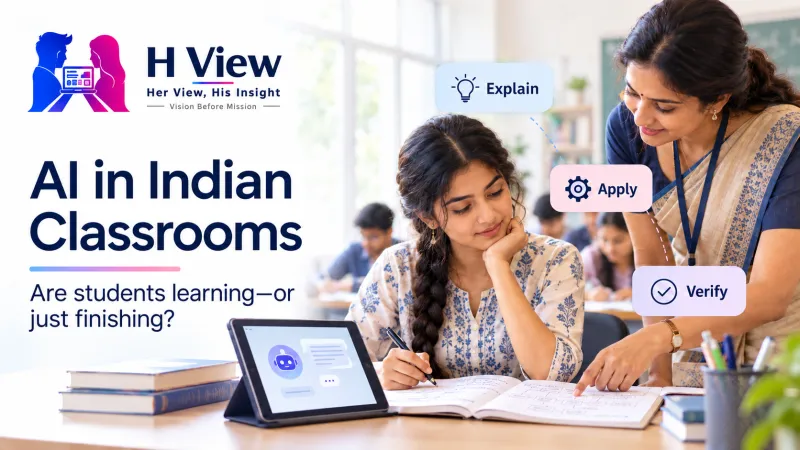
AI in classrooms helps students most when it supports explanation, practice and feedback while leaving them responsible for understanding. A polished answer is not proof that learning has happened. The useful check is whether a student can explain the idea independently and apply it when the example changes.
A student asks an artificial intelligence assistant to explain a chapter, receives a clear summary and feels ready for the test. The next morning, a slightly different question brings the confidence down. Many students will recognise that feeling from ordinary revision too, which makes this a question about learning habits as much as new technology.
Why is this question relevant to India now?
NDTV reported on 26 October 2026 that Bihar's Education Department had partnered with 11 information technology firms to train government-school teachers in technology and AI. The report describes a teacher-training initiative, not evidence that every school already has an AI tutor or that student results have improved. That distinction matters when an announcement reaches families through a short headline.
There is also recent research grounded in Indian classrooms. Cornell's 8 October report on Shiksha Copilot describes an evaluation involving more than 1,000 Karnataka teachers. It explains how teacher-reviewed lesson plans, local-language adaptation and classroom customisation supported their work. Teachers reported time savings and more practical activities, but those reports should not be turned into a claim that the system proved higher examination scores.
What is the difference between completing work and learning?
Completing work produces an output, such as a solved worksheet or a paragraph in a notebook. Learning changes what you can explain, recognise or do later. The two can happen together, but they can also separate when a student submits an answer without working through its meaning.
Imagine a lesson on household electricity consumption. An assistant gives the energy used by a 60-watt bulb running for five hours, and the student copies 0.3 kilowatt-hours into a notebook. The calculation is correct, but the student still needs to understand why watts become kilowatts and why operating time matters. That understanding is what makes the next question manageable.
Three ways to meet the same homework question
This is H View's suggested practice sequence. Each step reveals something that a finished homework page cannot show on its own.
 Also readHTML, React, PHP, Python or Node.js? Understand the Difference Through One College Project→
How can students use AI without giving away the thinking?
Start by attempting the question before opening the assistant. Even an incomplete attempt shows where the difficulty begins, which makes the request more useful than asking for the whole chapter again. You can then ask for help with one missing connection and return to the work yourself.
In our electricity example, a useful request would ask why a rating in watts must be converted before calculating kilowatt-hours. Another request might ask for a similar problem with different numbers while withholding the solution. These are suggested study activities rather than a guarantee about any particular product's accuracy, and the resulting explanation still needs checking.
Change the request to change the learning task
| Common request | A more useful learning request | What the student checks |
|---|---|---|
| Write my answer. | Read my attempt and identify the first step that needs correction. | Can I repair that step and explain why it changed? |
| Summarise the chapter. | Ask me three questions that test different ideas from this chapter. | Can I answer without looking at the summary? |
| Give me the solution. | Give one hint and let me attempt the next step. | Can I continue without another complete explanation? |
| Make it sound impressive. | Point out claims in my paragraph that need evidence. | Can I find a source that actually supports each claim? |
A useful prompt makes the learner's work easier to examine. It does not remove the need for textbooks, teacher feedback or independent practice.
What should students verify in an AI answer?
Read an explanation with the same care you would give advice from an unfamiliar person. Does it match your class level, use the right units and address the question that was actually asked? A fluent response can still include an unsupported claim, an invented reference or a method your syllabus has not introduced.
For factual homework, open the cited source and locate the relevant passage rather than trusting the appearance of a link. For mathematics, check the working and try substituting the answer back where that makes sense. For history and current affairs, check dates and distinguish a person's interpretation from an established event.
- Check the question. Identify what must be explained, calculated or compared before reading the response.
- Check the foundation. Compare definitions, formulas and terminology with a reliable class source.
- Check the evidence. Open references and confirm that they support the actual statement being made.
- Check your understanding. Close the response and explain the idea to someone else, then attempt a changed example.
Why do local examples and languages matter?
A familiar example can make the first step into an unfamiliar idea less intimidating. A household electricity bill, a bus journey or a local market gives students something they can picture before dealing with an abstract relationship. However, a familiar story is helpful only when the explanation preserves the concept accurately.
The Cornell report is useful here because it describes substantial review of local-language material, including terminology changes in Kannada plans. Translation and confident wording are therefore not sufficient checks on teaching quality. Students should be able to ask for a simpler explanation without being made to feel that difficulty comes from a lack of ability.
What can you try during your next study session?
Choose one concept that you recently found difficult and write a brief explanation before seeking help. Ask for feedback on that explanation, check the correction against your class material and then solve a different example without assistance. Keep the original attempt so you can see what changed rather than judging the session by how many pages you produced.
Use fictional details in practice prompts and follow your school's rules about permitted assistance. Avoid uploading classmates' marks, personal documents or photographs when they are unnecessary for the question. A useful learning habit should also respect the people whose information might appear in the material.
Leave the session with evidence of learning
What looks complete
- The notebook contains a neat answer and a long explanation.
- The student recognises the method when it is displayed.
What demonstrates understanding
- The student explains the method without reading it back.
- The student handles a changed example and identifies a mistake.
Recognition and independent use are different checks. A student can need more practice even after an explanation feels familiar.
 Also readESTIC 2026 Begins Tomorrow: How Does a Student Idea Become Something People Actually Use?→
Her View
Students should feel comfortable admitting that they do not understand something, even after receiving an apparently perfect explanation. The value of an assistant includes being able to ask again without embarrassment, but a supportive teacher or peer still matters. Technology should make the learning conversation more accessible rather than pressure students to appear constantly capable.
His Insight
Judge a learning tool by what you can do after closing it. A short explanation followed by an independently solved problem may be more valuable than a beautifully generated assignment. The same principle applies to practical work: our discussion of coding in the AI era asks why understanding remains important when output becomes easier to generate.
H View Verdict
Use AI as a partner in practice, with clear checks on accuracy and understanding. Keep asking whether you can explain, apply and question what you have received. For further reading, our guide to choosing a first programming language connects learning choices with practical goals, while our article on AI skills and jobseekers explores how those habits extend into work.
Frequently Asked Questions
Does using AI automatically mean a student is learning less?
No single outcome follows from every use of an assistant. The task, the student's existing knowledge and the way assistance is used all matter, so understanding should be checked directly.
Can an AI answer replace my textbook?
An answer can provide another explanation, but it may use different assumptions or contain errors. Keep the prescribed textbook and teacher's guidance as important reference points for your course.
What is a simple way to test whether I understand?
Close the explanation and describe the idea in your own words. Then try a changed example, because repeating a familiar answer can hide a remaining gap.
Should students ask AI for sources?
Sources can help when they are genuine and relevant. Open them yourself and check the supporting material, because the presence of a reference does not establish that the claim is correct.
Does teacher training prove that AI improves exam results?
A training programme shows that a particular initiative is being undertaken. Evidence of improved results requires an appropriate evaluation, and announcements should not be treated as that evidence.
H View stories follow our editorial policy. Spotted an error? Tell us and we will correct it.
Rate this article
One tap is enough. No comment needed.
Was this article helpful?
Your answer goes straight to our editors.










Comments0
No comments yet. Start the conversation.