
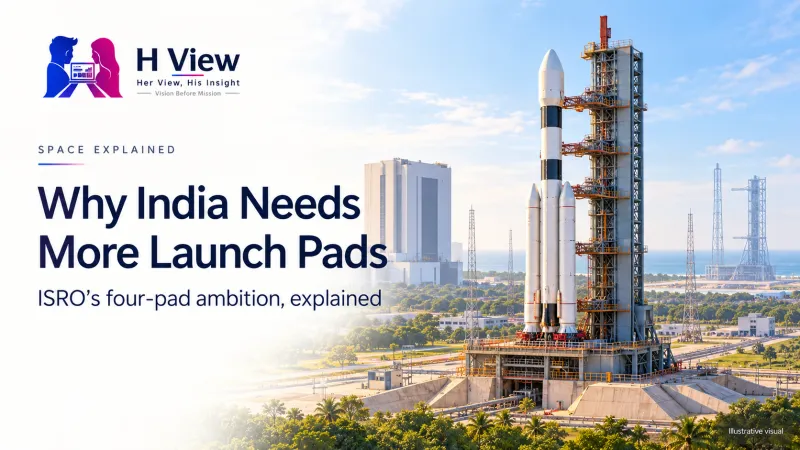
ISRO Wants Four Launch Pads by 2029. Why Does India Need More Than One?
India’s four-launch-pad ambition is a chance to understand the infrastructure behind space missions, from rocket preparation to safe flight paths and reliable scheduling.
ISRO launch pads do much more than provide a platform for a rocket. They connect the vehicle to preparation, checking and safety systems, and different missions need different arrangements. India's ambition for four functional launch pads by 2029 is therefore a story about capacity, compatibility and dependable operations.
A launch broadcast usually becomes exciting during the final countdown. We see a rocket, a tower and a cloud of exhaust, while months of work remain outside the camera frame. For a student trying to understand the news, the interesting question is what another launch pad makes possible that the existing ones cannot easily provide.
What has been announced, and what is already operating?
Recent reporting by Akashvani describes ISRO Chairman V. Narayanan's aim for four functional launch pads by 2029. That is a future target, rather than confirmation that four pads are operating today. A March 2026 parliamentary reply listed two operational pads at Sriharikota and placed the proposed third pad in the 2029–30 timeframe.
Those dates should remain attached to their sources. A later headline can express an updated ambition without establishing that every construction and commissioning milestone is complete. Commissioning means checking and bringing a facility into service, and it is different from announcing, funding or starting construction.
Read the four-pad ambition correctly
Existing Sriharikota facilities
- The First and Second Launch Pads were listed as operational in the March parliamentary reply.
- They support specified vehicles and share parts of the wider launch-centre infrastructure.
Expansion projects
- A Third Launch Pad at Sriharikota is intended for future requirements.
- A separate SSLV launch complex is being developed at Kulasekarapattinam in Tamil Nadu.
Four launch pads do not mean four separate spaceports. The expansion combines additional infrastructure at an existing centre with a second launch site.
How are a rocket, launch pad and spaceport different?
The rocket is the vehicle that carries its payload towards the required orbit or destination. The payload is what the mission carries, such as a satellite, scientific instruments or a spacecraft. A launch pad is the ground installation from which that vehicle is prepared for its final launch operations and lifted off.
A spaceport or launch centre is the larger operational site around the pad. It includes facilities for activities such as assembly, preparation, communication and mission coordination. An airport can help you picture the distinction between a transport vehicle and its supporting location, although launching a rocket involves very different engineering and safety requirements.
Separate the vehicle from the infrastructure
| Term | What it means | Question it answers |
|---|---|---|
| Launch vehicle | It provides the propulsion and stages needed to carry a payload. | What carries the satellite? |
| Launch pad | It supports final ground operations and the start of flight. | Where does the vehicle lift off? |
| Launch centre | It brings together the pad and wider mission-support facilities. | What supports the operation around the rocket? |
This is a conceptual comparison for beginners. It is not a technical specification of any particular launch complex.
 Also readOrionids Meteor Shower 2026: What It Is and How to Watch It From India→
Why can’t every rocket use the same pad?
Imagine a college laboratory receiving a much larger machine than the one it was designed to hold. Available floor space is only the first question; the supporting connections, operating arrangements and safe working area also need attention. A launch pad similarly has to be compatible with the vehicle and its ground operations.
ISRO's January 2025 approval notice explains that the Third Launch Pad is intended to support Next Generation Launch Vehicles and serve as a standby for the Second Launch Pad. The notice also describes adaptable arrangements for future configurations. That is a more specific purpose than simply creating another place to park an existing rocket.
Next Generation Launch Vehicle is abbreviated to NGLV in official material. Small Satellite Launch Vehicle is shortened to SSLV, and those names already suggest different mission requirements. Learning what an abbreviation refers to makes a space headline much easier to interpret without memorising a list of letters.
Why does Kulasekarapattinam have a different role?
ISRO's construction update says the Tamil Nadu complex is primarily planned for SSLV polar launches, serving small satellites up to 500 kilograms. Polar launches place satellites into paths that pass over or near the Earth's polar regions. The exact orbit still depends on the mission, rather than the location alone deciding everything.
The March parliamentary reply connects this site with Sun-synchronous Polar Orbit missions commonly used for Earth observation. Such satellites help gather information about the planet, rather than existing only as a record of a successful launch. A useful student question is therefore what information a satellite needs to collect before asking which rocket will carry it.
Location and the intended flight direction belong in the same discussion. ISRO's PSLV-C8 mission description notes Sriharikota's advantage near the equator for eastward launches. That does not make one location best for every orbit, and a simple map should never be mistaken for an approved flight path.
Does adding pads automatically mean more launches?
Additional compatible infrastructure can reduce some scheduling constraints, but a mission still depends on its vehicle, payload, staff, checks and readiness. A target launch date is a coordination problem across these activities. Having another pad cannot make an unfinished satellite ready or remove a concern identified during testing.
Consider an illustrative college exhibition with two demonstration stations and several teams. A third compatible station may reduce waiting, but it does not help a team whose device is unfinished or whose supervisor has not cleared the demonstration. This comparison explains a bottleneck, meaning a stage that limits progress, without claiming that rocket operations work exactly like a classroom event.
A launch depends on several kinds of readiness
This learning diagram simplifies the sequence. It is not an operational checklist or a substitute for mission procedures.
What can students learn from this news?
Take one space headline and make three columns labelled operating, under development and targeted. Place each claim in a column and record its source date, then check whether two reports are discussing the same facility. This small exercise develops a habit that is useful for research, infrastructure announcements and technology news generally.
Our guide to taking a student idea towards a tested prototype explains why a demonstration and a reliable system require different evidence. You can apply the same questioning habit while reading the news, instead of treating every planned capability as an accomplished result.
Her View
Space stories become more welcoming when we explain the work behind the spectacular moment. A student who enjoys geography, electronics or organising complex activities may recognise a connection that a launch video alone does not reveal. Curiosity should have several entry points, rather than requiring everyone to begin with advanced equations.
His Insight
The most useful question is which constraint the new infrastructure addresses. Compatibility, standby capability and preparation capacity are different benefits, and each deserves its own evidence. Our college-project technology explainer makes a similar distinction between a visible result and the supporting system that allows it to work.
H View Verdict
India's launch-pad expansion is worth following as an engineering story with milestones to verify. Understand what each facility is intended to do, distinguish targets from operations and keep asking how the pieces fit together. Our article on checking real learning offers a useful next step: explain this distinction independently before moving to another headline.
Frequently Asked Questions
Are four ISRO launch pads already operational?
The recent four-pad statement describes a future ambition. The March 2026 parliamentary reply listed two operational pads at Sriharikota and described the expansion projects separately.
Does four launch pads mean four spaceports?
A launch centre can contain multiple pads. Sriharikota's Third Launch Pad and the separate Kulasekarapattinam complex are different parts of the expansion.
What is SSLV?
SSLV means Small Satellite Launch Vehicle. ISRO describes the Kulasekarapattinam complex as primarily intended for its polar launches.
Is 2029 a guaranteed completion date?
A stated target is not a completion certificate. Recent reporting mentions 2029, while the March parliamentary reply gave 2029–30 for the Third Launch Pad.
Can extra pads guarantee a successful mission?
Ground infrastructure supports a mission but cannot by itself guarantee its outcome. Vehicle readiness, payload readiness and the required checks remain important parts of the operation.
H View stories follow our editorial policy. Spotted an error? Tell us and we will correct it.
Rate this article
One tap is enough. No comment needed.
Was this article helpful?
Your answer goes straight to our editors.








Comments0
No comments yet. Start the conversation.