
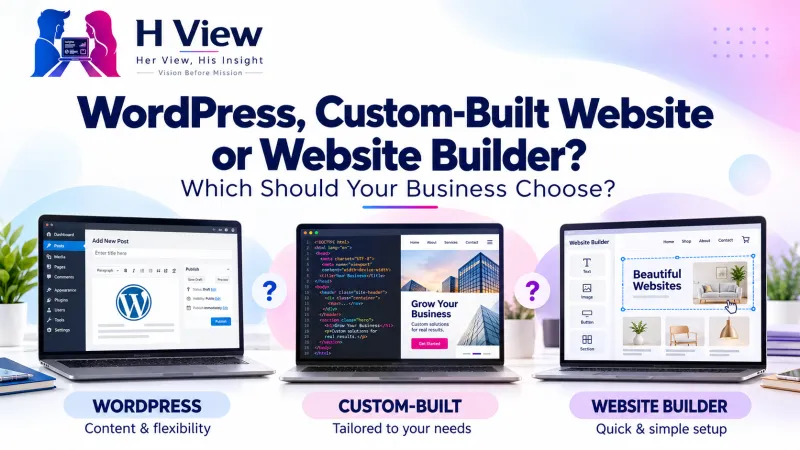
WordPress, Custom-Built Website or Website Builder: Which Should Your Business Choose?
WordPress, a website builder or a custom website? A plain-language guide to cost, control, speed and growth so Indian businesses pick the right platform the first time.
Most small businesses should start with WordPress or a website builder, and move to a custom website only when they need features that ready-made tools cannot handle. Website builders suit simple sites you want live this week, WordPress suits businesses that will publish content and grow, and custom builds suit unique workflows.
Choosing a platform feels technical, but it is really a business decision. It decides how much you spend, who can edit the site, how fast you can add features and how painful it is to move later. This guide explains the three options in plain words, with examples from the kind of businesses we all know: a boutique, a coaching centre, a clinic and a kirana store that wants to take orders online.
What are the three main ways to build a business website?
Every business website is built in one of three ways. The difference is how much is ready-made and how much is built specially for you.
Three ways to build a website
Website builder
- Examples: Wix, Squarespace, Shopify
- Drag-and-drop editing
- Hosting, security and updates included
- Monthly subscription
WordPress
- Free, open-source software
- You choose your own hosting
- Thousands of themes and plugins
- You or a developer handle updates
Custom website
- Written from scratch by developers
- Built around your exact workflow
- Highest flexibility and control
- Highest upfront cost and time
Each option trades convenience against control in a different way.
A website builder is a hosted service. You sign up, pick a template, drag in text and photos, and publish. The company runs the servers, handles security and keeps the software updated. Shopify is a builder focused on online stores.
WordPress is free software that you install on hosting you rent. It is open source, released under the GPL licence, so anyone can use and modify it. Its official plugin directory lists more than 76,000 free plugins that add features such as booking forms, WhatsApp chat buttons or online payments.
A custom website is written by developers for your business alone, using programming languages and frameworks rather than a template. Nothing is assumed: every page, form and dashboard is designed around how you work.
How popular is each option?
Popularity matters because a common platform means more developers, more tutorials and easier hiring. According to W3Techs, which surveys the top websites on the internet, WordPress is far ahead of every other content management system.
Share of all websites, October 2026
Source: W3Techs content management survey, data as of 23 October 2026.
Popular does not mean right for you. But it does mean that if your WordPress developer moves away, finding another one in Hyderabad, Pune or Kochi is not hard.
 Also readDomain, Hosting and DNS Explained for Business Owners→
When does a website builder make sense?
Think of a website builder like renting a furnished flat. You move in quickly, the landlord fixes the plumbing, and you cannot knock down walls. Builders work well when:
- You need a simple site of 5 to 10 pages: home, about, services, gallery and contact.
- Nobody on your team is technical and you want to edit text yourself.
- You want something live this week, for example a home baker or a boutique launching for Diwali.
- You sell a modest catalogue online and want payments and shipping built in, which is where Shopify is strong.
The trade-offs: you pay a subscription every month for as long as the site exists, you are limited to the features the platform offers, and moving to another platform later usually means rebuilding the design.
Why do so many businesses choose WordPress?
WordPress is like buying your own flat in a well-run society. You own it, you can renovate, and there are plenty of electricians and plumbers around. It suits a coaching centre that publishes exam tips every week, a clinic that wants doctor profiles and appointment forms, or a consultant building a blog to attract clients through search.
The strengths are flexibility, ownership of your content, and a huge range of plugins and themes. Google's own SEO Starter Guide notes that most content management systems can turn the titles you write into proper title tags and can even create sitemaps for you, which removes much of the technical work. If SEO is new to you, read our guide on how SEO actually works.
The responsibility is real, though. You must keep WordPress, the theme and plugins updated, choose good hosting and take backups. Too many plugins slow a site down and create security gaps. Our explainer on domain, hosting and DNS covers the hosting side in plain words.
When is a custom website worth the investment?
A custom website is like building a house on your own land to your own plan. It takes longer and costs more, but it fits your family exactly. It makes sense when the website is not just a brochure but part of how the business runs, for example:
- A coaching institute that needs student logins, test series, fee tracking and results in one place.
- A distributor whose retailers place orders, see their outstanding balances and download invoices online.
- A clinic chain that needs appointment slots synced across branches and connected to its patient records.
- A business that must connect the website to its own CRM, ERP or billing software.
Custom builds give full control over speed, design and data. The costs: higher upfront spend, a longer timeline, and dependence on a development team for changes. Budget for ongoing maintenance, not just the launch. Our guide on where small businesses should spend their marketing budget first can help you weigh this against other priorities.
How do you decide which option fits your business?
Answer four questions honestly before you speak to any developer or agency.
A simple decision path
Start from what the website must do, not from which tool is trending.
| Factor | Website builder | WordPress | Custom website |
|---|---|---|---|
| Time to launch | Fastest | Moderate | Slowest |
| Upfront cost | Low | Low to moderate | Highest |
| Ongoing cost | Monthly subscription | Hosting plus maintenance | Hosting plus developer support |
| Who maintains it | The platform | You or a developer | Your development team |
| Flexibility | Limited to platform features | High, through plugins and code | Unlimited |
| Best for | Simple sites, quick launches | Content-led and growing businesses | Portals, apps and unique workflows |
Before you sign anything, run through this checklist:
Before you choose a platform
- Write down the five things the website must do
- Confirm the domain is registered in your business name
- Ask who will update content each week
- Ask how backups and security updates are handled
- Check you can export your content if you leave
- Get the yearly running cost in writing, not just the launch price
 Also readHow to Build a Digital Marketing Plan for a Small Business in India→
Her View
Many business owners, especially first-time founders and women running home businesses, feel nervous asking "silly" questions about websites and end up agreeing to whatever the developer suggests. There is no silly question here. You are the one who will live with this website every day. If you cannot log in and change your own phone number or prices, the platform is not serving you. Pick the option that lets you feel in control, even if it looks less impressive on day one.
His Insight
Look at total cost over three years, not the launch quote. A cheap launch with an expensive monthly plan, or a cheap WordPress site that nobody maintains, often costs more in the end. Also count switching cost: rebuilding a site later means new design, new content migration and SEO risk if URLs change. If you already know you will need logins, integrations or automation within two years, it can be cheaper to plan a custom website, or a WordPress site built with that growth in mind, from the start.
H View Verdict
There is no single best platform. Choose a website builder for a quick, simple presence, WordPress for a content-led business that wants flexibility and ownership, and a custom website when the site has to run part of your business. Decide based on purpose, skills, three-year cost and growth plans.
Want this done for your business?
If you are unsure whether WordPress, a builder or a custom website fits your plans, the H View team can help you decide and build it. H View studies how your business works today and builds the right digital platform for it, from search visibility to turning manual work into automated systems.
- Website SEO
- GEO and AI search visibility
- Websites and apps
- CRM and ERP
- Management portals
- Automation and digitisation
Frequently Asked Questions
Is WordPress free to use?
The WordPress software itself is free and open source. You still pay for a domain name, hosting and any premium themes or plugins you choose. Maintenance, whether your own time or a developer's, is also a real cost.
Is a custom website better for SEO than WordPress?
Not automatically. Google ranks pages on content, relevance and experience, not on the platform used to build them. A well-built WordPress site and a well-built custom website can both rank well, and a badly built version of either can struggle.
Can I move from a website builder to WordPress later?
Yes, but it is usually a rebuild rather than a simple transfer. Text and images can be moved, while the design and some features need to be recreated. Keep your URLs the same or set up redirects so you do not lose search traffic.
Which option is best for a small online store in India?
For a small catalogue, a store builder like Shopify or WordPress with WooCommerce are both common choices. Compare payment gateway support, shipping options and yearly costs. Consider a custom build only when your ordering process is unusual, such as wholesale pricing for different retailers.
How do I know when it is time for a custom website?
It is usually time when you keep adding plugins or workarounds to make a ready-made platform do something it was not built for. Other signs are staff doing the same manual data entry every day, or needing the website to connect with your billing, CRM or ERP system.
H View stories follow our editorial policy. Spotted an error? Tell us and we will correct it.
Rate this article
One tap is enough. No comment needed.
Was this article helpful?
Your answer goes straight to our editors.







Comments0
No comments yet. Start the conversation.