

AI Search Optimization: How Bloggers and Small Businesses Can Stay Visible
Search is changing. Earlier, people typed a question into Google, clicked a few links, compared…
 Harika May 28, 2026
  By HarikaUpdated September 20, 20268 min read46 views
For more than two decades, searching the internet followed a familiar routine. You typed a few words into Google, received a page filled with links, opened the ones that looked useful and pieced together the answer yourself.
That experience is beginning to change.
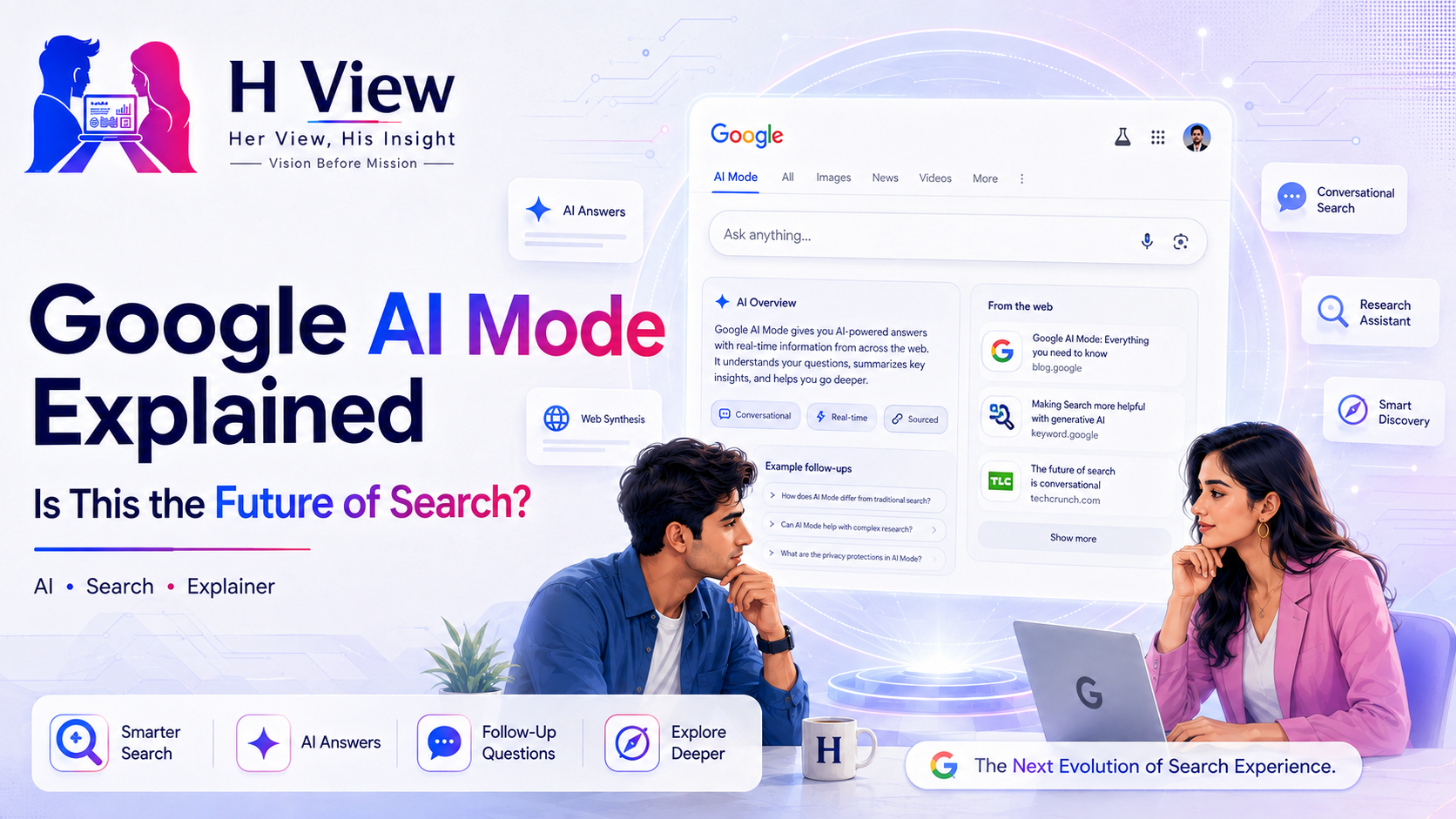
Google AI Mode is moving Search much closer to a conversation with an intelligent assistant. Instead of simply finding webpages that might contain an answer, Google can now interpret a complex question, search across different sources, organise what it finds and generate a detailed response directly inside Search.
Google describes AI Mode as its most powerful AI-powered Search experience, designed to handle questions that require deeper reasoning and follow-up exploration.
For everyday users, this could make searching significantly easier. For publishers, bloggers and businesses that depend on Google traffic, however, the same change raises a much more uncomfortable question.
If Google answers the question itself, will people still visit the websites that helped create that answer?
Google AI Mode should not be confused with the AI Overviews that already appear above some traditional search results.
An AI Overview generally provides an AI-generated summary within a normal Google results page. AI Mode goes considerably further.
It creates a dedicated conversational search experience where users can ask detailed questions, receive generated answers and continue asking follow-up questions without starting the search again.
Behind the scenes, Google says AI Mode can break a question into multiple subtopics and run searches for those areas simultaneously. This allows it to investigate a complicated query more deeply than a traditional single search.
Imagine someone searching:
“I am a fresher in India with no coding experience. Should I learn digital marketing, data analytics or AI tools if I want a job within six months?”
Traditional Google Search might show courses, career websites, YouTube videos and articles about each profession.
AI Mode can instead try to understand the entire situation, compare the options and construct a response specifically around the user’s question while still providing links that allow the reader to explore the underlying web sources.
That difference is important.
People are no longer necessarily searching only for webpages. Increasingly, they are searching for answers.
This transformation became even clearer during Google I/O 2026.
Google announced another generation of AI capabilities for Search, including more advanced AI Mode experiences and agent-like features capable of helping users complete more complicated tasks.
Search is also becoming increasingly multimodal. Google’s Search Live expansion allows people in more than 200 countries and territories to interact with Search using voice and their camera through AI Mode.
That means searching may increasingly look less like typing:
“best laptop under ₹70,000”
and more like asking:
“I’m learning full-stack development, travel occasionally and need good battery life. I don’t game much. Which laptop under ₹70,000 makes sense for me?”
The second question contains context, preferences and an intended outcome. AI-powered search systems are being designed specifically for this type of query.
This is one reason publishers should stop thinking only about short keywords and begin understanding the actual questions people are trying to solve.
Not immediately.
Google is still fundamentally connected to the open web, and AI Mode continues to provide links that allow users to visit external websites. Google has also been experimenting with different ways of displaying sources and links inside its generative AI experiences.
But the role of those links is changing.
In traditional Search, the links were the product. Google helped you choose which webpage to open.
In AI-powered Search, the generated answer can become the first product, while websites become supporting sources for deeper exploration.
That is a significant shift.
A person who previously visited five webpages to understand a subject may sometimes obtain enough information from the AI response without opening all five.
For websites that depend heavily on informational searches, that possibility cannot be ignored.
This is where the conversation becomes particularly important for publishers such as H View.
The old SEO formula encouraged websites to identify a keyword, create an article around that keyword and compete for one of the highest positions in Google’s results.
That approach will not suddenly disappear, but it is becoming incomplete.
A website may increasingly have two objectives: rank in conventional search results and become a trustworthy source that Google’s generative search systems can reference.
Google has now published dedicated guidance explaining how website owners should approach AI features including AI Overviews and AI Mode. Interestingly, Google isn’t recommending a completely separate secret form of “AI SEO.” Its guidance continues to emphasise strong SEO foundations, useful content, crawlability, good page experience and content created for people.
In other words, publishers should not start producing strange articles designed purely for AI systems.
They should become better at answering real questions.
Perhaps one of the strongest indications that AI Search is becoming a permanent part of Google’s ecosystem arrived in June 2026.
Google introduced dedicated reporting in Search Console for visibility within generative AI experiences, including AI Overviews and AI Mode. Website owners can now better understand how their content is appearing within Google’s AI-powered search features.
This matters because publishers will increasingly need to look beyond traditional rankings.
A page might be valuable even when it isn’t simply sitting at position one for a particular keyword. It could appear as a supporting source within an AI response, become visible for several conversational queries or attract users who want deeper information after reading Google’s summary.
Search performance therefore may become more complicated—but potentially more interesting.
There is no single answer that applies to every website.
Some searches are naturally satisfied quickly. If someone asks the age of an actor, the weather tomorrow or the definition of a term, they may have little reason to open another page after receiving the answer.
But other searches require experience, opinion, comparison and trust.
Someone researching whether a ₹50,000 smartphone is actually worth buying may still want detailed reviews. A person deciding whether to accept a suspicious job offer may want examples and warning signs. Someone experiencing a family problem may want thoughtful perspectives rather than a five-line generated summary.
This is where publishers have an opportunity.
The websites most vulnerable to AI Search may be those that simply rewrite information available everywhere else.
Websites that contribute something original—experience, testing, perspective, analysis, useful examples and clear judgement—give readers a stronger reason to visit.
At H View, we don’t think the right response is to panic and declare that “SEO is dead.”
Search is changing, but people’s need for trustworthy information isn’t disappearing.
In fact, the explosion of AI-generated information may make identifiable human perspective even more valuable.
Consider the difference between an article titled:
“Best AI Tools in 2026”
and one that asks:
“Which AI tools are actually useful for someone who doesn’t know coding?”
The second article understands a person rather than simply targeting a phrase.
That is the direction we believe modern publishing needs to take.
H View articles should not exist merely because a keyword has search volume. They should exist because somebody has a genuine question, confusion, problem or decision—and our article can make that decision easier.
Google AI Mode doesn’t remove that opportunity.
It makes the standard higher.
Most likely, it is at least a major part of it.
The future of Google probably won’t be only ten blue links, and it probably won’t be only an AI chatbot either. What is emerging instead is a combination of traditional web search, generative answers, visual search, voice interaction, personal context and eventually AI agents capable of taking actions on a user’s behalf.
Google’s own announcements in 2026 make that direction increasingly clear.
For users, Search could become faster and far more capable.
For publishers, the challenge will be earning a place inside that new discovery journey.
And that may require a change in mindset.
Instead of asking:
“How do we rank for this keyword?”
publishers may increasingly need to ask:
“Why should Google—or a reader—consider our page worth referencing in the first place?”
That could ultimately be the question that defines the next era of search.
No. Gemini is Google’s broader AI assistant and model ecosystem, while AI Mode is an AI-powered experience built directly into Google Search.
AI Mode is becoming an increasingly important part of Search, but traditional web results continue to exist. Google’s current approach combines AI-generated responses with links to websites and other search experiences.
Yes. Google AI Mode can include links and references to webpages it considers relevant to the user’s query. Google has published guidance specifically for website owners seeking visibility in its generative AI Search features.
Not necessarily. Google’s current guidance says the same fundamentals that support good Search performance remain relevant for its generative AI experiences. Creating useful, original, accessible and trustworthy content remains central.
Yes. Google introduced dedicated generative AI performance reporting in Search Console in June 2026, covering visibility from experiences including AI Overviews and AI Mode.
Harika is the co-founder of H View and covers AI, technology, gadgets, digital tools, online platforms, and modern internet trends. Her articles focus on simplifying complex topics with practical explanations, balanced opinions, and reader-first insights.
Share your real experience and help other readers decide better.
No community views yet. Be the first to share yours.
Search is changing. Earlier, people typed a question into Google, clicked a few links, compared…
Harika May 28, 2026