
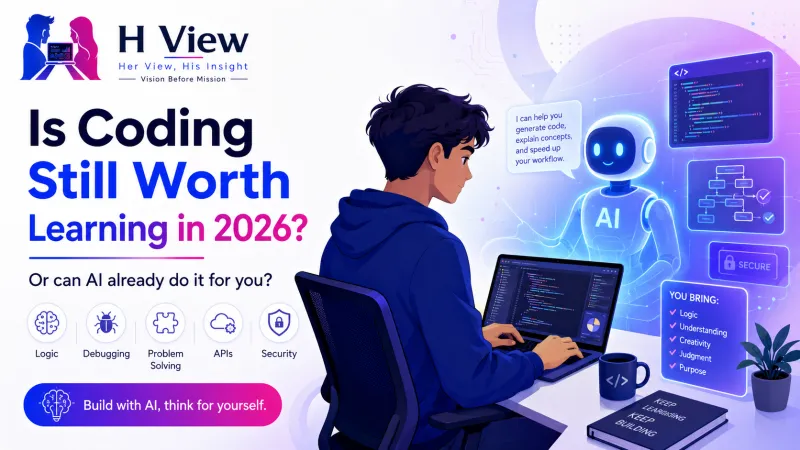
Is Coding Still Worth Learning in 2026? AI and the Developer’s Role
Coding still matters in 2026, but fundamentals now mean knowing how to direct, test and review AI-generated software.
Yes, coding is still worth learning in 2026—but memorising syntax is no longer the whole point. AI can draft code quickly; a developer still needs to decide what should be built, check whether the result works, protect the data and maintain the software after launch. If you enjoy solving problems, learning to code gives you the judgement to use AI well. If your only goal is a guaranteed job, no course or language can promise one.
The real question is not whether AI can write a function. It can. The question is whether a person who cannot read or test that function can safely turn it into a service that other people depend on.
What AI coding tools already do well
Code assistants can suggest completions, explain unfamiliar code, generate a first draft, write routine tests and help locate a likely error. Agent-style tools can also edit several files or run commands when given access to a project. These abilities save time on some tasks, especially when the request is clear and the result is easy to check.
That does not make the output self-validating. A page can look correct while its form submits nothing. A database query can return data while exposing records the user should not see. A script can work on one sample and fail on an empty file, a duplicate request or a different operating system. The visible demo is the beginning of review, not proof the product is ready.
What does the productivity research actually say?
There is no single speedup number that applies to every developer. In a 2025 randomized trial, METR asked 16 experienced open-source developers to complete 246 tasks in mature projects they knew well. With the early-2025 AI tools tested, they took about 19% longer on average, even though they expected the tools to help. The result describes that group, codebase and tool period; it does not tell us what happens to beginners, new projects or current tools.
METR’s February 2026 update described a later experiment with late-2025 tools, but said selection effects made the data an unreliable signal of the productivity effect. Some developers no longer wanted to work without AI, and measuring time became harder when people used multiple agents. The researchers said AI likely helped more than it had in early 2025, while stressing that their data gave weak evidence about how much. That is a useful reminder: tool capability, task type and the quality of the measurement all matter.
These studies are about productivity on selected tasks, not whether a company will hire a beginner or whether a particular AI-generated app is dependable. Treat broad claims such as “AI makes every developer five times faster” with the same care you would use for a product benchmark.
 Also readDo You Really Need a Coaching Institute to Learn Coding?→
Why fundamentals still matter
Consider a hypothetical student building a simple expense tracker. An AI assistant might create a form and a database table in minutes. The student still has to decide what counts as an expense, validate the amount, handle an empty submission, prevent one user from seeing another person’s records, and recover if saving fails. Those decisions turn a code sample into a useful application.
That is why core ideas remain valuable: variables and data types, conditions, loops, functions, collections, HTTP requests, SQL, version control and debugging. You do not need to memorise every library. You do need enough understanding to notice when a generated answer is inconsistent with the problem.
Security and privacy make this more than an academic exercise. Before accepting code that handles passwords, payments or personal information, understand where data goes, who can access it and how errors are logged. AI can help explain a security checklist; it cannot take responsibility for the choices made in a live system.
What should a learner practise?
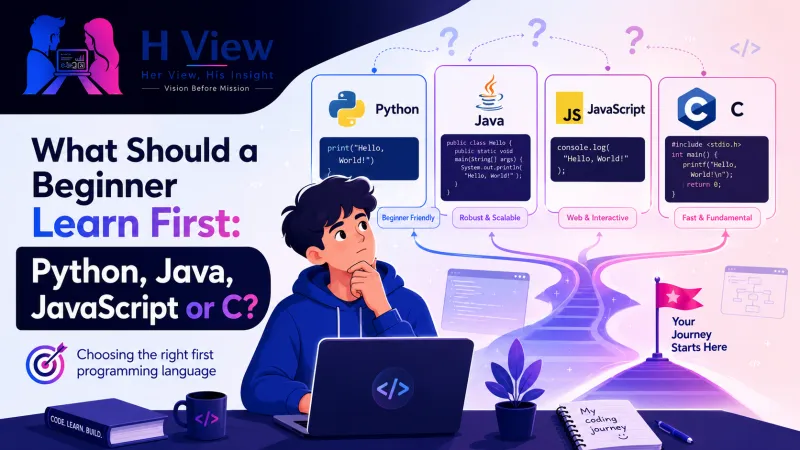
Choose one language that fits your goal rather than switching every week. Python works well for automation and data tasks; JavaScript can take you from browser interfaces to server-side applications. Java, C# and other languages make sense in particular courses and workplaces. The first language matters less than finishing projects and learning to read errors.
Build something small that another person can try. A useful first project might be a study planner, a local-business enquiry form or a page that organises public information. Keep the scope tight. Add one feature at a time, and write down the problem each feature is meant to solve.
- Make it work: handle ordinary input, missing fields and incorrect values.
- Make it testable: try cases you did not use while building it, and record what broke.
- Make it understandable: name things clearly and explain the main decisions in a README.
- Make it safer: keep secrets out of source code and check permissions before exposing data.
- Make it usable: test on a phone, show useful error messages and ask another person to try it.
A certificate can show that you completed a course. A project you can explain shows how you approach a problem. Keep the code, screenshots and a short description of what you changed after testing. Do not present a tutorial clone or AI-generated project as original work without explaining what you actually contributed.
How to use AI without outsourcing the learning
Start by writing the problem in your own words. Try a solution before asking for code; even a rough attempt gives you something concrete to compare. Then ask the assistant to explain a specific error or propose one small change. Large prompts that request an entire application make it harder to see which part failed.
- Ask for a small, reviewable change and the assumptions it makes.
- Read the diff before accepting it; check that unrelated files did not change.
- Run the tests, then add a case the assistant did not mention.
- Explain the new code aloud or in a note. If you cannot, pause and learn that piece.
- Keep a record of bugs you found. Debugging is part of the skill, not evidence that you are bad at coding.
Do not paste private company code, credentials or customer information into a tool unless your organisation has approved that use. For a learner’s public project, remove API keys and personal data before sharing code for help.
A realistic four-week starting plan
| Week | Focus | Evidence of progress |
|---|---|---|
| 1 | Basic logic and one language | Small programs you can explain without copying |
| 2 | Build a narrow project | A working form, script or simple interface |
| 3 | Data, errors and tests | Several edge cases handled and documented |
| 4 | Polish and share | A deployed demo, README and short walkthrough |
Four weeks will not make someone job-ready in every role. It can show whether you enjoy the work and give you a first project to improve. The next steps depend on your aim: web development adds databases and deployment; data work adds statistics and data handling; mobile development brings device testing and platform rules.
Is coding the right path for everyone?
No. If you dislike tracing problems, reading documentation or revising a solution after it fails, another technology role may suit you better. Product operations, technical support, quality assurance, design, business analysis and digital marketing all involve technology without requiring the same amount of daily programming. Learning basic code can still help you communicate with developers and automate small tasks.
For a career switch, assess time and finances realistically. A portfolio can help you demonstrate ability, but hiring also depends on role requirements, interview performance, location and experience. Do not quit a job or buy an expensive course solely because a viral clip says prompt engineering guarantees employment.
Her View
AI can make the first attempt less intimidating. A beginner can ask what an error means without waiting for a class or mentor. That is useful when the learner remains curious enough to check the answer and try again. The goal is confidence based on understanding, not simply a screen full of working-looking code.
 Also read₹50,000 Coding Course vs Free YouTube: What Are You Really Paying For?→
His Insight
When code is cheap to produce, careful review becomes more valuable. A developer who can explain trade-offs, spot a risky assumption and test a failure case brings something that a prompt alone does not supply.
H View Verdict
Learn coding if you want to build, analyse or improve software. Use AI as a capable assistant, but keep ownership of the requirement, testing and final decision. The job is changing; the need to understand what software does—and what could go wrong—has not disappeared.
Frequently Asked Questions
Can AI build an app without a programmer?
It can generate a prototype or handle bounded tasks. A dependable service still needs someone to define requirements, validate data, test security and maintain it.
Should beginners learn coding or prompt engineering?
Learn programming fundamentals and practise giving clear instructions. Prompting helps, but fundamentals make it possible to check the result.
Which language should I learn first?
Choose one that fits a project you want to finish. Python and JavaScript are common starting points, but the best choice depends on your goal and course.
Will learning coding guarantee a job?
No. Skills and projects help, but hiring depends on the role, experience and market. A course certificate alone cannot guarantee employment.
How should I use AI on a coding assignment?
Follow your institution’s rules. Use assistance to understand a concept or debug your own attempt, and disclose it when required.
Sources and review note
Updated on 12 November 2026. This article draws on METR’s 2025 randomized developer study and its February 2026 note on the limits of its later productivity data. Both studies cover particular groups, tools and tasks; neither predicts an individual learner’s career outcome.
H View stories follow our editorial policy. Spotted an error? Tell us and we will correct it.
Rate this article
One tap is enough. No comment needed.
Was this article helpful?
Your answer goes straight to our editors.









Comments0
No comments yet. Start the conversation.