

Entry-Level Job—but Experience Required? The Fresher Trap Nobody Is Fixing
A fresher opens a job portal and finds an attractive vacancy. The title says Entry-Level,…
 Satya Hemanth August 9, 2026
  By Satya HemanthUpdated September 20, 202610 min read65 views
Full-stack development has become one of the most heavily promoted technology courses in India.
Coaching centres advertise programmes covering HTML, CSS, JavaScript, React, Node.js, databases, APIs and deployment. Students are often told that learning the “complete stack” will make them more employable because they can work on both the visible part of an application and the systems behind it.
The promise sounds practical:
Learn frontend and backend development, build a few projects and become job-ready within three or six months.
But the market now contains thousands of people with similar course certificates, similar tutorial projects and almost identical resumes.
That creates an important question:
Is full-stack development still a strong career path, or has it become the most over-sold coding course in the market?
The honest answer is that full-stack development remains valuable.
Modern companies still need developers who understand how user interfaces, servers, databases, APIs, authentication and deployment work together. Software-development employment also continues to show strong long-term demand, with the US Bureau of Labor Statistics projecting 15% growth for software developers, quality-assurance analysts and testers between 2024 and 2034.
The problem is not the career path.
The problem is the shallow version of full-stack development sold as a quick route to employment.
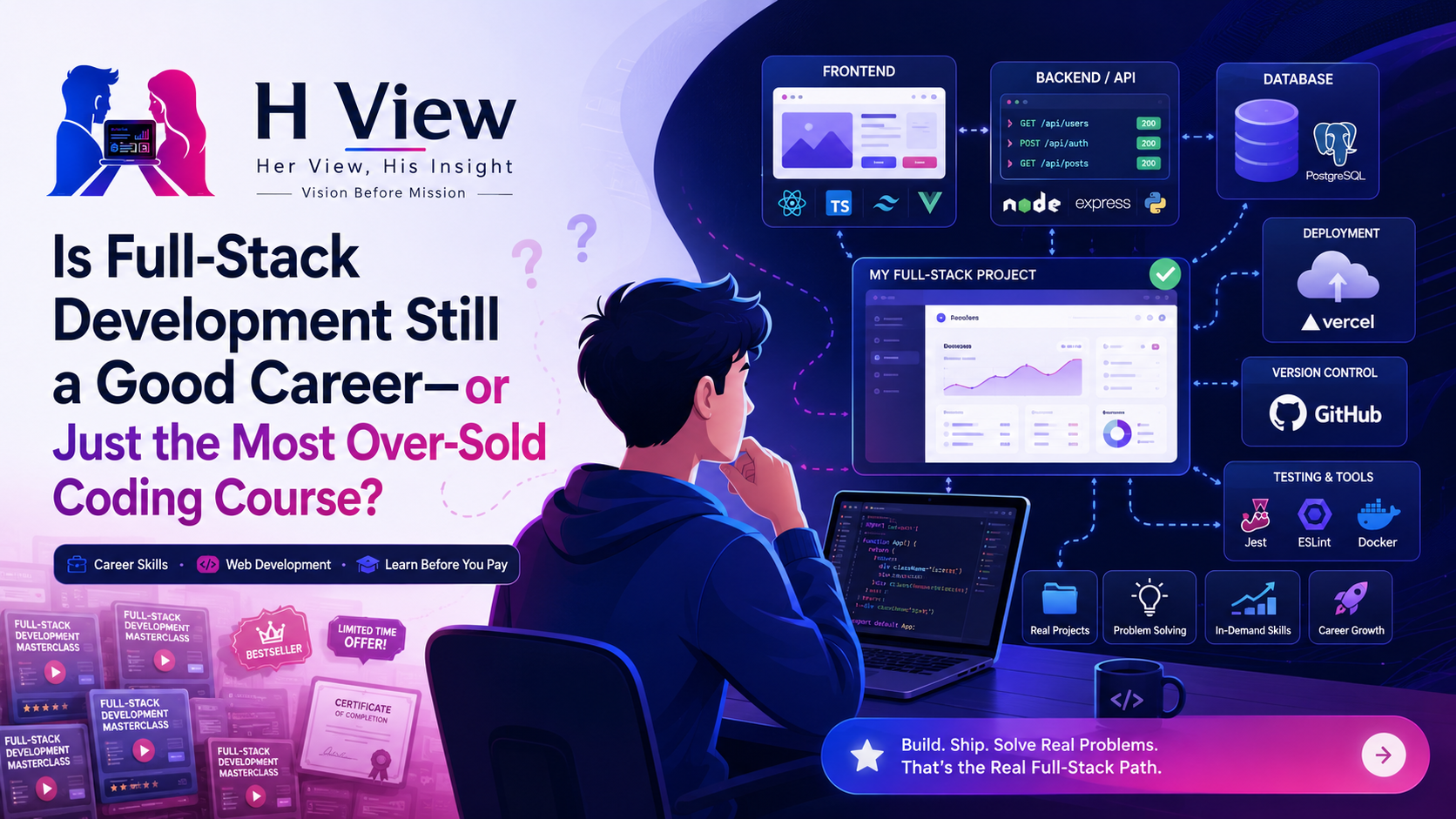
A full-stack developer works across multiple parts of an application.
The frontend is what users see and interact with. It may include:
The backend manages application logic and communication with data or external services. It may include:
A real full-stack role may also involve:
Therefore, full-stack development is not simply React plus Node.js.
It is the ability to understand how a complete application works from the browser to the database and back again.
Full-stack development is easy to market because it sounds complete.
A student may hesitate to join only frontend or backend training because they fear limiting their job opportunities. “Full stack” suggests that one course covers everything required to build software.
It also produces visually attractive demonstrations.
Within a few weeks, learners can create:
These projects look impressive in advertisements.
However, visible screens are only one part of production software.
A course may show students how to copy a project without teaching them how to:
The student finishes the course believing they are full-stack developers, while employers discover that they can only reproduce guided examples.
From one perspective, full-stack development is an excellent learning path.
It helps beginners understand how different technologies connect.
A frontend-only learner may know how to display information but not understand where the information comes from. A backend-only beginner may create APIs but struggle to see how users interact with them.
Full-stack learning can provide a broader picture.
A learner can understand:
This broader understanding can make developers more useful in startups, small teams and early-stage product environments.
The 2025 Stack Overflow Developer Survey also showed continued interest in combinations such as Node.js, React, Next.js and Vue.js, reflecting demand for developers who can contribute across more of the application stack.
Full-stack knowledge can therefore create flexibility.
The problem begins only when breadth is confused with mastery.
A six-month programme may try to cover:
That is a very large amount of material.
When the course moves too quickly, students may memorise procedures without understanding why they work.
They know how to run commands but not how to diagnose failures. They can create routes but do not understand request lifecycles. They can use authentication libraries but cannot explain sessions, tokens or permissions.
This creates a common fresher profile:
Exposure to many technologies, confidence in none.
Employers usually prefer someone who understands the fundamentals well and can learn additional tools over someone who has touched twenty technologies superficially.
The entry-level market is crowded, but that does not mean the career has no future.
It means many candidates are competing with nearly identical preparation.
They may all list:
They may also show the same ecommerce project, task manager or chat application.
From an employer’s perspective, the challenge is not finding applicants.
It is finding candidates who can genuinely solve problems.
Software and web-development roles continue to have positive long-term demand. The US Bureau of Labor Statistics projects 7% growth for web developers and digital designers from 2024 to 2034, while broader software-development roles are projected to grow faster.
The market is not overcrowded with strong full-stack developers.
It is overcrowded with people carrying similar course labels.
A fresher is not expected to know everything.
However, employers generally expect clear foundations.
A beginner should be able to explain:
The employer may also ask the candidate to modify an existing feature.
For example:
These tasks reveal whether the learner understands the application or simply followed a tutorial.
A strong roadmap should be layered rather than rushed.
Learn HTML, CSS, responsive layouts and core JavaScript.
Do not rush directly into React.
Understand variables, functions, arrays, objects, conditions, loops, asynchronous programming and error handling.
Learn components, state, forms, routing, API integration and user experience.
React remains widely used, but frameworks change. Core JavaScript knowledge remains transferable.
Learn servers, routes, controllers, validation, authentication and application logic.
Understand SQL or document databases, relationships, indexing and data design.
Learn commits, branches, pull requests and resolving conflicts.
Practise input validation, permissions, password handling, API testing and common security precautions.
Publish the frontend, backend and database using a real hosting environment.
Build something with real users, roles, data and failure conditions.
This roadmap takes time.
A learner may understand the basics within six months, but becoming dependable usually requires continued practice beyond the course.
There is no single compulsory stack.
A common JavaScript-based path is:
TypeScript has become increasingly important in modern software development. GitHub reported that it became the most-used language on the platform by contributor activity in August 2025, reflecting the value developers place on stronger typing and tooling in larger codebases.
Other valid paths include:
Do not select a stack only because an institute advertises it.
Choose based on the roles available, your learning goals and the kind of software you want to build.
A beginner can learn full-stack development, but they do not need to present themselves as experts in everything.
A more believable fresher profile may be:
Frontend developer with backend understanding
or:
Backend developer capable of building basic interfaces
This communicates a primary strength while showing broader awareness.
Trying to become equally advanced in frontend design, backend architecture, databases, cloud infrastructure, security and DevOps at the beginning may be unrealistic.
Start broad enough to understand the system.
Then go deeper in one area.
A strong full-stack project should include more than attractive pages.
Useful features may include:
Examples include:
The project should solve a complete workflow, not merely display data.
AI can generate components, routes, database models, tests and deployment instructions.
This makes development faster.
It also makes weak candidates look stronger until something fails.
The World Economic Forum identifies technology literacy, AI and big data, networks and cybersecurity among the fastest-growing skill areas, while also emphasising creative thinking, adaptability and lifelong learning.
For full-stack developers, this means the valuable skill is not simply producing more code.
It is being able to:
AI increases the value of understanding the complete stack.
It does not remove the need for it.
Be cautious when a programme:
A good programme should clearly explain what a beginner can realistically achieve.
Her View: Full-stack development gives learners a complete understanding of how applications work. It can create flexibility, practical project skills and strong opportunities in startups and product teams.
His Insight: The course market often compresses a large profession into a short syllabus. Learning many tools superficially can produce certificates without job-ready ability.
Both views are valid.
Full-stack development is a real career.
The shortcut version is the problem.
Full-stack development is still a good career path.
It is not an easy one.
The demand for people who can understand complete software systems remains strong, but employers are no longer impressed by the words “MERN Stack” alone.
Beginners should learn frontend, backend, databases, APIs, Git, testing, security and deployment through real projects. They should also develop one area more deeply instead of remaining equally weak across the entire stack.
Do not ask only:
“Which full-stack course should I join?”
Ask:
“Will this course help me build, test, deploy and explain a complete application independently?”
If the answer is no, the programme may teach tools without preparing you for the profession.
The full-stack market is crowded with certificates.
There is still room for developers who genuinely understand the stack.
Yes. Companies continue to need developers who understand frontend, backend, databases and application integration. Practical ability matters more than the course title.
The entry-level market has many applicants, but employers still struggle to find candidates with strong fundamentals, original projects and problem-solving ability.
Six months may be enough to build foundations and complete beginner projects with consistent practice. It is usually not enough to master every part of professional full-stack development.
JavaScript or TypeScript with React and Node.js is a common path. Java, Python and .NET are also strong backend choices. The best stack depends on career goals and local job opportunities.
No. Learn core JavaScript first. React becomes easier when you understand functions, arrays, objects, asynchronous programming and browser behaviour.
Yes. Applications usually depend on stored data, relationships, queries, validation and security. Database knowledge is essential.
A certificate can show structured learning, but it does not prove job readiness. Employers value projects, technical understanding and interview performance more.
Two or three complete, original and deployed projects are usually stronger than many copied tutorial applications.
Satya Hemanth is the founder of H View and writes on careers, sports, leadership, digital trends, and practical decision-making. His articles focus on clear explanations, real-world examples, and useful insights for students, young professionals, and everyday readers.
Share your real experience and help other readers decide better.
No community views yet. Be the first to share yours.
A fresher opens a job portal and finds an attractive vacancy. The title says Entry-Level,…
Satya Hemanth August 9, 2026 
You find a job that perfectly matches your profile. The company looks genuine. The role…
Satya Hemanth August 8, 2026 
For generations, the path to a secure career appeared simple: Study hard, complete a degree…
Satya Hemanth August 7, 2026 
Sending hundreds of job applications without receiving a single interview can be deeply frustrating. A…
Satya Hemanth August 6, 2026