
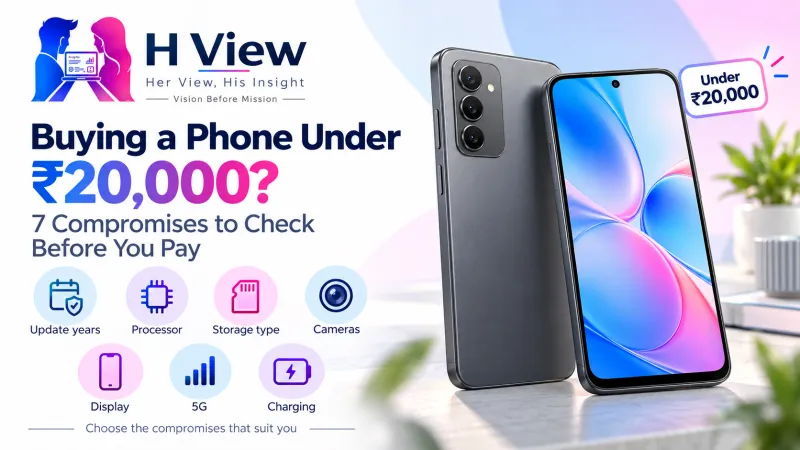
Buying a Phone Under ₹20,000? 7 Compromises to Check Before You Pay
Every budget phone cuts corners somewhere. These are the seven compromises to check first, and how to pick the ones that will not bother you.
Every phone under ₹20,000 cuts corners somewhere. The compromises worth checking first are software update years, the processor, storage type, the display, the camera count trick, charging and 5G support. Decide which two or three matter most for you, and accept cuts in the areas you rarely use.
The under-₹20,000 segment is where most Indians buy their phones, and it is also where spec sheets get creative. "50MP triple camera", "16GB RAM*" and "120Hz display" sound impressive on a banner. The fine print tells you whether those numbers mean anything. Here is what to look at, in the order that matters for daily life.
What do budget phones under ₹20,000 usually compromise on?
Where budget phones save money
1. How many years of updates will it get?
This is the compromise people notice last and regret most. Software updates bring new features, but security patches are what keep your banking, UPI and WhatsApp safe. A phone that stops getting patches after two years becomes risky long before the hardware wears out. Before you buy, look for the brand's written policy on the product page or support site: how many Android version upgrades and how many years of security updates. If the brand does not say, assume the shorter end.
 Also readBuy a Phone This Diwali or Wait for Black Friday 2026? A Simple Way to Decide→
2. Is the processor good enough for three years?
Almost every budget phone feels fast in the store. The difference shows in year two, when apps get heavier. Instead of the clock speed, look up the chipset name and check independent reviews for how it handles daily multitasking, camera processing and a little gaming. Be wary of "virtual RAM" or "RAM expansion" numbers: they borrow space from storage and are not the same as real RAM. A phone listed as "8GB + 8GB virtual" has 8GB of RAM.
3. What kind of storage does it use?
Two phones with 128GB can feel very different. Newer UFS storage is much faster than older eMMC storage, which affects app launch times, camera saving and updates. Many brands do not highlight this, so check the full specifications or reviews. Also pick at least 128GB if you shoot videos or use WhatsApp heavily; full storage slows any phone down. Our guide to freeing up phone storage helps if you are already short on space.
4. Is the camera count real?
A "triple camera" often means one good main camera plus a 2MP depth or macro sensor that adds very little. What matters is the main sensor, whether it has OIS (optical image stabilisation), and how it performs in low light and video. One good camera beats three average ones. Look at real sample photos at night and indoors, not the brand's marketing shots.
5. What about the display and build?
- AMOLED vs LCD: AMOLED gives deeper blacks and is usually easier to read outdoors; a good LCD is fine for many people
- Refresh rate: 90Hz or 120Hz feels smoother, but only if the chip can keep up
- Brightness: check peak brightness if you are outdoors a lot
- Water and dust resistance: an IP rating such as IP54 or IP64 offers splash or dust protection; no rating means no promise
- Speakers: stereo speakers make a real difference for videos and calls on speaker
6. Does it support 5G, and does that matter?
Not every phone in this range is 5G. In the OnePlus Diwali 2026 line-up, for example, the cheapest model on the official sale page is the OnePlus N6 Lite 4G, listed from ₹14,749 with bank offers, while the N6x is listed from ₹16,999. If 5G is available where you live and you plan to keep the phone for three or four years, pay a little more for it. If you mostly use Wi-Fi, a 4G phone with better updates or cameras may be the smarter buy.
7. Charging and battery
Budget phones now ship with large batteries, which is good. Check the charging speed and whether a charger is in the box. A big battery with slow charging means long waits. If you need to buy a charger, pick a certified one; our guide on spotting fake chargers explains how.
How to choose: pick your top three
| If you mostly... | Prioritise | Can compromise on |
|---|---|---|
| Call, chat and pay with UPI | Updates, battery, reliable brand service | Refresh rate, extra cameras |
| Take photos and make Reels | Main camera with OIS, storage | Speakers, charging speed |
| Watch videos and play games | Chip, display, speakers | Camera count, design |
| Buy for a parent | Updates, screen size and brightness, service centre nearby | Chip, high refresh rate |
 Also readOnePlus Diwali Sale 2026: How to Work Out the Real Final Price Before You Buy→
Her View
Budget phones are often bought for students and parents, the two groups who keep a phone the longest. That makes software updates and a nearby service centre more important than a flashy spec. When a phone is a teenager's first, also check that parental controls and screen-time tools work well on it.
His Insight
Spec sheets are designed to win comparisons, not to describe daily use. Ignore the biggest number on the banner and check the three that do not appear on it: update years, storage type and main camera stabilisation. These decide whether the phone still feels good in year three.
H View Verdict
A good phone under ₹20,000 is absolutely possible in 2026, as long as you choose your compromises on purpose. Lock in long software support and a decent processor first, then decide between camera, display and 5G based on how you use your phone. The cheapest phone is rarely the best value if it stops getting updates in two years.
Frequently Asked Questions
What is the most important thing to check in a phone under ₹20,000?
Check how many years of security updates the brand promises. It decides how long the phone stays safe for banking and payments.
Is virtual RAM the same as real RAM?
No. Virtual RAM uses part of the storage as temporary memory. It is much slower than real RAM, so compare the physical RAM figure.
Should I buy a 4G or 5G phone under ₹20,000?
Pick 5G if it is available in your area and you plan to keep the phone for several years. A 4G phone can still make sense if you mostly use Wi-Fi.
Do more cameras mean better photos?
No. Extra 2MP depth or macro cameras add little. The quality of the main camera and whether it has OIS matter far more.
H View stories follow our editorial policy. Spotted an error? Tell us and we will correct it.
Rate this article
One tap is enough. No comment needed.
Was this article helpful?
Your answer goes straight to our editors.










Comments0
No comments yet. Start the conversation.