
How to Choose a Power Bank in India: Real Capacity, Watt-Hours, Fast Charging and the New Flight Rules
A 20,000mAh label does not mean four full phone charges. How to choose a power bank that actually fits your phone and laptop, what to check for safety, and the flight rules every traveller should know.
Power banks look like the simplest gadget to buy. Pick a big mAh number, check the price, add to cart. Then the reality arrives: the “20,000mAh” power bank charges your phone fewer times than expected, it barely moves your laptop’s battery, and at the airport you are told you cannot use it on board.
If you want to choose a power bank that actually works for you, a few numbers and labels matter far more than the headline capacity. This guide explains them in plain language, along with the safety checks and flight rules every Indian buyer should know.
Why the mAh Number on the Box Is Misleading
The mAh figure printed on a power bank refers to the capacity of the cells inside, usually measured at around 3.6–3.7 volts. Your phone, however, charges at a higher voltage through USB, and some energy is lost as heat during conversion.
In practice, a power bank delivers noticeably less than its printed capacity to your device. As a rough rule, expect about 60–70% of the label.
| Power bank label | Rough energy (Wh) | Realistic charges for a 5,000mAh phone |
|---|---|---|
| 10,000mAh | ~37 Wh | About 1.2–1.5 |
| 20,000mAh | ~74 Wh | About 2.5–3 |
| 27,000mAh | ~100 Wh | About 3.5–4 |
Phones with very large batteries, which we covered in our look at 10,000mAh smartphones, will get even fewer full charges from the same power bank.
Watt-Hours Matter More Than mAh
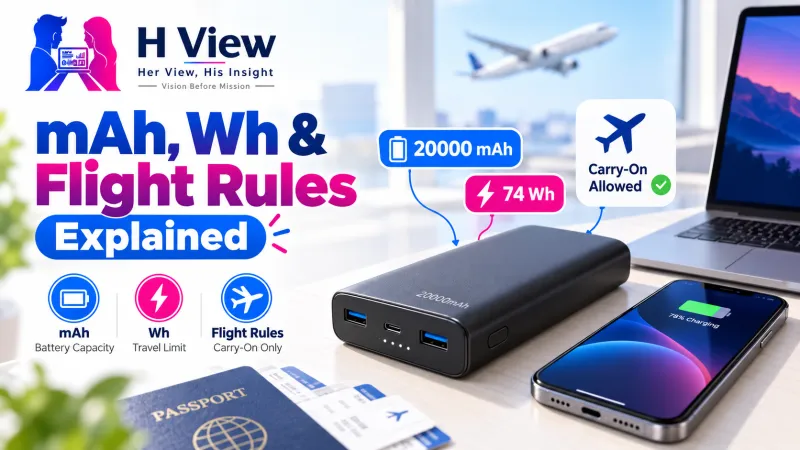
Watt-hours (Wh) tell you the actual energy stored. You can estimate it with this formula:
Wh = mAh × 3.7 ÷ 1000
So a 20,000mAh power bank stores roughly 74Wh. Watt-hours are also what airlines use to decide whether you can carry a power bank, so it helps to know the figure before you travel. Good power banks print it on the body.
 Also readIs Your Phone Charger Safe? How to Spot Fake Chargers and Cables Before They Damage Your Phone→
Output Power: Will It Charge Your Device Quickly?
Capacity tells you how much energy is stored. Output wattage tells you how fast it can deliver that energy.
- For phones: 18W to 25W output is enough for most phones. Some phones support faster speeds only with their own brand’s technology.
- For tablets and iPads: 20W to 30W USB-C output is a good minimum.
- For laptops: look for USB-C Power Delivery (PD) output of 45W, 65W or more, matching what your laptop’s own charger supplies.
Check which standard your phone supports. USB Power Delivery (USB-PD) is the most widely compatible. Some brands use their own fast-charging systems, which may only work at full speed with matching accessories.
Ports and Recharge Time
- USB-C input and output: ideal, because one cable can charge the power bank and your devices.
- Fast input: a 20,000mAh power bank with slow input can take many hours to refill. Look for 18W or faster input if you travel often.
- Number of ports: useful if you charge a phone and earbuds together, but total output is usually shared between ports.
Safety: Check for the BIS Registration Mark
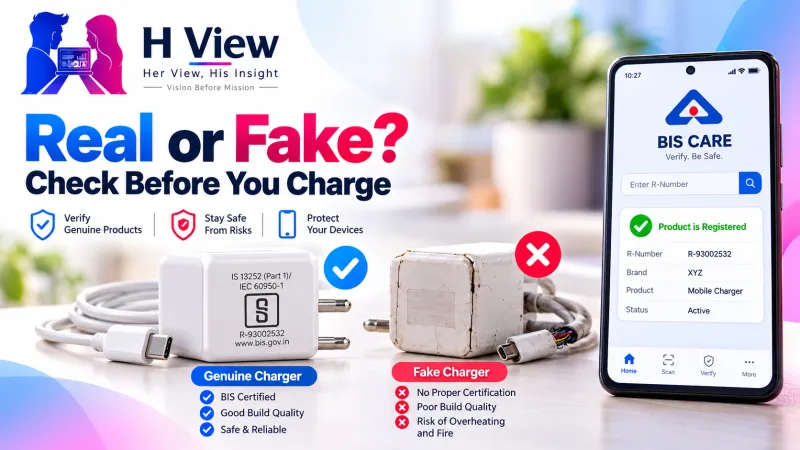
Power banks contain lithium-ion cells. A poorly made one can overheat, swell or even catch fire. In India, power banks for portable use fall under the Bureau of Indian Standards’ Compulsory Registration Scheme, so genuine products should carry a BIS registration mark with an R-number.
You can verify that number yourself in the official BIS Care app using its “Verify R-No under CRS” feature. If the number does not match the brand or product, or there is no number at all, do not buy it.
Other warning signs:
- Unrealistically high capacity for a very small, light body.
- No brand name, no warranty and no customer support details.
- Swelling, unusual heat or a burning smell during use. Stop using it immediately.
Flight Rules: What Indian Travellers Need to Know
Power bank rules for flights have become stricter. Based on current DGCA guidance and airline advisories:
- Cabin baggage only. Power banks and spare lithium batteries are not allowed in checked luggage.
- Up to 100Wh (roughly 27,000mAh) is generally allowed without airline approval.
- Between 100Wh and 160Wh usually needs prior airline approval.
- Above 160Wh is not allowed on passenger flights.
- No use on board. DGCA has barred passengers from using power banks to charge devices during the flight, and from charging power banks through aircraft seat ports.
- Not in overhead bins. Keep it in your seat pocket or under the seat in front of you, where crew can reach it quickly.
Airlines can apply stricter limits, so check your airline’s page before travelling, especially on international routes.
Which Power Bank Size Should You Buy?
| Your use | Suggested capacity | Key feature |
|---|---|---|
| Daily commute, one phone | 10,000mAh | Light, 18–25W output |
| Long trips, phone and earbuds | 20,000mAh | Two ports, fast USB-C input |
| Laptop on the go | 20,000–25,000mAh | 45–65W USB-C PD output |
| Frequent flyers | Under 100Wh | Wh clearly printed on the body |
 Also readAmazon Great Freedom Sale 2026: Real Smartphone Deals or Marketing Tricks?→
Her View: Buy for Your Real Day, Not the Biggest Number
Most people buy the largest power bank they can afford, then leave it at home because it is too heavy. If you mainly need a top-up during a long workday or a commute, a slim 10,000mAh unit you actually carry is more useful than a heavy 30,000mAh brick in a drawer.
And please don’t compromise on safety to save a few hundred rupees. A power bank sits in your bag, on your bed and next to your phone for hours. A verified BIS number is worth checking.
His Insight: Match the Output to the Device, Not Just the Capacity
The most common mistake is buying a high-capacity power bank with low output and expecting it to charge a laptop or charge a phone quickly. Capacity and speed are separate. A 20,000mAh power bank with 10W output will charge slowly no matter how big it is.
Before buying, check your device’s supported charging standard and wattage, then pick a power bank that supports the same standard at that wattage or higher. If you want your phone’s battery to last longer overall, our guide on protecting battery health has tips that apply to most Android phones.
H View Verdict
To choose a power bank well, look past the mAh headline. Check watt-hours for real energy and flight limits, output wattage and charging standard for speed, USB-C input for convenient recharging, and a verifiable BIS R-number for safety.
For most people, a well-made 10,000mAh or 20,000mAh power bank with USB-C PD is the sweet spot. And if you fly, keep it under 100Wh, in your cabin bag, and switched off during the flight.
Frequently Asked Questions
How many times will a 20,000mAh power bank charge my phone?
For a phone with a 5,000mAh battery, expect roughly 2.5 to 3 full charges, because some energy is lost during voltage conversion and heat.
How do I convert mAh to watt-hours?
Multiply the mAh by 3.7 and divide by 1,000. For example, 20,000mAh × 3.7 ÷ 1,000 ≈ 74Wh.
Can I carry a power bank on a flight in India?
Yes, in cabin baggage only. Power banks up to 100Wh are generally allowed without approval, but you cannot use them to charge devices during the flight under current DGCA guidance.
How can I check if a power bank is genuine?
Look for the BIS registration mark and R-number on the product, then verify the number in the official BIS Care app using the “Verify R-No under CRS” option.
Can a power bank charge a laptop?
Only if it supports USB-C Power Delivery at a wattage close to your laptop charger, usually 45W, 65W or higher.
H View stories follow our editorial policy. Spotted an error? Tell us and we will correct it.
Rate this article
One tap is enough. No comment needed.
Was this article helpful?
Your answer goes straight to our editors.







Comments0
No comments yet. Start the conversation.