
Digital Arrest and Online Payment Scams: How to Protect Your Money Without Living in Fear
How digital arrest and payment scams create pressure, how to verify a suspicious request, and what to do if money has already left your account.
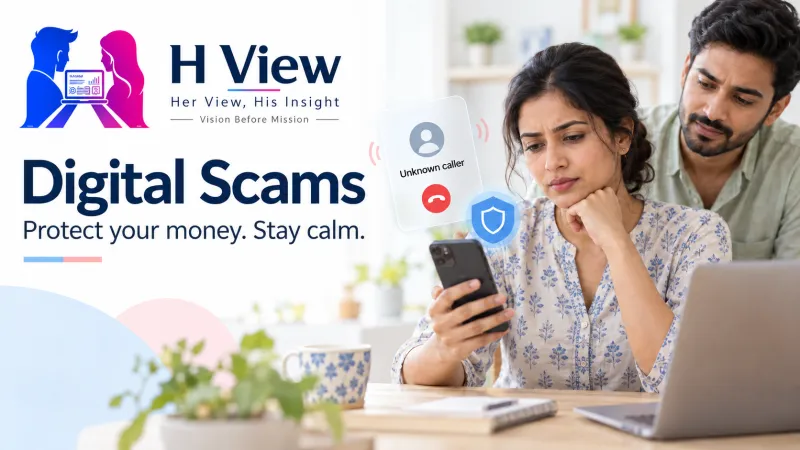
Your phone rings while you are finishing lunch or travelling home. The caller says a parcel linked to your name contains illegal items, or your bank account has appeared in an investigation. Before you can understand what is happening, they threaten arrest and tell you not to speak to anyone.
That moment of fear is what the scammer wants. The aim is to make you act before you have time to check the story. Understanding this pattern can help you protect your money without becoming afraid of every phone call or digital payment.
If money has already been lost
Contact your bank through its verified fraud channel, call 1930 and follow the reporting instructions at cybercrime.gov.in. Preserve messages and transaction references. Prompt reporting does not guarantee recovery.
What is a digital arrest scam?
In a digital arrest scam, criminals pretend to be police officers, investigators or other officials. They may show a uniform, an official-looking document or a video background resembling a government office. They then pressure someone to stay on a call, follow instructions and transfer money.
The Central Bureau of Investigation has explicitly stated that digital arrest has no legal existence in Indian law. An intimidating video call does not give a stranger authority to detain you or demand a payment to clear your name. If someone threatens you in this way, end the call and verify the claim through an independently obtained official channel.
The CBI’s official warning also explains how fabricated notices are used to create fear. A document bearing an agency’s name is not sufficient proof of authenticity. Verification should take place outside the suspicious caller’s instructions.
A familiar situation: “Your parcel has been stopped”
Consider a fictional example involving Kavya, a working professional waiting for an online delivery. A caller says a different parcel has been booked using her identity and contains prohibited goods. When she denies knowing about it, the caller offers to transfer her to an investigating officer.
The second person sounds serious and already knows her name. They tell her that discussing the matter with her family will interfere with the investigation. Finally, they ask her to move her savings into an account supposedly used for verification.
Kavya has not become careless overnight. She has been placed inside a story designed to make obedience feel safer than questioning. The useful turning point is to leave the caller’s instructions, contact someone she trusts and verify independently.
This example is fictional, but the parcel allegation, impersonation and pressure to remain on a video call reflect methods described in a Ministry of Home Affairs warning. Individual scripts vary, so recognising the pressure matters more than memorising one story. A different caller may allege that a family member is in trouble.
 Also readIndependence Day Scam Alert 2026: Fake Greetings, Gift Links and Offers You Should Never Click→
Which warning signs should you notice?
A caller may speak politely, use correct terminology or send a convincing document. None of those details independently proves who they are. Pay closer attention to what they want you to do.
| What they request | Why it matters | A safer response |
|---|---|---|
| “Do not tell your family.” | Removes outside advice. | Disconnect and contact someone you trust. |
| “Transfer money to verify your account.” | Turns a threatening story into a financial transaction. | Do not transfer; contact your bank independently. |
| “Stay on video until we clear you.” | Attempts to control your time and decisions. | End the call and verify officially. |
| “Install this app.” | May expose your screen or device. | Refuse unsolicited access and contact verified support. |
| “Read out the code you received.” | Requests an authentication secret. | Do not share it; secure the relevant account. |
You do not need to win an argument with the caller. You also do not need to remain connected while collecting perfect proof. Your first responsibility is to stop following instructions that could expose your money or accounts.
What about refunds, QR codes and helpful strangers?
Some scams begin with relief: a promised refund, cashback or payment for something you are selling. The person may sound helpful and describe a payment step as a routine formality. Read the payment screen rather than following spoken instructions.
The National Payments Corporation of India’s fraud guidance warns about fake rewards and QR-code requests asking people to enter a Unified Payments Interface personal identification number, or UPI PIN. You do not need to enter your UPI PIN merely to receive an ordinary incoming UPI payment. If someone promises a refund while your app asks you to authorise a payment, stop and check.
Another route is fake technical support for a failed payment or account problem. The caller asks you to install a screen-sharing application. CERT-In’s advisory warns that remote access can expose device activity or control and facilitate financial fraud.
A simple decision map for a stressful moment
A short routine is easier to remember than a catalogue of scam names. The purpose is to create enough distance to make your own decision. Use this sequence when a stranger combines urgency with money, secrecy or account access.
Suspicious request → independent decision
If money has already moved, report promptly instead of continuing the conversation.
The Reserve Bank of India’s safety guidance reinforces the importance of protecting passwords, PINs and one-time passwords, or OTPs. It also cautions against suspicious links received through messages, email and social platforms. Treat requests for these secrets as a reason to stop, even when the caller sounds informed.
What should you do if money has already left?
A loss can make someone freeze or delete embarrassing messages. Try to move towards reporting instead. Do not send another payment to supposedly release or recover the first one.
- Contact your bank. Use its verified fraud channel, explain what happened and request protective action. Keep the complaint reference.
- Call 1930 and use the official portal. Follow the instructions for lodging or completing your complaint at cybercrime.gov.in. Do not substitute a helpline supplied by the caller.
- Preserve evidence. Keep transaction references, amounts, dates, messages and recipient details. Do not publish sensitive account information on social media.
- Secure affected access. Tell the bank if credentials or device access were exposed. Follow its instructions using a trusted device where possible.
The Ministry of Home Affairs describes these reporting channels and its financial-fraud response mechanism. Rapid reporting supports efforts to prevent funds moving further. It does not guarantee that money will be recovered.
Will the bank definitely return the money?
There is no responsible promise that every scam victim receives a refund. Circumstances matter, including how the transaction occurred, when it was reported and which rules apply. Describe exactly what happened rather than assuming all fraudulent payments are treated alike.
RBI’s framework for unauthorised electronic banking transactions distinguishes bank-related failures, certain third-party breaches and customer negligence. Its provisions depend on the category and reporting circumstances. Do not assume a transfer someone was deceived into authorising qualifies for every protection covering an unauthorised debit.
Report immediately rather than treating a regulatory reporting window as time you can safely wait. Ask the bank for its complaint process, applicable policy and written response. Keep those records alongside your cybercrime complaint details.
Her View: Make it safe to ask for help
A family’s reaction can influence whether someone reports quickly or hides what happened. Asking “How could you believe that?” adds shame when practical help is needed. A better response is to help contact the bank and organise the evidence.
Families can agree that anyone may interrupt a workday to check a suspicious demand. Students should have the same freedom to question messages about fees, scholarships or account problems. Asking for verification should be treated as sensible behaviour.
His Insight: Remove the single-person decision
This is also a management lesson for households and small businesses. One unexpected call should not trigger an unusual transfer or a change in supplier payment details. Independent confirmation creates a barrier between a convincing story and a financial loss.
A small company could require a second person to confirm unfamiliar payment requests through an existing contact. A family could check urgent money requests using an already known number. These suggested safeguards reduce dependence on one person making a perfect decision under pressure.
H View Verdict
Digital safety does not require you to distrust everyone or abandon online payments. It requires stepping back when someone combines urgency, secrecy and a demand for money or access. Pause, verify independently and involve someone you trust.
If a loss occurs, contact your bank, call 1930 and follow the official reporting process. Focus on protecting affected accounts and preserving evidence. The person needs support, while responsibility for the deception belongs to the criminal.
Frequently Asked Questions
Does knowing my name prove a caller is genuine?
No, personal details do not establish identity. A caller’s information cannot replace independent verification. Contact the claimed organisation using details you obtain yourself.
Should I enter a UPI PIN to receive a refund?
An ordinary incoming UPI payment does not require your UPI PIN. Read the screen carefully when someone asks you to approve something. Stop if the action does not match your intention.
Can I report after transferring money?
Yes, report rather than assuming it is too late. Contact your bank and the official reporting channels promptly. Preserve evidence even if the caller disappears.
Does reporting guarantee full recovery?
No, reporting and recovery are different stages. Outcomes depend on the circumstances and subsequent action. Be cautious of anyone demanding an upfront payment while guaranteeing recovery.
Sources and editorial method
This original awareness guide draws on the linked official guidance from MHA, CBI, RBI, NPCI and CERT-In, consulted on 29 October 2026. Kavya’s story is an illustrative scenario, not an interviewed victim’s account. This is desk research and general safety information, not a determination of liability in an individual dispute.
For related reading, explore how paid task scams build trust, how mule accounts connect to cyber fraud and warning signs in recruitment offers. These explain different situations in which a believable story can lead to a harmful financial decision. Check each situation independently rather than assuming one safety rule covers every scam.
H View stories follow our editorial policy. Spotted an error? Tell us and we will correct it.
Rate this article
One tap is enough. No comment needed.
Was this article helpful?
Your answer goes straight to our editors.







Comments0
No comments yet. Start the conversation.