


H View
  • Home
  • About
  • Blogs
  • Categories
    • AI
    • Tech
    • Lifestyle
    • Business
      • Money
    • Sports
  • Reviews
  • Contact
Connect With Us
H View
  • Home
  • About
  • Blogs
  • Categories
    • AI
    • Tech
    • Lifestyle
    • Business
      • Money
    • Sports
  • Reviews
  • Contact
Connect
Money

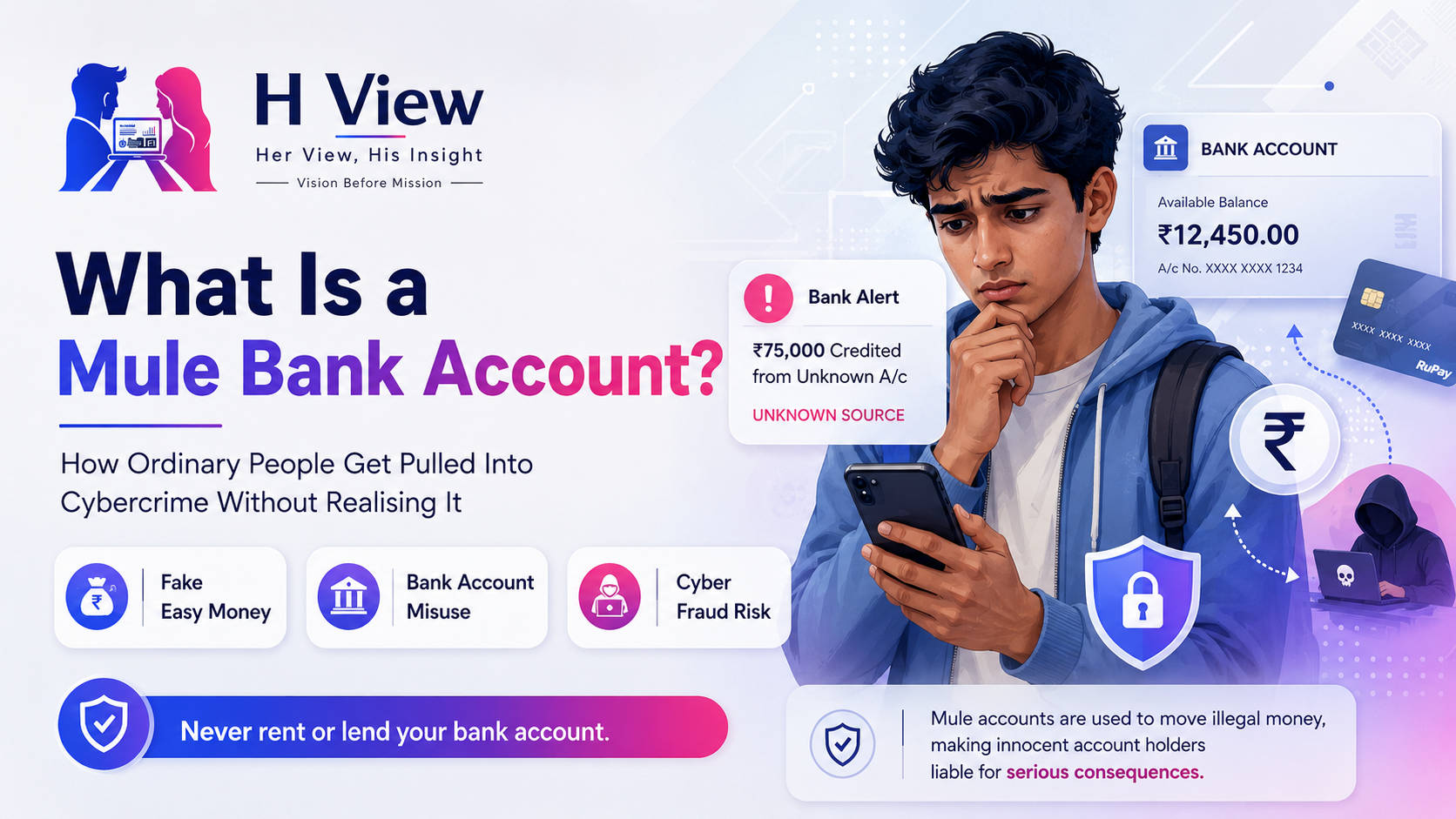
What Is a Mule Bank Account? How Ordinary People Get Pulled Into Cybercrime Without Realising It

☆☆☆☆☆No reader ratings yet
By HarikaUpdated August 9, 202611 min read11 views

A stranger messages you with what sounds like an easy opportunity.

“Use your bank account for company transactions and earn ₹5,000 every month.”

Another person may call it a work-from-home job. Someone else may say their business has reached its transaction limit and they only need your account temporarily. A friend might even offer a commission every time money passes through your account.

It can sound harmless.

But the money entering that account may have been stolen from victims of investment scams, digital-arrest fraud, phishing, fake shopping websites or other cybercrimes.

When a personal bank account is used to receive, move or withdraw money connected to criminal activity, it can become what investigators call a mule account.

And the person whose name is attached to that account can face frozen funds, police questioning and potentially serious legal consequences.

What is a mule bank account?

A mule bank account is an account used to receive or transfer money obtained through fraud or other illegal activity.

The Reserve Bank of India has warned about “money mules” for years, explaining that criminals may recruit third parties to receive proceeds from phishing, identity theft and similar frauds and then transfer the money onward.

The account holder may be:

  • Fully aware that the activity is illegal
  • Suspicious but willing to participate for commission
  • Misled into believing it is a genuine job
  • Pressured by someone they know
  • Completely unaware until the bank account is frozen

That distinction can matter during an investigation, but claiming ignorance does not automatically make the problem disappear.

Your name, Permanent Account Number, Know Your Customer details, mobile number and banking history are connected to the account.

When stolen money travels through it, investigators can follow that trail.

Why cybercriminals need mule accounts

A scammer usually does not want stolen money transferred directly into a bank account openly associated with the mastermind.

That would make tracing the crime much easier.

Instead, criminal networks may move funds through several accounts.

For example:

Victim → Mule Account A → Mule Account B → Wallet or another account → Withdrawal or further transfer

Each additional transfer can make the money trail more complicated.

The mule account therefore acts as a temporary bridge between the person who was defrauded and those ultimately controlling the proceeds.

Recent cases show how extensively such accounts can be used.

Mumbai Police recently registered a case involving 22 alleged mule accounts connected to at least 42 cyber-fraud cases involving approximately ₹7.42 crore.

In another case reported in the Mumbai region, police arrested a 23-year-old student whose account was allegedly used to channel part of the proceeds from a stock-market investment fraud targeting a retired Border Security Force employee.

These are not merely accounts sitting quietly in the background. They are part of the financial infrastructure that allows cybercrime networks to operate.

How ordinary people get recruited

The frightening part is that recruitment does not always look criminal.

“Earn money by renting your bank account”

Someone offers a fixed monthly payment simply for allowing transactions through your account.

They may say:

  • “You do not have to do anything.”
  • “Our company handles everything.”
  • “We only need your account because of transaction limits.”
  • “You will receive ₹5,000 every month.”

A legitimate company should not need to rent a stranger’s personal savings account for routine business transactions.

That alone should be enough reason to refuse.

Fake work-from-home jobs

A supposed employer may recruit people as:

  • Payment-processing executives
  • Online transaction coordinators
  • Account-handling agents
  • Cryptocurrency settlement assistants
  • E-commerce refund executives

The “job” may simply involve receiving money and transferring it elsewhere.

A genuine employer normally processes business funds through accounts belonging to the company, not through employees’ personal bank accounts.

Social-media recruitment

Messaging platforms can make recruitment especially easy.

In a recent Pune case, police alleged that an unemployed young man came into contact with fraudsters through a social-messaging application and eventually operated nine accounts through which money from cyber-fraud victims was allegedly routed. Investigators said roughly ₹1.15 crore from 65 victims had entered those accounts.

The wider investigation was linked to a suspected ₹150-crore cyber-fraud network.

Friends and acquaintances

The request may come from someone you trust.

“Bro, my account has a limit. Let ₹2 lakh come into yours and send it back.”

Even when you know the person socially, you may have no idea where the money originated.

Never assume that familiarity makes the transaction safe.

Students and unemployed youth can be attractive targets

Criminal recruiters understand vulnerability.

Someone without regular income may consider ₹3,000 or ₹5,000 easy money meaningful.

Students may also have recently opened accounts with:

  • Active Unified Payments Interface access
  • Clean transaction histories
  • Valid KYC documentation
  • Few existing financial commitments

That can make the account useful to criminals.

Recruiters may tell young people that nothing can happen because:

“You are only receiving money.”

That is dangerously misleading.

When a fraud victim complains, investigators do not initially see the verbal promises made to you.

They see where the victim’s money went.

If that destination is your account, your details become part of the investigation.

What happens when stolen money reaches your account?

Suppose a victim loses ₹3 lakh in a fake trading scam.

₹1 lakh of that amount reaches your bank account.

You then transfer ₹95,000 to another account and keep ₹5,000 as commission.

From an investigator’s perspective, the transaction history can show:

  • Money from the victim entering your account
  • Your account receiving suspicious funds
  • Money being transferred onward
  • You retaining part of the proceeds

Even if someone else planned the original fraud, you may now have to explain why your account participated in moving the money.

This is why “I did not personally scam anyone” is not a safe financial strategy.

Can your bank account be frozen?

Yes.

When police or financial institutions identify money connected to suspected cybercrime, accounts in the transaction chain may be restricted or frozen while the matter is investigated.

That can affect legitimate money already in the same account, including:

  • Salary
  • Savings
  • Scholarship funds
  • Family transfers
  • Business income

The account holder may then need to provide explanations and supporting documents.

RBI’s anti-money-laundering and Know Your Customer framework requires regulated entities to identify customers and monitor suspicious transactions, forming part of the controls used to identify unusual financial activity.

Banks do not necessarily know the full story when suspicious money first appears.

That is why unusual transactions can trigger restrictions while authorities investigate.

Will the police arrest everyone whose account is used?

Not automatically.

Cases depend on facts, evidence, knowledge, intent and the person’s role.

Someone whose account was compromised without their knowledge is in a very different position from someone who knowingly opened several accounts, handed over credentials and accepted commission.

However, even an innocent account holder may still need to cooperate with the bank or police to explain what happened.

Recent enforcement shows that authorities are actively targeting alleged mule-account networks. Maharashtra’s “Operation Mule Hunt” reportedly resulted in around 140 FIRs and more than 150 arrests within roughly three weeks.

The Supreme Court has also recently called for coordinated action against digital-arrest fraud and directed the RBI to share procedures relating to mule accounts.

So this is no longer a minor banking issue.

It is becoming a major part of India’s cybercrime response.

Warning signs of a mule-account offer

Treat the situation as high risk when someone:

  • Offers money merely for access to your bank account
  • Asks you to open additional accounts
  • Wants your debit card or cheque book
  • Requests Internet-banking credentials
  • Asks for your UPI PIN or OTP
  • Wants control of your registered SIM
  • Tells you to receive and immediately forward payments
  • Pays commission based on transaction volume
  • Refuses to explain where the money originates
  • Says the company cannot use its own account
  • Promises unusually high income for almost no work
  • Asks you not to speak to the bank about the arrangement

No legitimate job should require surrendering control of your personal banking identity.

Never hand over these items

Do not give another person:

  • Debit card
  • Credit card
  • Cheque book
  • ATM PIN
  • UPI PIN
  • Internet-banking password
  • OTPs
  • Registered SIM card
  • Banking application access
  • Aadhaar-linked authentication access

You should also never open a bank account specifically because someone promises to “manage” it for you.

The account legally remains associated with your identity.

“But the money is not staying in my account”

That does not make the activity safe.

In fact, immediately forwarding funds is one of the characteristics that can make a transaction chain look suspicious.

The account is useful precisely because the money does not stay there.

You are allowing your financial identity to become one step in moving money from its original source toward another destination.

Whether you keep ₹500, ₹5,000 or nothing at all does not change the need to explain your role if the transaction is connected to fraud.

What if you have already allowed someone to use your account?

Do not continue because you are afraid of getting caught.

Continuing can make the situation worse.

Stop further transactions

Do not receive or forward any additional money on behalf of the person.

Contact your bank

Explain that you are concerned your account may have been misused.

Ask the bank to:

  • Review suspicious transactions
  • Block unauthorised access where necessary
  • Change compromised credentials
  • Replace cards if required
  • Record your complaint

RBI’s consumer guidance emphasises informing the bank immediately when fraudulent transactions are detected.

Change credentials

Change:

  • Internet-banking password
  • Banking app PIN
  • Email password
  • UPI credentials where appropriate

Remove unknown devices and revoke unnecessary application permissions.

Preserve evidence

Do not delete messages with the recruiter.

Save:

  • WhatsApp or Telegram conversations
  • Phone numbers
  • Job advertisements
  • Payment instructions
  • Account numbers
  • Screenshots
  • Commission payments
  • Transaction references

Those records may help establish how you were recruited and what you were told.

Report suspected cybercrime

India’s Indian Cybercrime Coordination Centre operates the National Cyber Crime Reporting Portal, while 1930 is used for reporting financial cyber-fraud incidents.

If suspicious or stolen money has already moved through your account, contacting the bank and appropriate cybercrime authorities promptly is far safer than waiting for investigators to contact you first.

For personalised legal advice about your potential exposure, speak with a qualified lawyer.

What parents should explain to college students

Financial safety conversations with young adults should go beyond:

“Do not share your OTP.”

Explain this rule clearly:

Your bank account is part of your identity. Never lend it, rent it or sell access to it.

Parents should specifically warn about:

  • Work-from-home payment jobs
  • Telegram earning groups
  • Cryptocurrency settlement tasks
  • Receiving money for online sellers
  • “Account rental” opportunities
  • Commission for transferring funds
  • Friends asking to route business payments

A student may understand that sharing an OTP is dangerous while still believing that receiving money into their own bank account is harmless.

That gap in awareness needs to be addressed.

What genuine employers should do

A legitimate employer should normally:

  • Pay salary into your account
  • Reimburse documented expenses
  • Use company-controlled accounts for company funds
  • Provide employment documentation
  • Clearly explain your responsibilities

They should not ask you to use your personal account as a clearing house for unknown customer payments.

If payment processing is genuinely part of a role, it should happen through authorised company systems with formal oversight.

Why mule accounts matter to every cybercrime victim

Think back to the Digital Arrest Scam.

A victim may transfer ₹10 lakh believing the police are verifying their money.

Where does that money go?

Often, not directly to the scam mastermind.

It may first enter several accounts controlled or provided by other people.

The same pattern can appear in:

  • Fake investment scams
  • Loan fraud
  • Romance scams
  • Job scams
  • Phishing attacks
  • Fake online shopping
  • Impersonation fraud
  • Digital-arrest scams

Mule accounts are one reason cybercrime can operate at scale.

Stopping people from supplying those accounts can make it harder for criminal networks to collect and move stolen funds.

Her View

Young people are often warned about losing money online but not about the danger of helping someone else move money.

That distinction is important.

A student desperate for income may see ₹5,000 as an opportunity rather than a warning sign.

Families and colleges should therefore teach financial responsibility as clearly as cybersecurity: never allow your identity, SIM card or bank account to be rented by someone else.

His Insight

Follow the money and the risk becomes easier to understand.

If someone genuinely owns a successful business, there is little reason for them to depend on a stranger’s savings account to process customer payments.

When somebody offers money merely for access to your banking infrastructure, the account itself is probably what they value.

That should immediately raise suspicion.

H View Recommendation

Never rent, sell or lend your bank account.

Do not open additional accounts for someone else, and never transfer unknown funds simply because you are promised commission.

If you have already done so, stop immediately, preserve the messages, secure your banking access and contact your bank.

If cyber-fraud proceeds may be involved, report the matter promptly rather than hoping it disappears.

Easy money can disappear in minutes.

The financial and legal consequences attached to your identity may remain much longer.

Frequently Asked Questions

What is a mule bank account?

A mule bank account is an account used to receive or transfer money connected to fraud or other criminal activity. RBI has long warned that money mules can be used to move proceeds from phishing, identity theft and related schemes.

Is renting my bank account illegal?

Allowing an account to knowingly facilitate criminal funds can create serious legal risk. The exact consequences depend on the circumstances and applicable law. If you have already participated, obtain legal advice and contact your bank.

Can my bank account be frozen because someone sent fraudulent money to it?

An account involved in a suspected fraud transaction chain may be restricted while authorities investigate. The outcome depends on the circumstances and evidence.

What should I do if somebody offers money to use my bank account?

Refuse. Do not provide account access, debit cards, OTPs, SIM cards or login credentials. Preserve the message if the approach appears suspicious.

What if I unknowingly received stolen money?

Do not transfer or spend suspicious funds. Contact your bank immediately, preserve evidence and consider reporting the incident to cybercrime authorities.

Where can cybercrime be reported in India?

Cybercrime can be reported through the National Cyber Crime Reporting Portal. Financial cyber-fraud incidents can also be reported through 1930.

Are students being recruited as money mules?

Recent Indian cases have involved students, unemployed young people and other individuals accused of operating mule accounts. Recruitment can occur through social-media and messaging platforms.

Written by

Harika

Harika is the co-founder of H View and covers AI, technology, gadgets, digital tools, online platforms, and modern internet trends. Her articles focus on simplifying complex topics with practical explanations, balanced opinions, and reader-first insights.

Topics coveredAIAutoBusinessCyber SafetyDigital MarketingGuidesH ViewHistoryLifestyleMoneyReviewsTechAudioGadgetsWordpress
View all posts by author

Submit Your View

Share your real experience and help other readers decide better.

🔒 Your review may be published after moderation.

Reader Reviews

No community views yet. Be the first to share yours.

8.0Excellent

H View Score

A quick view of our final rating for this review.

✉

Stay Updated with H View

Get the latest reviews and insights straight to your inbox.

🔒 No spam. Unsubscribe anytime.

Trending Reviews

The Art of Saying “NO”: Reclaiming Your Time, Energy, and PeaceAugust 20, 2026Keyword Research for Beginners: How to Find What People Actually Search on GoogleAugust 20, 2026What Does “Savings” Actually Mean? Cash, Bank Balance, FD, RD, Gold, Insurance and Investments ExplainedAugust 20, 2026Companies Replaced Workers With AI. Why Are Some Hiring People Back?August 20, 2026Nothing X App Explained: 12 Settings Every Nothing and CMF Earbud Owner Should KnowAugust 20, 2026Am I in a Toxic Relationship? 10 Signs You Shouldn’t IgnoreAugust 20, 2026How to Get Your Website Mentioned in ChatGPT, Gemini and Google AI SearchAugust 19, 2026Why the Middle Class Is Spending More and Saving LessAugust 19, 2026

Related Blogs

Money

Fake Instant Loan Apps in India: How “Loan Approved in 5 Minutes” Can Turn Into a Financial Nightmare

“Loan approved in five minutes.” “No salary slip required.” “₹50,000 instantly.” “100% approval—even with a…

Harika August 10, 2026
Gadgets

Amazon Great Freedom Sale 2026: Real Smartphone Deals or Marketing Tricks?

Amazon’s Great Freedom Sale 2026 is now live, bringing discounts across smartphones, laptops, televisions, appliances,…

Harika August 7, 2026
Careers

They Paid You First—So How Is It a Scam? The Work-From-Home Task Trap

A WhatsApp message arrives from an unknown recruiter: “Earn ₹2,000 to ₹5,000 daily from home.…

Satya Hemanth August 5, 2026
Money

Digital Arrest Scam in India: What Every Family Must Know Before It Is Too Late

A phone call arrives from someone claiming to be a police officer, customs official, courier…

Harika August 4, 2026
H View

Honest reviews. Smart ratings. Real insights.

Explore

HomeReviewsBlog

Company

AboutAdvertiseContact

Support

Privacy PolicyTerms & ConditionsDisclaimerEditorial Policy

Subscribe to H View

Get the latest updates and exclusive content straight to your inbox.

🔒 No spam. Unsubscribe anytime.
© 2026 H View. All rights reserved.
HomeReviewsBlogContact