
ESTIC 2026 Begins Tomorrow: How Does a Student Idea Become Something People Actually Use?
Ahead of ESTIC 2026, follow a student water-leak detector from an interesting idea to a tested prototype, and learn what separates a demonstration from useful evidence.
ESTIC 2026 is scheduled for 27–29 October in New Delhi, bringing research, technology and innovation into the same conversation. For students, the useful question is how an idea travels beyond a college demonstration. That journey requires a clear problem, fair testing, practical costs and evidence that people can use the result.
A project exhibition can be exciting because every table offers a possible solution. One team demonstrates a sensor, another presents an application and a third explains a new material. However, a working demonstration is only the beginning of a more demanding story: whether the solution works reliably outside the conditions arranged for the presentation.
What is ESTIC, and why should students pay attention?
The Emerging Science, Technology and Innovation Conclave, or ESTIC, is scheduled at Bharat Mandapam, New Delhi. The government's advance announcement describes a programme connecting researchers, startups, industry and policymakers, with themes including energy, biotechnology, artificial intelligence and space. As of this preview on 26 October, those are announced plans rather than outcomes from an event that has already happened.
The official event website provides programme and exhibition information. Check its current arrangements before making travel or attendance decisions, because access to an exhibition and participation in conference sessions can involve different conditions. Students following from elsewhere can still use the event as a reason to ask how research claims should be examined.
How does a useful student project begin?
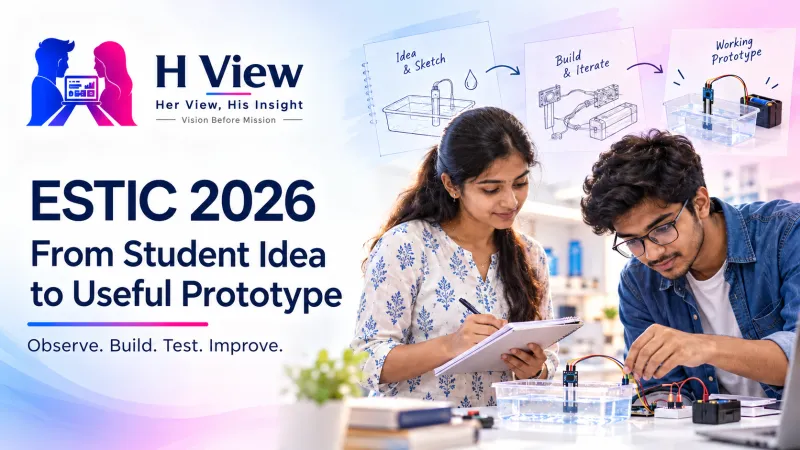
Begin by observing a problem before naming the technology that will solve it. Suppose a college building sometimes has water leaking near an overhead tank, and the caretaker discovers it only after someone complains. A team might immediately propose a smart detector, but it first needs to understand where the water appears, how often the problem occurs and how it is currently handled.
The example throughout this article is an illustrative H View project, not an announced ESTIC exhibit or a product we have tested. Its purpose is to show the decisions behind an investigation. A real team would need permission to inspect the building and should avoid electrical installations or unsafe access to tanks.
The journey from an observation to useful evidence
The stages form a learning cycle rather than a guaranteed route to a successful product. A failed test can send the team back to its original assumptions.
A useful question might ask whether a low-cost sensor can alert the caretaker within one minute after water reaches a defined test area. That is narrower than promising to end water waste across the campus. The narrower question creates something the team can investigate and report honestly.
 Also readFinancial Freedom 101: Where Does the Journey Actually Begin?→
What should you investigate before building anything?
Talk to the people who already handle the problem and record their explanation with permission. The caretaker might reveal that the main difficulty is an inaccessible shut-off valve, not late detection. In that case, a detector could provide information without fixing the most important obstacle.
Look for existing approaches as well, including simple ones that use no software. A routine inspection, a repaired valve or a commercially available alarm may already address part of the need. Research becomes more useful when the team can explain the remaining gap instead of assuming that a new device is automatically an improvement.
Turn a broad claim into a question you can examine
| Broad claim | More useful question | Evidence to collect |
|---|---|---|
| Our detector saves water. | Does it reduce the time before someone notices the defined leak? | Record detection and response times under described conditions. |
| The system is accurate. | How often does it miss a leak or raise an unnecessary alert? | Count both kinds of error separately across repeated trials. |
| Everyone can afford it. | What does one installation cost, including maintenance? | List parts, power, replacement needs and support costs. |
| The project is easy to use. | Can the intended user interpret and act on an alert? | Observe a permitted practice task and record confusion. |
These are proposed measures for the example, not findings from a field trial. The team must choose measures that match the actual problem it observes.
How can students design a fair test?
Write the test procedure before collecting the results. Define the surface, sensor position, amount of water used and what counts as an alert, then keep those conditions consistent when making a comparison. If a condition changes, record it so that an improvement is not mistakenly attributed to the prototype.
A baseline is the reference you compare your new approach against. For a supervised tabletop test, that could be a simple indicator used under the same conditions, provided the comparison genuinely answers your question. It would not be fair to compare a continuously monitored device with an arbitrarily long inspection gap and then imply the device always performs better in real buildings.
- State the question and success condition. Specify what you expect to detect and decide how you will measure the outcome before starting.
- Record the setup. Describe the materials and conditions well enough for another student to repeat the investigation.
- Repeat and include difficult cases. Examine ordinary trials alongside situations such as small splashes or a temporarily disconnected alert.
- Keep unsuccessful trials. Document missed detections and unnecessary alerts instead of showing only the most successful demonstration.
- Describe the limit of the conclusion. Separate what the tabletop results establish from what still needs a supervised field evaluation.
Why can a good demonstration still become a poor product?
A prototype is an early version used to explore whether an approach can work. A product must also deal with installation, maintenance, support and the variety of conditions people encounter. A sensor that works during a presentation may behave differently after dust accumulates or when the person receiving the message is unavailable.
Consider an illustrative calculation rather than a field result: if a trial includes 20 deliberately created leak events and the prototype detects 18, the detection rate for those trials is 90%. That number says nothing by itself about unnecessary alerts when there is no leak, and it cannot establish long-term reliability across other buildings. Reporting both the result and its boundary is more informative than presenting a large percentage alone.
Two questions belong beside every impressive result
What worked in the test?
- The team describes the conditions and all recorded attempts.
- The result answers the specific question that was investigated.
What remains unproven?
- Long-term operation and performance in other locations still need evidence.
- Maintenance, unnecessary alerts and user response may change the practical value.
A limitation does not make the investigation worthless. It helps the next team understand what to test and prevents readers from expecting more than the evidence supports.
What should students look for in research news?
When a headline describes a breakthrough, look for the original institution, paper or technical explanation. Check whether the work is a proposal, a simulation, a laboratory experiment or a trial with real users. Those stages answer different questions, and moving from one to another requires additional evidence.
Ask what was measured, what the comparison was and which limitations the researchers themselves reported. You do not need to dismiss an exciting idea because it is early, but you should know how early it is. This habit also applies to software: our explanation of coding in the AI era considers why a plausible output still needs human understanding.
 Also readOpenAI GPT-6 Astra Explained: What It Is, What It Can Do, and Why It Matters→
Her View
A useful innovation begins with respect for the person living with the problem. The caretaker, student or family member is not simply a source of testimonials after the project is complete. Listening to that person's routine can change the design, expose an incorrect assumption and prevent a technically impressive solution from becoming another inconvenience.
His Insight
A project becomes stronger when someone else can inspect how its conclusion was reached. Keep a record of the setup, the failed attempts and the changes between versions, because those details make improvement possible. Our explanation of website infrastructure offers a related lesson: the visible experience depends on supporting systems that deserve attention too.
H View Verdict
Use ESTIC 2026 as a prompt to follow the journey from an interesting idea to evidence of practical value. Start small, measure fairly and explain what remains uncertain before promising an impact. When a project reaches potential users, the clarity principles in our guide to a useful business website can help a team describe its purpose without exaggerating what it can deliver.
Frequently Asked Questions
When and where is ESTIC 2026 scheduled?
The announced dates are 27–29 October 2026 at Bharat Mandapam, New Delhi. Consult the official event information for current programme and access arrangements before planning a visit.
Does a college project have to become a startup?
A project can be valuable because it teaches a method or answers a useful question. Starting a business is a separate decision involving users, costs, responsibilities and continued support.
What is the difference between a prototype and a product?
A prototype helps investigate an approach and its assumptions. A product also needs to perform reliably for intended users with an appropriate plan for maintenance and support.
Should unsuccessful tests appear in a report?
Relevant unsuccessful tests belong in an honest account of the investigation. They help readers understand the conditions in which the approach fails and what future work should address.
Is the water-leak example an actual ESTIC exhibit?
It is an illustrative H View example designed to explain research decisions. We are not claiming to have built or tested it, or that it appears in the announced exhibition.
H View stories follow our editorial policy. Spotted an error? Tell us and we will correct it.
Rate this article
One tap is enough. No comment needed.
Was this article helpful?
Your answer goes straight to our editors.






Comments0
No comments yet. Start the conversation.