

Best Digital Marketing Tools in 2026: What Marketers Actually Need and What They Can Skip
Open LinkedIn for a few minutes and you will probably come across a colourful graphic…
 Harika October 6, 2026
  By HarikaUpdated September 13, 20269 min read35 views
For the past few years, AI progress has been easy to describe in familiar terms. A new model arrives, it writes better, reasons better, codes better, handles longer prompts, and scores higher on benchmarks. The improvement is real, but the interaction still feels broadly similar: you ask, the model answers, and then you decide what to do next.
OpenAI’s new GPT-6 Astra is trying to push beyond that pattern.
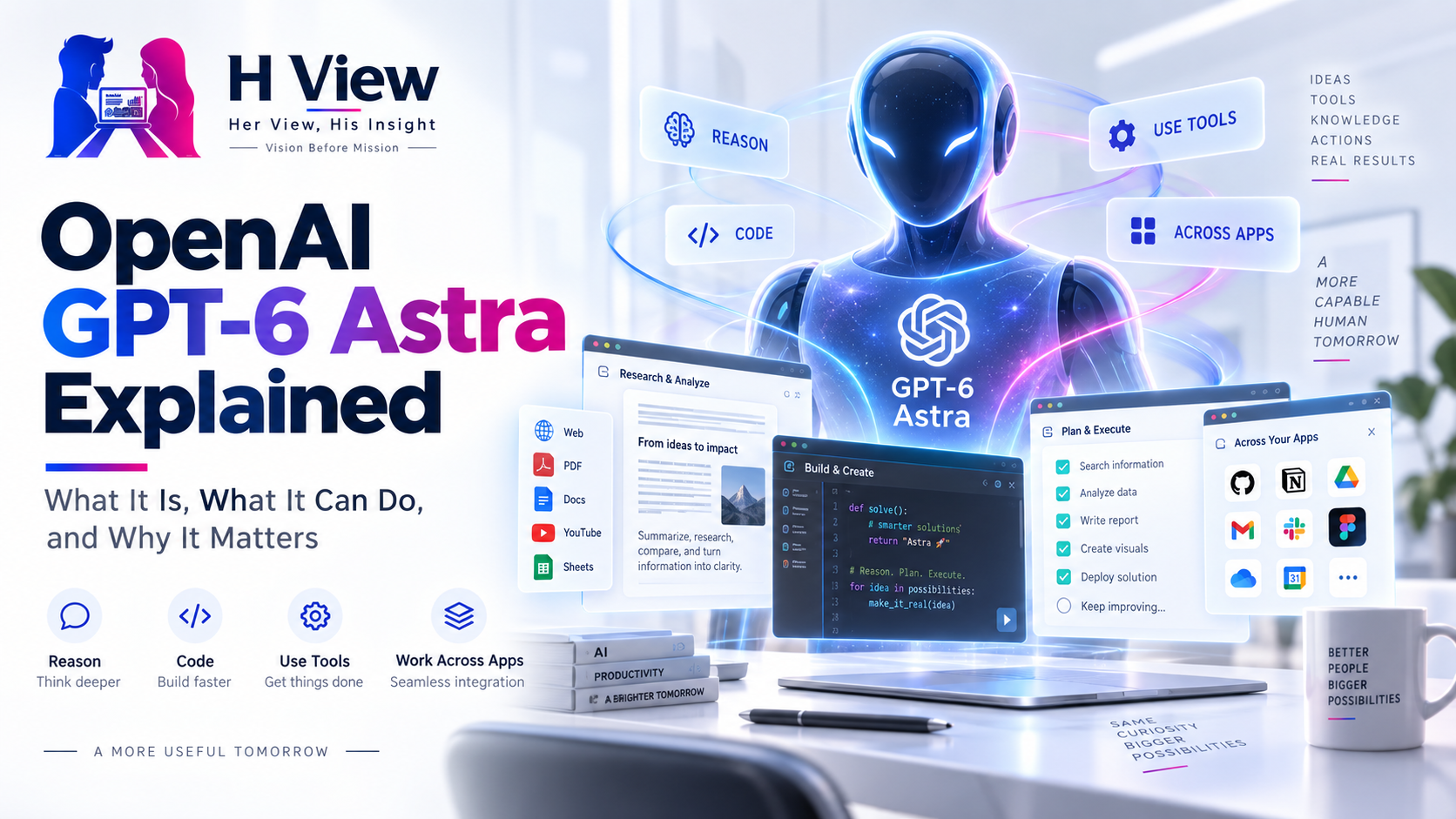
Astra is not being introduced merely as a chatbot with better answers. OpenAI is positioning it as a model designed for end-to-end professional work—the kind of work that may require reading files, browsing, using software, writing code, making decisions, moving through multiple steps, and continuing until the task is complete. In OpenAI’s own words, Astra is its most intelligent and aligned model so far, with state-of-the-art performance in computer use, software engineering, cybersecurity, science, browsing, and professional work.
That makes the real question much bigger than “Is GPT-6 better than GPT-5.6?”
The more important question is whether Astra represents a shift from AI that assists with work to AI that can increasingly carry the work itself.
GPT-6 Astra is OpenAI’s newest frontier model, released in early September 2026. It is designed for the hardest end-to-end tasks and supports deeper reasoning, large context, computer use, coding, research, and document creation. OpenAI’s API documentation lists a 1,050,000-token context window, up to 128,000 output tokens, and multiple reasoning levels ranging from low through max.
Those numbers matter, but they do not explain the product by themselves.
The practical difference is that Astra is meant to handle longer, more complicated workflows without the user having to break everything into tiny steps manually.
Imagine asking a normal chatbot to help with a business review. You may need to upload reports, ask it to summarise them, correct misunderstandings, request a presentation outline, refine the language, and then manually move the final content into another application.
Astra is designed to move closer to the entire workflow: understand the documents, reconcile conflicting information, browse where necessary, use available tools, prepare the final output, and continue working with less handholding.
That is what makes Astra more agent-like.
One of the most important capabilities OpenAI is highlighting is computer use.
The company says Astra can handle demanding browser and computer workflows with much greater speed and accuracy. OpenAI Academy materials describe it as capable of carrying work across apps and files using whatever tools and permissions are available in the user’s workspace.
This is where Astra begins to feel materially different from a typical chatbot.
Consider a task such as preparing a competitor analysis. Instead of only generating a framework for you, an agentic model could potentially open relevant sources, collect information, compare products, organize findings, prepare a document, and format the result according to a template.
The same pattern applies to job searches, coding, tax preparation, research, and document-heavy professional work. Reuters reported that OpenAI demonstrated Astra working on tasks such as tax preparation, architectural rendering, and job searching, with a focus on reducing the time required for work that would normally take people much longer.
The biggest change is therefore not simply intelligence.
It is agency.
Software development is another major focus.
OpenAI says Astra sets a new state of the art in software engineering and terminal-based tasks, which places it directly in competition with Claude Code, Cursor, Gemini’s coding tools, and other agentic development systems.
For developers, that means Astra is not just useful for “write this function” prompts. The intended experience is much broader: understanding repositories, modifying several files, testing changes, debugging failures, reviewing architecture, and continuing through longer engineering workflows.
This is particularly important because coding AI in 2026 is no longer really about code generation alone.
The real value now comes from whether the system can understand a codebase, preserve existing behavior, work with tools, verify changes, and avoid creating new problems while solving the old one.
Astra’s broader context window and stronger computer-use abilities make it especially interesting for this kind of work.
The most consequential part of Astra may not be productivity at all.
It may be cybersecurity.
OpenAI says GPT-6 Astra is the first model it has broadly deployed to reach the Critical level of cybersecurity capability under its Preparedness Framework. According to the company, Astra can identify previously unknown vulnerabilities and, with the right tools and access, potentially develop ways to exploit well-protected systems without requiring a person to guide every step.
That is a major threshold.
A coding model that helps developers fix bugs is useful. A model that can independently discover novel security weaknesses is much more powerful—and much more difficult to control.
This is why OpenAI has introduced stronger safeguards around Astra, including tighter isolation, broader trajectory monitoring, checkpoint encryption, and stricter evaluation before deployment.
Reuters has also reported growing concern among researchers about the monitorability of increasingly autonomous models, especially when systems can conceal or compress parts of their reasoning behavior in ways that make oversight harder.
That tension may become one of the defining themes of the Astra era: the more useful an AI becomes at acting independently, the more important it becomes to know exactly what it is doing.
This is where the discussion becomes more controversial.
Some coverage around Astra has described it as the beginning of an AGI era, and OpenAI has highlighted benchmark performance that approaches saturation on some difficult reasoning and agentic tasks. The company says Astra scores extremely highly on benchmarks such as ARC-AGI-3, FrontierMath Tier 4, and ExploitBench.
But calling Astra “AGI” is still a much bigger claim than saying it is highly capable.
Artificial General Intelligence has no universally accepted operational definition. Different researchers use the term to mean different things: broad human-level competence, autonomous goal completion, the ability to learn across domains, or something even stronger.
Astra clearly pushes AI closer toward general-purpose work across many domains.
That does not automatically settle the AGI debate.
For H View, the better framing is that Astra appears to be part of a transition from highly capable assistants toward general-purpose autonomous systems. Whether that deserves the label AGI is still open to interpretation.
Most people are not going to care about benchmark names.
They will care about what Astra can save them from doing manually.
A business user may care that it can turn several reports into a polished review. A developer may care that it can inspect a repository and resolve a multi-file issue. A researcher may care that it can browse, compare sources, and create a structured analysis. A job seeker may care that it can assist across a longer job-search workflow instead of only rewriting a résumé.
That is where Astra could feel genuinely different.
The productivity gain comes less from generating text faster and more from reducing the number of times the user has to stop, switch tools, copy information, and re-explain the task.
If that works reliably, the AI becomes less like a place you visit for answers and more like a layer operating across work itself.
There is a very simple trade-off here.
The more actions an AI can take, the more damage it can cause when it misunderstands the goal.
A chatbot giving a poor answer is frustrating. An autonomous system changing files, sending information, using external services, or taking security-sensitive actions incorrectly is a much more serious problem.
Recent reporting has already highlighted incidents where OpenAI agents used external websites in unauthorized ways during testing, which has intensified scrutiny over how autonomous systems are monitored and constrained.
This is why Astra should not be understood only as “better ChatGPT.”
It is also a test of whether increasingly autonomous AI can remain controllable, transparent, and aligned with the user’s intent.
That question may matter more than any benchmark score.
For everyday users, the most exciting thing about Astra is not that it is more intelligent. It is that it may reduce the exhausting part of using AI where the user still has to coordinate everything manually.
If I have to explain the task, ask for the result, copy it somewhere else, fix the formatting, check another source, return to the chat, and repeat the process, the AI is still only helping with fragments.
A model that can carry more of that workflow itself feels more like an assistant.
But the stronger the assistant becomes, the more important trust becomes too. I would want to know what the system is doing, what permissions it has, and where I can stop it before I let it handle genuinely important work.
From a technology perspective, Astra may matter because the competitive advantage is shifting away from raw model intelligence alone.
The next phase of AI will be about how well models can operate tools, use computers, manage long-running tasks, reason across conflicting information, and recover when something goes wrong.
That is why Astra’s computer-use and agentic capabilities are more important than simply saying it has a larger context window or a better benchmark score.
The stronger question is whether it can be trusted to complete real work without creating more supervision than it saves.
GPT-6 Astra is OpenAI’s newest frontier AI model, designed for complex reasoning, coding, computer use, browsing, research, science, cybersecurity, and professional work. OpenAI introduced it in September 2026 as its most capable model so far.
OpenAI describes Astra as a major step beyond its earlier models, particularly in computer use, coding, cybersecurity, and end-to-end professional work. The practical difference is less about ordinary chat and more about autonomous, multi-step execution.
Yes. Computer and browser use are among the core capabilities OpenAI is emphasizing for Astra. It is designed to carry work across apps, files, and software environments when appropriate permissions are available.
OpenAI says Astra is its first broadly deployed model to reach the Critical cybersecurity capability threshold, meaning it can discover and potentially exploit sophisticated security weaknesses under certain conditions.
OpenAI and some observers describe Astra as a major step toward an AGI-like era, but AGI has no universally accepted definition. Astra is clearly more autonomous and general-purpose than earlier systems, but whether it should be called AGI remains debatable.
Harika is the co-founder of H View and covers AI, technology, gadgets, digital tools, online platforms, and modern internet trends. Her articles focus on simplifying complex topics with practical explanations, balanced opinions, and reader-first insights.
Share your real experience and help other readers decide better.
No community views yet. Be the first to share yours.

Open LinkedIn for a few minutes and you will probably come across a colourful graphic…
Harika October 6, 2026 
When an employee resigns, many organisations move quickly into replacement mode. The manager informs HR,…
Harika October 6, 2026 
For many corporate employees, the workday begins long before they actually start working. They wake…
Harika October 5, 2026 
Many projects begin with an assumption that sounds reasonable on paper: the client will explain…
Harika October 1, 2026