

Best Digital Marketing Tools in 2026: What Marketers Actually Need and What They Can Skip
Open LinkedIn for a few minutes and you will probably come across a colourful graphic…
 Harika October 6, 2026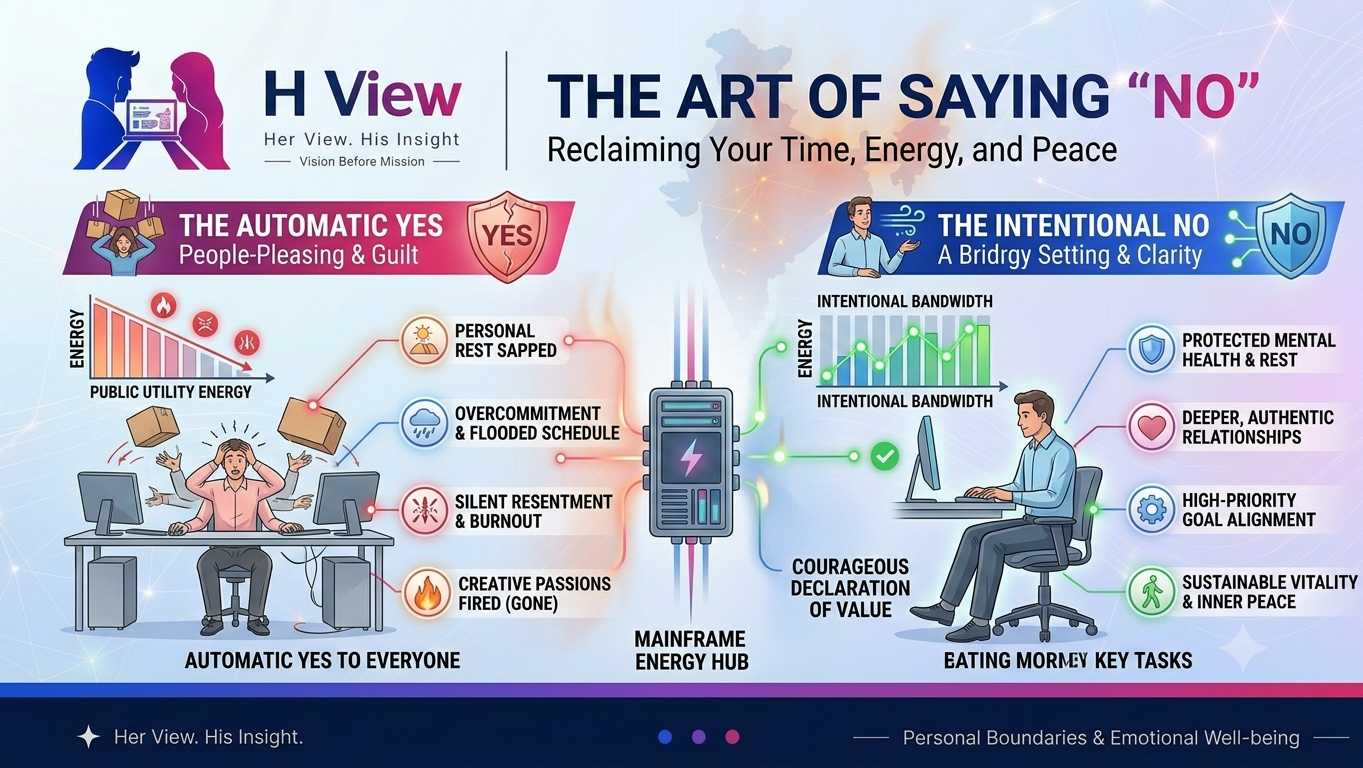
 By RajeshUpdated September 20, 20263 min read34 views
We are raised in a world that praises the word “yes.” From an early age, we learn that agreeing makes us helpful, kind, and dependable. We say yes to extra assignments at work when our schedules are already overflowing, yes to social invitations when our emotional batteries are running on empty, and yes to requests from loved ones even when it means sacrificing our own peace of mind.
Over time, this relentless urge to please transforms our personal energy into a public utility. We end up exhausted, resentful, and distant from the things that truly matter to us.
At H View, our “Vision Before Mission” philosophy reminds us that purpose without boundaries is simply burn-out in disguise. Learning to say “no” isn’t about building walls or turning cold toward the world; it is an act of self-preservation and deep self-respect. It is the gentle art of protecting your finite bandwidth so that when you finally do say “yes,” you can offer your full, authentic self.
Why is a simple two-letter word so difficult to speak? For most of us, saying “no” triggers an immediate wave of guilt. We fear disappointing others, being perceived as selfish, or missing out on opportunities.
Saying “no” does not require harshness, confrontation, or elaborate excuses. The most effective boundaries are rooted in clarity and kindness.
Mastering the art of saying “no” is a lifelong practice, not a one-time event. It requires unlearning decades of people-pleasing and learning to sit comfortably with the brief discomfort of disappointing someone else rather than destroying your own inner equilibrium.
By holding a clear vision of your personal priorities, you transform your daily life. A well-placed “no” is not a rejection of others—it is a courageous declaration of what you value most.
Rajesh is an H View contributor covering science, energy, architecture, sustainability, and practical knowledge topics. His articles focus on explaining complex ideas in a simple way, connecting real-world examples with useful insights for readers who want to understand how systems, design, and innovation shape everyday life.
Share your real experience and help other readers decide better.
No community views yet. Be the first to share yours.
Open LinkedIn for a few minutes and you will probably come across a colourful graphic…
Harika October 6, 2026 
When an employee resigns, many organisations move quickly into replacement mode. The manager informs HR,…
Harika October 6, 2026 
For many corporate employees, the workday begins long before they actually start working. They wake…
Harika October 5, 2026 
Many projects begin with an assumption that sounds reasonable on paper: the client will explain…
Harika October 1, 2026