
Delhi AQI After Diwali 2026: What Very Poor Air Means for Your Day
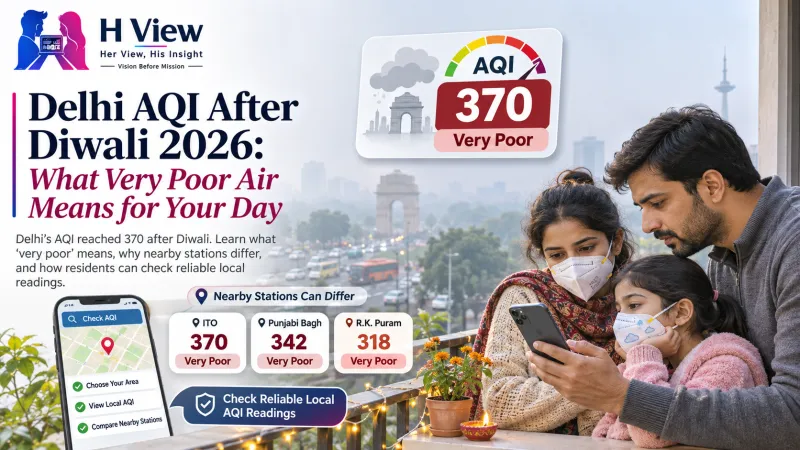
Delhi’s AQI reached 370 on the morning after Diwali, but readings vary by station and time. Here is how to interpret the number and make practical choices.
Delhi’s post-Diwali air deserves more than a single alarming number. At 9 am on November 9, 2026, the Central Pollution Control Board’s city reading was 370, in the “very poor” band, Reuters reported; individual monitoring stations later showed a mixed picture, with some readings above 400 and others lower. That snapshot explains why the AQI matters, but your local conditions, time outdoors and health all matter too.
Google Trends in India has shown “Delhi AQI” among its fastest-rising searches this morning. The practical question for residents is simple: what does the number tell you, what does it leave out, and what can you do without turning a daily reading into either panic or false reassurance?
What does a Delhi AQI of 370 mean?
India’s AQI translates measurements of key pollutants into a single scale. The highest sub-index among the monitored pollutants determines the overall AQI, so the number is not an average of every pollutant and it is not the same as a personal exposure reading. India’s scale places 301–400 in “very poor”; 401–500 is “severe.” A reading of 370 is therefore serious, but it is still in the very poor band, not the severe band.
The IITM Air Quality Early Warning System listed Delhi as “Very Poor – GRAP 2” on November 9 and reported station-level readings that varied by location. At 1 pm, for example, its page listed DTU at 427 (severe), ITO at 400 (very poor), and IGI Airport Terminal 3 at 299 (poor). That spread is why the city-wide number should be read as a broad alert, not a promise that every neighbourhood has identical air.
Why can two AQI reports show different numbers?
Numbers differ when they refer to different places, stations, hours, averaging periods, or data providers. A city-wide figure, an individual CPCB station, a private dashboard and a global ranking do not necessarily use the same stations or update at the same time. Read the timestamp and station name before sharing a screenshot. If one station is missing data, the city picture can also be less complete.
Diwali fireworks were one contributor to the morning haze on November 9, according to Reuters, but Delhi’s winter pollution has several sources. Traffic, construction dust, industrial emissions, smoke transported from outside the city and weather conditions can all shape the air. Cooler, calmer air can limit how quickly pollutants disperse. Avoid treating one cause as the complete explanation for a season-long problem.
 Also readMedical Device Safety in India: What Adverse-Event Reports Mean for Patients→
How should you read your local AQI?
Use the official CPCB Sameer app or the CPCB monitoring dashboard to check nearby station readings and their update time. Look at the main pollutant when it is listed. PM2.5 consists of very small particles that can travel deep into the respiratory system; PM10 is larger particulate matter. A daily AQI is useful for decisions, but it does not tell you exactly what each person inhaled on a route or inside a building.
India’s categories provide a plain-language frame:
- 0–50: Good
- 51–100: Satisfactory
- 101–200: Moderate
- 201–300: Poor
- 301–400: Very Poor
- 401–500: Severe
These categories are intended to make pollutant data easier to interpret, not to replace a doctor’s advice. The CPCB explains the index and its health messages in its National Air Quality Index resources. For Delhi forecasts and station details, the Air Quality Early Warning System shares monitoring and forecast information.
What can residents do on a very poor air day?
Use the AQI to make proportionate choices. If the air is very poor, consider moving strenuous outdoor exercise indoors or to a cleaner time and place; keep young children and people with respiratory or heart conditions from prolonged exertion outdoors; and follow any local school or government instructions. If you have asthma or another diagnosed condition, follow your clinician’s plan rather than changing medication based on a number in an app.
Indoors is not automatically clean. Keep doors and windows closed during a smoky period if outdoor air is worse, but ventilate when conditions improve. Avoid adding indoor smoke from cigarettes, incense, or cooking without an exhaust hood. A properly sized, well-maintained HEPA air cleaner can reduce particles in the room it serves; it cannot clean an entire building or remove every gas. Check the filter, room size, noise and ongoing filter cost before buying. Be cautious about devices that make dramatic claims without explaining what they remove.
For a well-fitted N95 or equivalent respirator, fit matters: gaps around the nose and cheeks reduce protection. A mask is not a substitute for reducing avoidable exposure or seeking care when symptoms become severe. If breathing becomes difficult or symptoms worsen, contact a medical professional promptly.
Does a post-Diwali spike prove the cause?
A sharp change after fireworks is important context, but a before-and-after comparison cannot isolate every source. Weather, traffic, construction activity, regional transport, and the coverage of monitoring stations also change. The November 9 Reuters report linked the overnight fireworks with deterioration, while also describing Delhi’s wider winter pollution problem. A careful article should preserve both facts: fireworks can add pollution, and the baseline is already shaped by more than fireworks alone.
 Also readMobile Phones and Pregnancy: What the Evidence Says→
Her View: why reliable local information matters
When the sky looks grey, people need useful guidance more than a competition over the most frightening number. Publish the time, station and source; distinguish a neighbourhood reading from the city-wide AQI; and update the story when new data appears. That is how public information stays useful after a trend peaks.
Frequently asked questions
Is AQI 370 severe in Delhi?
On India’s scale, 370 falls in the “very poor” range of 301–400. “Severe” begins at 401. A nearby station may be higher or lower than the city figure.
Why does my AQI app disagree with another app?
Apps can show different monitoring stations, update times, averaging periods or data sources. Compare the station and timestamp before comparing the numbers.
Should I avoid going outdoors at all?
Use current official readings and local guidance to limit strenuous or prolonged outdoor activity when air is very poor. People with existing conditions should follow their clinician’s advice and seek care for worsening symptoms.
Verdict
Delhi’s AQI is a warning system, not a personal diagnosis. On November 9, the city reading of 370 and the variation across stations showed both the scale of the post-Diwali concern and the need to check local, time-stamped data. Use the number to reduce avoidable exposure, look at official updates, and keep the conversation focused on solutions that last beyond one festival night.
Sources: Reuters, Nov 9, 2026; IITM Air Quality Early Warning System for Delhi; Central Pollution Control Board National AQI; Google Trends India.
H View stories follow our editorial policy. Spotted an error? Tell us and we will correct it.
Rate this article
One tap is enough. No comment needed.
Was this article helpful?
Your answer goes straight to our editors.











Comments0
No comments yet. Start the conversation.